Loading...
This comparison has not been analyzed yet.
One-time AI generation (~1 minute). Scores and timeline are already available below.
Mauno Koivisto vs Omar Bongo
Mauno Koivisto leads by 1.4 pts · 2 figures compared
…

Mauno Koivisto
Politician · Modern
54.7Total
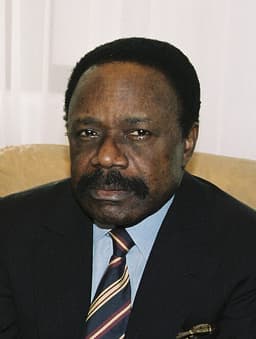
Omar Bongo
Politician · Modern
53.3Total
Basic Information
Born
1923
1935
Died
—
—
Era
Modern
Modern
Nationality
Finland
Gabon
Occupation
Politician
Politician
Civilization
Western
Other
Score Comparison
Military (10%)
50.0
39.9
Political (20%)
55.0
45.1
Influence (20%)
57.2
53.3
Legacy (20%)
48.3
52.0
Leadership (15%)
72.0
78.0
Strategy (15%)
42.3
44.8
TOTAL
54.7
53.3
Mauno Koivisto — Complete Timeline
1979 AD
Served as Prime Minister of FinlandPolitical Action◆ Major
Koivisto served as Prime Minister from 1979 to 1982, leading a coalition government. He implemented economic policies to combat inflation and unemployment, and his government faced the 1980s recession.
Prime MinisterEconomyCoalition
Impact: national
1982 AD
Elected President of FinlandPolitical Action◆ Major
Mauno Koivisto was elected as the 9th President of Finland, succeeding Urho Kekkonen. His election marked a shift from Kekkonen's long era, with Koivisto emphasizing economic reform and a more cautious foreign policy.
PresidencyElectionFinland
Impact: nationalconstructive
1991 AD
Managed the collapse of the Soviet Union and Finnish-Soviet relationsPolitical Action◆ Major
Koivisto navigated Finland's relationship with the Soviet Union during its dissolution, maintaining stability and avoiding conflict. He renegotiated the 1948 Finno-Soviet Treaty, allowing Finland to pursue EU membership.
Soviet UnionForeign PolicyCold War
Impact: nationalconstructive
1994 AD
Resigned from the presidencyPolitical Action
Koivisto did not seek re-election in 1994, ending his presidency after two terms. He was succeeded by Martti Ahtisaari, and his departure marked the end of an era of Social Democratic dominance.
ResignationPresidencyTransition
Impact: national
1995 AD
Oversaw Finland's accession to the European UnionPolitical Action◆ Major
As president, Koivisto supported Finland's application to join the European Union, which was approved in a 1994 referendum. Finland became a member on January 1, 1995, ending its policy of neutrality.
European UnionForeign PolicyIntegration
Impact: nationalconstructive
Omar Bongo — Complete Timeline
1967 AD
Became President of GabonPolitical Action
Bongo succeeded Leon Mba as President of Gabon after Mba's death. He inherited a one-party state and began a 42-year rule characterized by authoritarianism and oil wealth.
PresidencyGabonSuccession
Impact: national
1968 AD
Introduced One-Party RulePolitical Action◆ Major
Bongo established the Gabonese Democratic Party as the sole legal party, consolidating his power. One-party rule lasted until 1990, suppressing political opposition.
One-Party StateGabonAuthoritarianism
Impact: nationaldestructive
1993 AD
Re-elected in Controversial ElectionsPolitical Action◆ Major
Bongo was re-elected in Gabon's first multi-party elections, which were marred by allegations of fraud. The election sparked protests and highlighted the limits of democratic reform.
ElectionGabonControversy
Impact: national
2009 AD
Died in OfficePolitical Action
Bongo died in office after 42 years as president, making him the longest-serving head of state in Africa. His death ended an era of authoritarian rule and led to a succession by his son Ali Bongo.
DeathGabonEnd of Era
Impact: national
This comparison has not been analyzed yet.
One-time AI generation (~1 minute). Scores and timeline are already available below.
Rankings
🥇
Mauno KoivistoLeader
Mil: 50.0Pol: 55.0Inf: 57.2
54.7
🥈
Omar Bongo
Mil: 39.9Pol: 45.1Inf: 53.3
53.3
+1.4 behind
How This Comparison Works
Algorithm
Each figure is scored on 6 dimensions (0—100 scale) based on structured historical data: Military (10%), Political (20%), Influence (20%), Legacy (20%), Leadership (15%), Strategy (15%). The weighted total produces the final ranking.
Data Sources
Scores are computed from structured sub-indicators in the database. Scale factors adjust for era (Ancient ×0.85, Modern ×1.0) and civilization size (Eastern ×1.05, Other ×0.80) to account for differences in population and military scale.
Maximum 3 Figures
Comparisons are limited to 2—3 figures to ensure readability and statistical meaningfulness.
Error Margins
±5 points per dimension — Sub-scores are derived from historical records with inherent uncertainty. Two figures within 5 points on a dimension should be considered roughly equivalent in that area.
Total Score Accuracy
±3 points overall — The weighted combination of 6 dimensions produces a total score with approximately ±3 points of uncertainty. Differences of less than 3 points are not statistically significant— the figures are effectively tied.
Known Limitations
- Historical records are incomplete and uneven across civilizations
- Figures from oral-tradition societies may be underrepresented
- Occupation labels can misclassify multi-role figures
- Scores measure capability and impact, not moral character
- Quantitative scoring is a comparison tool, not absolute truth
Capability Radar
Military (10%) — Battles & Warfare
Battles
30
22
Win Rate
30
26
Expansion
35
25
Political (20%) — Governance & Reform
Reform
60
20
Diplomacy
75
60
Economy
65
30
Influence (20%) — Cultural & Global Reach
Cultural
30
20
Global
55
30
Legacy (20%) — Historical Impact
Historical
50
30
Longevity
40
70
Leadership (15%) — Power & Stability
Tenure
70
95
Stability
80
50
Strategy (15%) — Tactics & Innovation
Strategy
40
29
Tactics
41
34
Reform
41
35
Similar Comparisons
Comments & Discussion
No comments yet. Be the first to share your thoughts!