Loading...
This comparison has not been analyzed yet.
One-time AI generation (~1 minute). Scores and timeline are already available below.
Martin Vizcarra vs Ri Yong-ho
Martin Vizcarra leads by 7.2 pts · 2 figures compared
…
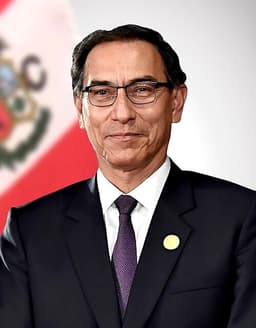
Martin Vizcarra
Politician · Modern
52.1Total

Ri Yong-ho
Politician · Modern
44.9Total
Basic Information
Born
1963
1956
Died
—
—
Era
Modern
Modern
Nationality
Peru
North Korea
Occupation
Politician
Politician
Civilization
Western
Eastern
Score Comparison
Military (10%)
50.0
16.2
Political (20%)
68.0
39.4
Influence (20%)
51.0
51.8
Legacy (20%)
40.8
39.2
Leadership (15%)
64.0
74.0
Strategy (15%)
43.7
35.4
TOTAL
52.1
44.9
Martin Vizcarra — Complete Timeline
2018 AD
Succeeded Pedro Pablo Kuczynski as PresidentPolitical Action◆ Major
Martín Vizcarra, then First Vice President, succeeded to the presidency after the resignation of Pedro Pablo Kuczynski. His ascension was seen as a chance to restore public trust in government amid widespread corruption.
SuccessionPresidency
Impact: nationalconstructive
2019 AD
Dissolved Congress in 2019Political Action
President Vizcarra dissolved the Peruvian Congress after it refused to hold a vote of confidence on his anti-corruption reforms. This triggered a constitutional crisis, but Vizcarra called for new legislative elections, which were held in 2020.
Constitutional CrisisCongressReform
Impact: national
2020 AD
Impeached and removed from officePolitical Action
Vizcarra was impeached by the new Congress on charges of corruption and moral incapacity, and removed from office. His removal was highly controversial, with many seeing it as a political maneuver by the opposition, and it sparked widespread protests.
ImpeachmentRemovalProtest
Impact: nationaldestructive
Ri Yong-ho — Complete Timeline
2016 AD
Appointed Foreign Minister of North KoreaPolitical Action◆ Major
Ri Yong-ho was appointed Foreign Minister of North Korea in 2016, replacing Ri Su-yong. He was a veteran diplomat who had served as ambassador to the United Kingdom and as a nuclear negotiator.
North KoreaDiplomacyForeign Minister
Impact: national
2017 AD
Led North Korea's delegation to the UN General AssemblyPolitical Action◆ Major
Ri Yong-ho addressed the United Nations General Assembly in 2017, where he threatened to test a hydrogen bomb over the Pacific Ocean. His speech escalated tensions with the U.S. and led to increased sanctions against North Korea.
North KoreaUNNuclear Threats
Impact: globaldestructive
2018 AD
Negotiated at the Singapore SummitPolitical Action◆ Major
Ri Yong-ho was a key member of the North Korean delegation at the first U.S.-North Korea summit in Singapore. He participated in working-level discussions on denuclearization and security guarantees, though the summit's joint statement was vague.
North KoreaUS SummitSingapore
Impact: global
2019 AD
Participated in the Hanoi SummitPolitical Action◆ Major
Ri Yong-ho accompanied Kim Jong-un to the second U.S.-North Korea summit in Hanoi. He was involved in the negotiations that ultimately broke down over disagreements on sanctions relief and denuclearization steps.
North KoreaUS SummitHanoi
Impact: global
This comparison has not been analyzed yet.
One-time AI generation (~1 minute). Scores and timeline are already available below.
Rankings
🥇
Martin VizcarraLeader
Mil: 50.0Pol: 68.0Inf: 51.0
52.1
🥈
Ri Yong-ho
Mil: 16.2Pol: 39.4Inf: 51.8
44.9
+7.2 behind
How This Comparison Works
Algorithm
Each figure is scored on 6 dimensions (0—100 scale) based on structured historical data: Military (10%), Political (20%), Influence (20%), Legacy (20%), Leadership (15%), Strategy (15%). The weighted total produces the final ranking.
Data Sources
Scores are computed from structured sub-indicators in the database. Scale factors adjust for era (Ancient ×0.85, Modern ×1.0) and civilization size (Eastern ×1.05, Other ×0.80) to account for differences in population and military scale.
Maximum 3 Figures
Comparisons are limited to 2—3 figures to ensure readability and statistical meaningfulness.
Error Margins
±5 points per dimension — Sub-scores are derived from historical records with inherent uncertainty. Two figures within 5 points on a dimension should be considered roughly equivalent in that area.
Total Score Accuracy
±3 points overall — The weighted combination of 6 dimensions produces a total score with approximately ±3 points of uncertainty. Differences of less than 3 points are not statistically significant— the figures are effectively tied.
Known Limitations
- Historical records are incomplete and uneven across civilizations
- Figures from oral-tradition societies may be underrepresented
- Occupation labels can misclassify multi-role figures
- Scores measure capability and impact, not moral character
- Quantitative scoring is a comparison tool, not absolute truth
Capability Radar
Military (10%) — Battles & Warfare
Battles
29
17
Win Rate
30
15
Expansion
33
17
Political (20%) — Governance & Reform
Reform
65
20
Diplomacy
50
55
Economy
40
15
Influence (20%) — Cultural & Global Reach
Cultural
20
10
Global
25
30
Legacy (20%) — Historical Impact
Historical
30
15
Longevity
15
10
Leadership (15%) — Power & Stability
Tenure
55
60
Stability
20
25
Strategy (15%) — Tactics & Innovation
Strategy
39
25
Tactics
41
26
Reform
46
27
Similar Comparisons
Comments & Discussion
No comments yet. Be the first to share your thoughts!