Loading...
Margaret Thatcher vs Veluthampi Dalawa
Margaret Thatcher leads by 26.4 pts · 2 figures compared
…
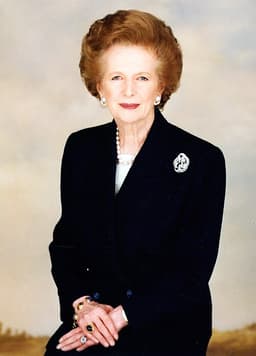
Margaret Thatcher
Politician · Modern
74.2Total

Veluthampi Dalawa
Politician · Modern
47.8Total
Basic Information
Born
1925
1765
Died
—
1809
Era
Modern
Modern
Nationality
United Kingdom
India
Occupation
Politician
Politician
Civilization
Western
Indian
Score Comparison
Military (10%)
55.0
22.6
Political (20%)
88.0
48.0
Influence (20%)
88.0
52.5
Legacy (20%)
68.0
45.0
Leadership (15%)
80.0
65.7
Strategy (15%)
45.0
41.0
TOTAL
74.2
47.8
Margaret Thatcher — Complete Timeline
1979 AD
Became the first female Prime Minister of the United KingdomPolitical Action◆ Major
Thatcher led the Conservative Party to victory in the general election, becoming Britain's first female prime minister. Her government pursued a radical agenda of economic liberalization, privatization, and reduction of trade union power.
ElectionFirst Female PMConservatism
Impact: nationalconstructive
1982 AD
Waged the Falklands WarWar◆ Major
Thatcher ordered a military task force to retake the Falkland Islands after Argentina invaded. The British forces succeeded after a 10-week conflict. The victory boosted Thatcher's popularity and her government's standing, leading to her re-election in 1983.
Falklands WarMilitary ConflictSovereignty
Impact: regional
1984 AD
Privatized state-owned industriesReform◆ Major
Thatcher's government sold off major state-owned enterprises, including British Telecom, British Gas, and British Airways, to private investors. This program of privatization was a central part of her economic policy, aimed at increasing efficiency and reducing public debt.
PrivatizationEconomic ReformFree Market
Impact: nationalconstructive
1985 AD
Defeated the miners' strikePolitical Action◆ Major
Thatcher's government faced a year-long strike by the National Union of Mineworkers led by Arthur Scargill. The government stockpiled coal and used police to prevent picketing. The strike collapsed, weakening trade union power and enabling further pit closures.
Trade UnionsStrikeCoal Mining
Impact: nationaldestructive
1986 AD
Signed the Single European ActPolitical Action◆ Major
Thatcher signed the Single European Act, which reformed the European Economic Community and set the goal of a single market by 1992. Despite her Eurosceptic views, she supported this act, which expanded qualified majority voting and European integration.
European UnionSingle MarketIntegration
Impact: regionalconstructive
Veluthampi Dalawa — Complete Timeline
1801 AD
Appointment as DalawaPolitical Action◆ Major
Veluthampi Dalawa was appointed as the Diwan (prime minister) of Travancore by the Maharaja. He inherited a state burdened by debts and British interference, and immediately began administrative and financial reforms.
TravancoreDiwanAdministration
Impact: regionalconstructive
1805 AD
Reforms and ResistanceReform◆ Major
Veluthampi Dalawa implemented financial reforms to reduce Travancore's debt to the British East India Company. He also reorganized the army and attempted to reduce British influence, which led to growing tension with the Company.
ReformBritish East India CompanyTravancore
Impact: regionalconstructive
1809 AD
Kundara ProclamationPolitical Action
Veluthampi Dalawa issued the Kundara Proclamation, calling on the people of Travancore to rise against British rule. He denounced British interference and urged resistance, marking the start of an open rebellion.
RebellionBritish East India CompanyKerala
Impact: regional
Defeat and SuicidePolitical Action
After British forces defeated the Travancore army, Veluthampi Dalawa was pursued by Company troops. To avoid capture, he committed suicide at the temple of Mannadi. His death ended the rebellion and solidified British control over Travancore.
DeathBritish East India CompanyRebellion
Impact: regionaltragic
Expert Analysis
Origins
Margaret Thatcher (born 1925) was the daughter of a grocer in Grantham, England. She studied chemistry at Oxford and later qualified as a barrister. Her father's conservative values shaped her political outlook. Veluthampi Dalawa (born 1765) was born into a noble Nair family in Travancore (modern Kerala, India). He became a trusted official under Maharaja Balarama Varma, navigating the complex politics of the princely state.
Rise to Power
Thatcher entered Parliament in 1959, served as Education Secretary, and in 1975 defeated Edward Heath to lead the Conservative Party. She became Prime Minister in 1979 after winning the general election. Veluthampi Dalawa was appointed Diwan of Travancore in 1802, inheriting a state burdened by debts to the British East India Company. He quickly implemented reforms to stabilize finances and reduce British influence.
Leadership & Governance
Thatcher's leadership was defined by conviction politics. She privatized state industries (British Telecom, British Gas), curbed union power (defeating the miners' strike in 1984-85), and deregulated financial markets. Her governance score is 80.0. Veluthampi Dalawa focused on administrative and financial reforms: he reorganized the army, reduced court expenses, and renegotiated treaties. However, his governance was constrained by British pressure. His leadership score is 65.7.
Triumph & Tragedy
Thatcher's triumphs include winning the Falklands War (1982), transforming the British economy, and influencing global free-market policies. Her tragedy was the poll tax riots (1990) and her eventual resignation after a party rebellion. Veluthampi Dalawa's triumph was the Kundara Proclamation (1809), a call to arms against British domination. His tragedy: after British forces defeated his army, he committed suicide in 1809 to avoid capture. His military score is 22.6, reflecting the failure of his rebellion.
Character & Destiny
Thatcher was resolute, confrontational, and ideologically driven. Her character led to both economic revival and social division. Veluthampi Dalawa was patriotic but impetuous; his direct confrontation with a superior British force proved fatal. Historians note his bravery but also his strategic miscalculation.
Legacy
Thatcher's legacy is vast: she reshaped British politics, inspired Reaganomics, and her policies influenced global neoliberalism. Her legacy score is 68.0. Veluthampi Dalawa is remembered in Kerala as a martyr against colonialism, but his rebellion did not achieve lasting change. His legacy score is 45.0.
Conclusion
Thatcher had a greater impact. Her political score of 88.0 vs Veluthampi Dalawa's 48.0 reflects her success in implementing transformative policies. While Veluthampi Dalawa's resistance was heroic, it failed to alter the course of history. Thatcher's total score of 74.2 dwarfs his 47.8, demonstrating a clear difference in historical influence.
Rankings
🥇
Margaret ThatcherLeader
Mil: 55.0Pol: 88.0Inf: 88.0
74.2
🥈
Veluthampi Dalawa
Mil: 22.6Pol: 48.0Inf: 52.5
47.8
+26.4 behind
How This Comparison Works
Algorithm
Each figure is scored on 6 dimensions (0—100 scale) based on structured historical data: Military (10%), Political (20%), Influence (20%), Legacy (20%), Leadership (15%), Strategy (15%). The weighted total produces the final ranking.
Data Sources
Scores are computed from structured sub-indicators in the database. Scale factors adjust for era (Ancient ×0.85, Modern ×1.0) and civilization size (Eastern ×1.05, Other ×0.80) to account for differences in population and military scale.
Maximum 3 Figures
Comparisons are limited to 2—3 figures to ensure readability and statistical meaningfulness.
Error Margins
±5 points per dimension — Sub-scores are derived from historical records with inherent uncertainty. Two figures within 5 points on a dimension should be considered roughly equivalent in that area.
Total Score Accuracy
±3 points overall — The weighted combination of 6 dimensions produces a total score with approximately ±3 points of uncertainty. Differences of less than 3 points are not statistically significant— the figures are effectively tied.
Known Limitations
- Historical records are incomplete and uneven across civilizations
- Figures from oral-tradition societies may be underrepresented
- Occupation labels can misclassify multi-role figures
- Scores measure capability and impact, not moral character
- Quantitative scoring is a comparison tool, not absolute truth
Capability Radar
Military (10%) — Battles & Warfare
Battles
0
35
Win Rate
0
20
Expansion
20
10
Political (20%) — Governance & Reform
Reform
90
50
Diplomacy
80
30
Economy
90
40
Influence (20%) — Cultural & Global Reach
Cultural
75
30
Global
80
15
Legacy (20%) — Historical Impact
Historical
80
35
Longevity
70
25
Leadership (15%) — Power & Stability
Tenure
85
45
Stability
70
20
Strategy (15%) — Tactics & Innovation
Strategy
0
25
Tactics
0
30
Reform
30
40
Similar Comparisons
Comments & Discussion
No comments yet. Be the first to share your thoughts!