Loading...
Margaret Thatcher vs Martin Fayulu
Margaret Thatcher leads by 34.2 pts · 2 figures compared
…
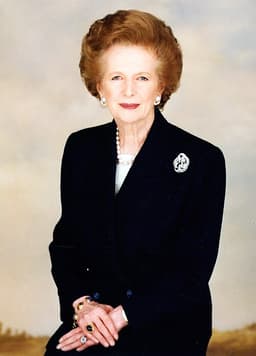
Margaret Thatcher
Politician · Modern
74.2Total

Martin Fayulu
Politician · Modern
40.0Total
Basic Information
Born
1925
1956
Died
—
—
Era
Modern
Modern
Nationality
United Kingdom
DR Congo
Occupation
Politician
Politician
Civilization
Western
Other
Score Comparison
Military (10%)
55.0
22.0
Political (20%)
88.0
26.4
Influence (20%)
88.0
47.1
Legacy (20%)
68.0
35.8
Leadership (15%)
80.0
58.8
Strategy (15%)
45.0
43.0
TOTAL
74.2
40.0
Margaret Thatcher — Complete Timeline
1979 AD
Became the first female Prime Minister of the United KingdomPolitical Action◆ Major
Thatcher led the Conservative Party to victory in the general election, becoming Britain's first female prime minister. Her government pursued a radical agenda of economic liberalization, privatization, and reduction of trade union power.
ElectionFirst Female PMConservatism
Impact: nationalconstructive
1982 AD
Waged the Falklands WarWar◆ Major
Thatcher ordered a military task force to retake the Falkland Islands after Argentina invaded. The British forces succeeded after a 10-week conflict. The victory boosted Thatcher's popularity and her government's standing, leading to her re-election in 1983.
Falklands WarMilitary ConflictSovereignty
Impact: regional
1984 AD
Privatized state-owned industriesReform◆ Major
Thatcher's government sold off major state-owned enterprises, including British Telecom, British Gas, and British Airways, to private investors. This program of privatization was a central part of her economic policy, aimed at increasing efficiency and reducing public debt.
PrivatizationEconomic ReformFree Market
Impact: nationalconstructive
1985 AD
Defeated the miners' strikePolitical Action◆ Major
Thatcher's government faced a year-long strike by the National Union of Mineworkers led by Arthur Scargill. The government stockpiled coal and used police to prevent picketing. The strike collapsed, weakening trade union power and enabling further pit closures.
Trade UnionsStrikeCoal Mining
Impact: nationaldestructive
1986 AD
Signed the Single European ActPolitical Action◆ Major
Thatcher signed the Single European Act, which reformed the European Economic Community and set the goal of a single market by 1992. Despite her Eurosceptic views, she supported this act, which expanded qualified majority voting and European integration.
European UnionSingle MarketIntegration
Impact: regionalconstructive
Martin Fayulu — Complete Timeline
2018 AD
Presidential Candidacy in 2018 ElectionPolitical Action◆ Major
Martin Fayulu ran as the joint opposition candidate in the 2018 presidential election, representing the Lamuka coalition. He was widely seen as the main challenger to the ruling party, but official results placed him third, a result he rejected as fraudulent.
ElectionOppositionLamuka
Impact: national
2019 AD
Challenged Election Results at Constitutional CourtPolitical Action◆ Major
Fayulu filed a petition with the Constitutional Court challenging the official results that declared Felix Tshisekedi the winner. The court rejected his petition, and Fayulu called for international sanctions, claiming the election was stolen through a backroom deal.
Election disputeLegal challengeControversy
Impact: national
Declared Himself PresidentPolitical Action◆ Major
Martin Fayulu declared himself the legitimate president of the DRC, citing leaked election data that he claimed showed he won. He held a symbolic swearing-in ceremony and continued to dispute Tshisekedi's legitimacy, though he failed to gain international recognition.
Self-declarationPolitical crisisLegitimacy
Impact: national
2023 AD
Presidential Candidacy in 2023 ElectionPolitical Action◆ Major
Fayulu ran again in the 2023 presidential election as the candidate of the Lamuka coalition. He finished second with about 5% of the vote, according to official results, and again rejected the outcome, alleging widespread irregularities and fraud.
ElectionOppositionLamuka
Impact: national
Expert Analysis
Origins
Margaret Thatcher, born October 13, 1925 in Grantham, England, was the daughter of a grocer and local alderman. She studied chemistry at Oxford University (1943-1947) and later qualified as a barrister. Her father's conservative values shaped her political outlook. She married Denis Thatcher in 1951 and had twins Mark and Carol.
Martin Fayulu, born November 21, 1956 in Kinshasa, Democratic Republic of Congo, came from a modest family. He studied at the National University of Zaire (now University of Kinshasa) and later earned an MBA from the University of Southern California. Before politics, Fayulu worked as an executive at ExxonMobil and then founded his own oil trading company. His business success provided resources for political ambitions.
Rise to Power
Thatcher entered Parliament in 1959 as MP for Finchley. She served as Education Secretary under Edward Heath (1970-1974) where she ended free milk for older children, earning the nickname "Thatcher the milk snatcher." She challenged Heath for party leadership in 1975 and won, becoming Leader of the Opposition. In 1979, she became Prime Minister after defeating James Callaghan's Labour government, capitalizing on public discontent with strikes and inflation.
Fayulu entered politics as a member of the Union for Democracy and Social Progress (UDPS). He later founded the Commitment for Citizenship and Development (ECiDé) party. In 2018, he became the candidate of the Lamuka coalition, uniting several opposition figures. The election was controversial; official results gave Félix Tshisekedi 38.57% to Fayulu's 34.8%, but leaked data from the electoral commission suggested Fayulu won with 59.4%. Fayulu challenged the results at the Constitutional Court, which upheld Tshisekedi's victory. He then declared himself president, holding a symbolic swearing-in ceremony. In 2023, he ran again but finished second with about 5% of the vote.
Leadership & Governance
Thatcher's leadership style was confrontational and decisive. She pursued a radical agenda: privatization of state-owned industries (British Telecom, British Gas, British Airways), deregulation, tax cuts, and reducing union power. Her government defeated the miners' strike (1984-1985) through stockpiling coal and police tactics. She also waged the Falklands War (1982) against Argentina, sending a task force 8,000 miles to retake the islands. In foreign policy, she developed a close relationship with US President Ronald Reagan and was skeptical of European integration, though she signed the Single European Act (1986).
Fayulu has not held executive office. His leadership is primarily as an opposition figure. He advocates for democratic reforms, anti-corruption, and rule of law in the DRC. His strategy involves electoral participation and international appeals. He lacks the institutional power to implement policies. His governance score of 26.4 reflects his limited direct impact.
Triumph & Tragedy
Thatcher's triumphs: becoming Britain's first female prime minister, winning the Falklands War (scored 55 in military), transforming the British economy through privatization, and breaking the power of trade unions. Her political score of 88 reflects her dominance. Tragedies: the Poll Tax riots (1990) led to her downfall; her policies increased inequality and unemployment in industrial regions; she became increasingly authoritarian, leading to her forced resignation in 1990 after 11 years in power.
Fayulu's triumph: uniting opposition forces in 2018 and possibly winning the election, as suggested by leaked data. His tragedy: being denied the presidency despite apparent victory; his subsequent electoral performance in 2023 dropped to 5%, indicating diminished support. His political score of 26.4 and legacy score of 35.8 reflect his failure to achieve power.
Character & Destiny
Thatcher was known for her determination, ideological rigidity, and confrontational style. She often clashed with her own cabinet and was dubbed "The Iron Lady" by a Soviet journalist. Her character led to both her success and her fall: she transformed Britain but ultimately alienated many in her party. Her leadership score of 80 reflects her strong but divisive approach.
Fayulu is characterized by persistence and principled opposition. He has maintained his claim to the presidency despite setbacks. However, his inability to build a broader coalition or adapt strategies has limited his influence. His leadership score of 58.8 is modest, reflecting his role as a perennial candidate.
Legacy
Thatcher's legacy is profound. She fundamentally changed British politics, moving the Labour Party to the center (New Labour). Privatization and deregulation influenced economies worldwide. The Falklands War restored British confidence. Her legacy score of 68 reflects her lasting impact, though she remains controversial. Thatcherism is a term used to describe her policies.
Fayulu's legacy is still forming. He represents the struggle for democracy in the DRC but has not achieved significant change. His influence score of 47.1 is moderate. He is likely to be remembered as a symbol of electoral integrity issues in the DRC rather than as a transformative leader.
Conclusion
Margaret Thatcher had a far greater impact than Martin Fayulu. Her total score of 74.2 dwarfs Fayulu's 40.0. Thatcher transformed a major Western nation, reshaped its economy, and influenced global politics. Fayulu, despite a credible claim to have won an election, remains an opposition figure without executive power. The score gap of 34.2 points reflects the difference between a world leader who changed history and a regional candidate who failed to gain office. While Fayulu's story highlights flaws in Congolese democracy, Thatcher's legacy endures in policies and institutions.
Rankings
🥇
Margaret ThatcherLeader
Mil: 55.0Pol: 88.0Inf: 88.0
74.2
🥈
Martin Fayulu
Mil: 22.0Pol: 26.4Inf: 47.1
40.0
+34.2 behind
How This Comparison Works
Algorithm
Each figure is scored on 6 dimensions (0—100 scale) based on structured historical data: Military (10%), Political (20%), Influence (20%), Legacy (20%), Leadership (15%), Strategy (15%). The weighted total produces the final ranking.
Data Sources
Scores are computed from structured sub-indicators in the database. Scale factors adjust for era (Ancient ×0.85, Modern ×1.0) and civilization size (Eastern ×1.05, Other ×0.80) to account for differences in population and military scale.
Maximum 3 Figures
Comparisons are limited to 2—3 figures to ensure readability and statistical meaningfulness.
Error Margins
±5 points per dimension — Sub-scores are derived from historical records with inherent uncertainty. Two figures within 5 points on a dimension should be considered roughly equivalent in that area.
Total Score Accuracy
±3 points overall — The weighted combination of 6 dimensions produces a total score with approximately ±3 points of uncertainty. Differences of less than 3 points are not statistically significant— the figures are effectively tied.
Known Limitations
- Historical records are incomplete and uneven across civilizations
- Figures from oral-tradition societies may be underrepresented
- Occupation labels can misclassify multi-role figures
- Scores measure capability and impact, not moral character
- Quantitative scoring is a comparison tool, not absolute truth
Capability Radar
Military (10%) — Battles & Warfare
Battles
0
21
Win Rate
0
22
Expansion
20
26
Political (20%) — Governance & Reform
Reform
90
10
Diplomacy
80
20
Economy
90
5
Influence (20%) — Cultural & Global Reach
Cultural
75
10
Global
80
10
Legacy (20%) — Historical Impact
Historical
80
10
Longevity
70
5
Leadership (15%) — Power & Stability
Tenure
85
0
Stability
70
5
Strategy (15%) — Tactics & Innovation
Strategy
0
29
Tactics
0
34
Reform
30
38
Similar Comparisons
Comments & Discussion
No comments yet. Be the first to share your thoughts!