Loading...
Mao Zedong vs Yoweri Museveni
Mao Zedong leads by 15.5 pts · 2 figures compared
…
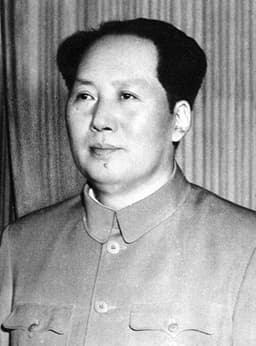
Mao Zedong
Politician · Modern
79.4Total
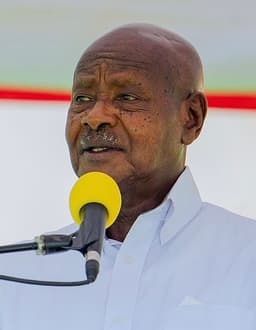
Yoweri Museveni
Politician · Modern
63.9Total
Basic Information
Born
1893
1944
Died
1976
—
Era
Modern
Modern
Nationality
China
Uganda
Occupation
Politician
Politician
Civilization
Eastern
Other
Score Comparison
Military (10%)
75.0
67.5
Political (20%)
88.0
72.0
Influence (20%)
85.0
61.0
Legacy (20%)
70.0
50.0
Leadership (15%)
85.0
80.0
Strategy (15%)
72.0
66.3
TOTAL
79.4
63.9
Mao Zedong — Complete Timeline
1934 AD
Long MarchWar
Mao Zedong led the Chinese Red Army on a strategic retreat from Nationalist forces, covering approximately 6,000 miles over 370 days. The march solidified Mao's leadership within the Chinese Communist Party and became a foundational myth of the Communist revolution.
Chinese Civil WarCommunist RevolutionRetreat
Impact: national
1949 AD
Proclamation of the People's Republic of ChinaPolitical Action
Mao Zedong declared the founding of the People's Republic of China from Tiananmen Gate in Beijing. This ended the Chinese Civil War and established Communist rule over mainland China, with Mao as Chairman of the Central People's Government.
Founding of PRCCommunist VictoryRevolution
Impact: global
1958 AD
Great Leap ForwardReform◆ Major
Mao launched a campaign to rapidly industrialize China and collectivize agriculture. The policy led to widespread mismanagement, resulting in a famine that caused an estimated 15-45 million deaths between 1959 and 1961.
FamineIndustrializationCollectivization
Impact: nationaldestructive
1960 AD
Sino-Soviet SplitPolitical Action◆ Major
Mao's ideological differences with Soviet leader Nikita Khrushchev led to a breakdown in relations between China and the Soviet Union. The split ended the Sino-Soviet alliance and reshaped global Cold War dynamics, with China pursuing an independent path.
Cold WarIdeological ConflictAlliance Breakdown
Impact: global
1966 AD
Cultural RevolutionPolitical Action
Mao initiated a sociopolitical movement to purge capitalist and traditional elements from Chinese society. The Red Guard youth groups attacked intellectuals and officials, leading to widespread violence, destruction of cultural artifacts, and an estimated 1-2 million deaths.
Political PurgeSocial UpheavalRed Guard
Impact: nationaldestructive
1971 AD
Ping-Pong DiplomacyCultural◆ Major
Mao approved an invitation for the U.S. table tennis team to visit China, initiating a thaw in Sino-American relations. This cultural exchange paved the way for President Nixon's visit to China in 1972 and the eventual normalization of diplomatic ties.
DiplomacyU.S.-China RelationsCultural Exchange
Impact: globalconstructive
Yoweri Museveni — Complete Timeline
1986 AD
Bush War Victory and Capture of KampalaWar
Museveni's National Resistance Army (NRA) captured Kampala, ending the Ugandan Bush War. He was sworn in as President on January 29, 1986, overthrowing the government of Tito Okello and beginning his long rule.
Ugandan Bush WarSeizure of PowerNRA
Impact: national
Introduction of the Movement SystemPolitical Action◆ Major
Museveni established a 'no-party' Movement system, banning political party activity. This system concentrated power in the National Resistance Movement (NRM) and was justified as necessary to prevent ethnic conflict, but was criticized as authoritarian.
Political SystemNRMAuthoritarianism
Impact: national
1998 AD
Invasion of the Democratic Republic of CongoWar◆ Major
Ugandan forces, allied with Rwanda, invaded the Democratic Republic of Congo (DRC) to overthrow Laurent Kabila. This intervention escalated the Second Congo War, drawing in multiple African nations and causing widespread devastation.
Second Congo WarRegional ConflictIntervention
Impact: regionaldestructive
2005 AD
Constitutional Amendment Removing Term LimitsPolitical Action◆ Major
Museveni's government pushed through a constitutional amendment removing presidential term limits. This allowed him to run for a third term in 2006 and subsequent elections, consolidating his hold on power and drawing domestic and international criticism.
Constitutional ChangeTerm LimitsPower Consolidation
Impact: nationaldestructive
2014 AD
Anti-Homosexuality ActPolitical Action◆ Major
Museveni signed the Anti-Homosexuality Act, which imposed life imprisonment for certain same-sex acts. The law was widely condemned internationally, leading to aid cuts from some Western nations, though it was later annulled by the Constitutional Court on procedural grounds.
LGBTQ RightsLegislationInternational Condemnation
Impact: nationaldestructive
Expert Analysis
Mao Zedong vs Yoweri Museveni
# The Long March to Power: Museveni and Mao
On a January morning in 1986, Yoweri Museveni stood in the ruins of Kampala’s parliament building, a guerrilla commander who had just taken power after five years of bush war. Half a world away and decades earlier, on October 1, 1949, Mao Zedong had stood atop Tiananmen Gate, proclaiming the birth of the People’s Republic of China after a civil war that had lasted more than two decades. Both men had seized power through the barrel of a gun. Both would go on to rule for decades, reshaping their nations in their own image. But the paths they walked, and the destinations they reached, could hardly have been more different.
Origins
Mao Zedong was born in 1893 in Shaoshan, a village in Hunan province, the son of a prosperous peasant farmer. China was then a dying empire, humiliated by foreign powers and torn by internal rebellion. Mao grew up watching his father beat his mother, and he learned early to rebel against authority. He read voraciously—Chinese classics, Western philosophy, Marxist pamphlets—and by his twenties, he was a schoolteacher turned revolutionary, convinced that only a violent upheaval could save China.
Yoweri Museveni was born in 1944 in Ntungamo, a small town in southwestern Uganda, to a cattle-keeping family of the Banyankole people. Uganda was then a British protectorate, calm on the surface but seething with ethnic tensions. Museveni attended elite missionary schools and later studied economics at the University of Dar es Salaam in Tanzania, where he encountered Marxist theory and the writings of Frantz Fanon. While Mao was shaped by the collapse of an ancient civilization, Museveni was shaped by the collapse of a fragile post-colonial state.
Rise to Power
Mao’s rise was a story of survival against impossible odds. In 1934, with the Nationalist forces of Chiang Kai-shek closing in, Mao led the Chinese Red Army on the Long March—a 6,000-mile retreat through some of the most brutal terrain on earth. Of the 86,000 who set out, fewer than 8,000 reached the final destination in Yan’an. But those survivors became the hardened core of the Communist revolution. Mao used those years in the wilderness to consolidate his ideological control over the party, writing the essays that would become the bible of Chinese communism.
Museveni’s path was shorter but no less violent. In 1981, after a disputed election brought Milton Obote back to power, Museveni took 27 men into the bush of central Uganda to begin a guerrilla war. The National Resistance Army started with little more than rusty rifles and a conviction that the post-colonial state had failed. By 1986, Museveni’s forces had captured Kampala. Where Mao’s struggle had spanned decades and consumed millions, Museveni’s victory came in just five years—a testament to the speed of modern guerrilla warfare and the weakness of the state he was overthrowing.
Leadership & Governance
Mao’s leadership was defined by grand, catastrophic experiments. In 1958, he launched the Great Leap Forward, a campaign to industrialize China overnight. Peasants were forced into communes, backyard steel furnaces were built in every village, and grain quotas were set at impossible levels. The result was the largest famine in human history, with estimates of deaths ranging from 20 to 45 million. Mao’s response was not to admit error but to double down, purging anyone who criticized him. In 1966, he unleashed the Cultural Revolution, turning teenage Red Guards loose on teachers, officials, and anyone suspected of bourgeois tendencies. The chaos lasted a decade and destroyed China’s cultural heritage, educational system, and social fabric.
Museveni’s governance was more pragmatic, at least in its early years. He introduced the “Movement System,” a no-party political structure that he argued was necessary to overcome ethnic divisions. For a time, Uganda experienced relative stability and economic growth. Museveni welcomed foreign investment, fought HIV/AIDS with unusual openness, and restored basic order to a country that had known only violence since independence. His military score of 61.8 and strategy score of 58.8 reflect a competent but not brilliant commander; his leadership score of 80.8 and political score of 72.0 suggest a skilled politician who understood the art of survival.
Triumph & Tragedy
Mao’s greatest triumph was the Proclamation of the People’s Republic of China in 1949. After a century of foreign domination and civil war, China was finally unified under a single government. His greatest tragedy was that he could not stop destroying what he had built. The Great Leap Forward and the Cultural Revolution were not mistakes—they were logical extensions of Mao’s belief that perpetual revolution was necessary to keep China pure. His legacy is a country that he both created and nearly destroyed.
Museveni’s triumph was the Bush War itself—the capture of Kampala in 1986 and the restoration of order to a shattered nation. His tragedy has been the slow decay of that triumph. In 2005, he pushed through a constitutional amendment removing term limits, ensuring he could remain president for life. In 1998, he invaded the Democratic Republic of Congo, a war that destabilized the entire Great Lakes region and left behind a trail of atrocities. In 2014, he signed the Anti-Homosexuality Act, a piece of legislation that horrified the international community and revealed how far he had drifted from his early promises of justice.
Character & Destiny
Mao was a man of immense charisma and terrifying ruthlessness. He wrote poetry, swam the Yangtze River at age 72, and spoke of peasants as the true heroes of history—yet he presided over famines that killed tens of millions. He believed that willpower could overcome any material obstacle, and that destruction was a necessary prelude to creation. His personality was the engine of China’s revolution and the source of its greatest catastrophes.
Museveni is a survivor, not a visionary. He began as an idealist—a young man who believed in liberation and justice—but power slowly corrupted him. He learned to use ethnicity, patronage, and violence to stay in office. Where Mao’s mistakes came from grand ideological certainty, Museveni’s came from the mundane arithmetic of political survival.
Legacy
Mao’s legacy is monumental and deeply ambiguous. He is the founder of modern China, the man who lifted the country from humiliation to global power. But he is also the man who starved millions and destroyed his own culture. In China today, his image is everywhere—on currency, in statues, in official propaganda—but the policies he championed have been quietly abandoned. China’s economic miracle is a repudiation of everything he believed.
Museveni’s legacy is smaller but no less complicated. He is remembered as the man who ended Uganda’s nightmare of violence and as the man who could not let go of power. His country is more stable than it was in 1986, but it is also more authoritarian. He is a cautionary tale about how liberation movements become oppressive regimes.
Conclusion
What separates a revolutionary from a warlord? Perhaps only time. Mao and Museveni both began as rebels with a cause, both seized power through force, and both held onto it for decades. But Mao’s ambitions were cosmic—he wanted to remake human nature itself—while Museveni’s were local and personal. Mao’s failures were epic; Museveni’s are merely tragic. In the end, both men remind us that the hardest thing for a revolutionary is to know when to stop. The Long March ends, but the habit of power does not.
Rankings
🥇
Mao ZedongLeader
Mil: 75.0Pol: 88.0Inf: 85.0
79.4
🥈
Yoweri Museveni
Mil: 67.5Pol: 72.0Inf: 61.0
63.9
+15.5 behind
How This Comparison Works
Algorithm
Each figure is scored on 6 dimensions (0—100 scale) based on structured historical data: Military (10%), Political (20%), Influence (20%), Legacy (20%), Leadership (15%), Strategy (15%). The weighted total produces the final ranking.
Data Sources
Scores are computed from structured sub-indicators in the database. Scale factors adjust for era (Ancient ×0.85, Modern ×1.0) and civilization size (Eastern ×1.05, Other ×0.80) to account for differences in population and military scale.
Maximum 3 Figures
Comparisons are limited to 2—3 figures to ensure readability and statistical meaningfulness.
Error Margins
±5 points per dimension — Sub-scores are derived from historical records with inherent uncertainty. Two figures within 5 points on a dimension should be considered roughly equivalent in that area.
Total Score Accuracy
±3 points overall — The weighted combination of 6 dimensions produces a total score with approximately ±3 points of uncertainty. Differences of less than 3 points are not statistically significant— the figures are effectively tied.
Known Limitations
- Historical records are incomplete and uneven across civilizations
- Figures from oral-tradition societies may be underrepresented
- Occupation labels can misclassify multi-role figures
- Scores measure capability and impact, not moral character
- Quantitative scoring is a comparison tool, not absolute truth
Capability Radar
Military (10%) — Battles & Warfare
Battles
85
65
Win Rate
80
70
Expansion
85
55
Political (20%) — Governance & Reform
Reform
95
60
Diplomacy
80
70
Economy
70
55
Influence (20%) — Cultural & Global Reach
Cultural
90
45
Global
90
50
Legacy (20%) — Historical Impact
Historical
95
55
Longevity
85
50
Leadership (15%) — Power & Stability
Tenure
95
85
Stability
60
50
Strategy (15%) — Tactics & Innovation
Strategy
85
80
Tactics
75
75
Reform
90
60
Similar Comparisons
Comments & Discussion
Rooster on a Bicycle6/16/2026
Comparing Mao and Museveni is like comparing a typhoon to a drizzle. Mao's Long March built a modern state from feudal wreckage through total societal transformation. Museveni's bush war was a regional power grab by a cattle-keeping elite. Uganda's GDP per capita was higher in 1962 than under Museveni. Show me one mass literacy campaign or industrial policy comparable to the Great Leap's hunger. These are parallel revolutions the way a bicycle and a Caterpillar D9 are parallel forms of transport
湖北渔夫6/16/2026
别被Museveni的“群众路线”口号骗了。他1995年写的《什么是非洲的民主?》里全盘照搬毛的三大纪律八项注意,连突击性整党运动都学来了。但乌干达2023年The Index of State Weakness排名非洲第14,中国1950年呢?战后废墟排全球前五脆弱国家。毛用三十年给中国造了工业脊梁,Museveni三十年留给乌干达的只有Kadaga议长女儿买法拉利的丑闻。
数据拆解师6/16/2026
统计对比最打脸:毛时代中国婴儿死亡率从220‰降到74‰(UN Data),同期印度才到130。Museveni执政期间乌干达婴儿死亡率从115‰降到40‰(World Bank),进步幅度确实大。但看人均钢产量——中国1978年33公斤,乌干达2022年不到5公斤。工业基础决定发展天花板,这个维度Museveni连毛的尾灯都看不到。
Zinn's Shadow6/16/2026
Every comparison of "peasant revolutionaries" erases the actual peasants. Mao's land reform killed millions through class struggle quotas. Museveni's "no-party democracy" murdered civilians in Luwero Triangle with equal indifference. These men share one talent: converting rural bodies into political capital. Uganda's cattle-keepers got Bannyaabo dynasty; China's peasants got hukou system. Two roads to the same destination — a supreme leader who knows better than the dirt he walks on.
Cannon Fodder Analyst6/16/2026
Military historians miss the key divergence: Mao won with decentralized guerrilla warfare (base areas, self-sufficient Red Armies) while Museveni's NRA depended on Rwandan heavy weapons and Tanzanian air support. Mao's 1949 victory parade featured captured American artillery from the Korean War frontlines — guns his own logistics network dragged 300 miles through enemy territory. Museveni's 1986 entry into Kampala rode in Tanzanian-supplied Chinese Type 63 APCs. One built a war machine from mud;