Loading...
Mao Zedong vs Vijayalaya Chola
Mao Zedong leads by 25.2 pts · 2 figures compared
…
Mao Zedong
Politician · Modern
79.4Total
Vijayalaya Chola
Emperor · Medieval
54.2Total
Basic Information
Born
1893
820
Died
1976
870
Era
Modern
Medieval
Nationality
China
India
Occupation
Politician
Emperor
Civilization
Eastern
Indian
Score Comparison
Military (10%)
75.0
45.0
Political (20%)
88.0
40.8
Influence (20%)
85.0
58.0
Legacy (20%)
70.0
54.0
Leadership (15%)
85.0
64.0
Strategy (15%)
72.0
60.0
TOTAL
79.4
54.2
Mao Zedong — Complete Timeline
1934 AD
Long MarchWar
Mao Zedong led the Chinese Red Army on a strategic retreat from Nationalist forces, covering approximately 6,000 miles over 370 days. The march solidified Mao's leadership within the Chinese Communist Party and became a foundational myth of the Communist revolution.
Chinese Civil WarCommunist RevolutionRetreat
Impact: national
1949 AD
Proclamation of the People's Republic of ChinaPolitical Action
Mao Zedong declared the founding of the People's Republic of China from Tiananmen Gate in Beijing. This ended the Chinese Civil War and established Communist rule over mainland China, with Mao as Chairman of the Central People's Government.
Founding of PRCCommunist VictoryRevolution
Impact: global
1958 AD
Great Leap ForwardReform◆ Major
Mao launched a campaign to rapidly industrialize China and collectivize agriculture. The policy led to widespread mismanagement, resulting in a famine that caused an estimated 15-45 million deaths between 1959 and 1961.
FamineIndustrializationCollectivization
Impact: nationaldestructive
1960 AD
Sino-Soviet SplitPolitical Action◆ Major
Mao's ideological differences with Soviet leader Nikita Khrushchev led to a breakdown in relations between China and the Soviet Union. The split ended the Sino-Soviet alliance and reshaped global Cold War dynamics, with China pursuing an independent path.
Cold WarIdeological ConflictAlliance Breakdown
Impact: global
1966 AD
Cultural RevolutionPolitical Action
Mao initiated a sociopolitical movement to purge capitalist and traditional elements from Chinese society. The Red Guard youth groups attacked intellectuals and officials, leading to widespread violence, destruction of cultural artifacts, and an estimated 1-2 million deaths.
Political PurgeSocial UpheavalRed Guard
Impact: nationaldestructive
1971 AD
Ping-Pong DiplomacyCultural◆ Major
Mao approved an invitation for the U.S. table tennis team to visit China, initiating a thaw in Sino-American relations. This cultural exchange paved the way for President Nixon's visit to China in 1972 and the eventual normalization of diplomatic ties.
DiplomacyU.S.-China RelationsCultural Exchange
Impact: globalconstructive
Vijayalaya Chola — Complete Timeline
820 AD
Foundation of the Imperial Chola DynastyPolitical Action◆ Major
Vijayalaya Chola established the Imperial Chola dynasty, reviving the ancient Chola lineage after centuries of obscurity. He consolidated control over the Kaveri delta region, laying the foundation for the Chola Empire's future expansion.
Impact: regionalconstructive
850 AD
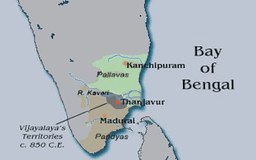
Capture of Thanjavur from the MutharaiyarWar◆ Major
Vijayalaya Chola captured the city of Thanjavur from the Mutharaiyar chieftains, who were vassals of the Pallavas. This victory established the Chola kingdom as an independent power and made Thanjavur the new Chola capital.
Impact: regionalconstructive
860 AD
Construction of the Vijayalaya Choleswaram TempleCultural
Vijayalaya Chola built the Vijayalaya Choleswaram temple at Narthamalai, a rock-cut temple dedicated to Shiva. This temple is one of the earliest Chola architectural monuments, reflecting the transition from Pallava to Chola styles.
constructive
Expert Analysis
Mao Zedong vs Vijayalaya Chola
### The Founder and the Father: Two Architects of Empire
In the winter of 850, a minor chieftain named Vijayalaya led his warriors into the muddy fort of Thanjavur, a prize he had snatched from a fading Pallava vassal. He was a man of modest ambition, seeking not to conquer a world but to reclaim a name. Twelve hundred years later, on a crisp October day in 1949, Mao Zedong stood atop the Gate of Heavenly Peace in Beijing and declared to a billion ears that the Chinese people had stood up. One man carved a kingdom from a stone; the other remade a civilization in fire. What separates a founder from a father? And what drives the difference between building a dynasty and forging a revolution?
### Origins
Vijayalaya Chola was born into a time of shadows. The ancient Chola dynasty, once powerful in Tamilakam, had faded into obscurity by the 9th century, its lineage surviving only as minor chieftains under the suzerainty of the Pallava Empire. He grew up in a world of local rivalries, temple patronage, and the slow rhythms of agrarian life. The past was a memory to be revived, not a problem to be solved. His era was medieval, hierarchical, and deeply religious—a world where power flowed through bloodlines and divine sanction.
Mao Zedong was born in 1893 in Shaoshan, a village in Hunan province, into a China reeling from the Opium Wars and internal decay. The son of a prosperous peasant, he witnessed the collapse of the Qing Dynasty, the humiliation of foreign concessions, and the chaos of warlordism. His world was one of collapse and possibility—a modern crucible where ancient certainties were shattered by guns, ideas, and empires. Where Vijayalaya inherited a tradition, Mao inherited a crisis.
### Rise to Power
Vijayalaya’s ascent was a slow, patient climb. He did not invent a new ideology or mobilize a mass movement. He chose his moment: the Pallava kingdom was weakening, its vassals—the Mutharaiyar chieftains—were vulnerable. In 850, he struck, capturing Thanjavur, a city that would become the heart of Chola power for centuries. He then consolidated his hold through temple building—the Vijayalaya Choleswaram temple, completed around 860, was both a religious act and a political statement, a stone declaration that the Chola sun had risen again. His power came from cunning, patience, and a mastery of local alliances.
Mao’s rise was a furnace of war and ideas. In 1934, during the Long March, he emerged as the leader of the Chinese Communist Party not by capturing a city but by surviving a catastrophe. The march—a 6,000-mile strategic retreat from Nationalist forces—transformed him into a symbol of endurance. He did not inherit a kingdom; he built a party, an army, and a peasant revolution. His power came from ideology, organization, and a willingness to sacrifice millions for a vision. Where Vijayalaya seized a throne, Mao invented a new world.
### Leadership & Governance
Vijayalaya ruled as a classical Indian monarch. He patronized the arts, built temples, and established a lineage that would produce some of India’s greatest rulers—Rajendra Chola, Rajaraja Chola. His governance was local, religious, and dynastic. He did not reform society; he restored an order. His military strategy was tactical, not systemic—a war here, a treaty there. His leadership score of 74.0 reflects a steady hand, not a revolutionary mind.
Mao governed as a titan of transformation—and destruction. His political score of 82.0 and leadership score of 80.6 mask a terrifying duality. In 1958, he launched the Great Leap Forward, a campaign to industrialize China overnight through collectivized agriculture. It led to one of the worst famines in human history, with tens of millions dead. In 1966, he initiated the Cultural Revolution, a sociopolitical purge that destroyed institutions, families, and lives. Yet he also engineered the Sino-Soviet Split in 1960, asserting China’s independence from Moscow, and in 1971, approved Ping-Pong Diplomacy, thawing relations with the United States. His genius was strategic; his governance was often catastrophic.
### Triumph & Tragedy
Vijayalaya’s greatest triumph was the capture of Thanjavur—a single, decisive act that resurrected a dynasty. His tragedy was that he did not live to see its full glory. He died around 870, leaving his son Aditya I to expand the empire. His legacy was a foundation, not a monument.
Mao’s greatest triumph was the proclamation of the People’s Republic of China in 1949, ending a century of humiliation and civil war. His tragedy was that he then turned on his own people. The Great Leap Forward and Cultural Revolution were not failures of circumstance but of design—ideological purity over human life. His total score of 76.4 reflects a figure of immense influence and immense cost.
### Character & Destiny
Vijayalaya was a builder. He saw the past as a blueprint and the future as a restoration. His personality was conservative, pious, and patient—he did not seek to remake the world, only to claim his place in it.
Mao was a destroyer and a creator. He saw the past as a prison and the future as a blank slate. His personality was volatile, visionary, and ruthless—he believed that revolution required blood. His destiny was to break China from its ancient mold, but the breaking left scars that still ache.
### Legacy
Vijayalaya’s legacy is the Chola Empire, which would dominate South India for over four centuries. His name lives in stone—in the temple he built, in the lineage he founded. He is remembered as a founder, a restorer, a local hero.
Mao’s legacy is modern China. He unified the country, industrialized it, and gave it a sense of global purpose. But he also bequeathed a legacy of trauma—the Cultural Revolution, the famine, the political purges. His score of 69.9 for legacy reflects a figure who is both revered and reviled, a father who was also a tyrant.
### Conclusion
One man captured a fort and built a temple. The other captured a country and remade a civilization. Vijayalaya Chola founded a dynasty; Mao Zedong founded a nation. The difference is not just of scale but of soul. Vijayalaya worked within the logic of his time—honor, lineage, faith. Mao broke the logic of his time—revolution, ideology, power. Both succeeded. Both left worlds that were unimaginable before they arrived. But the question lingers: is it better to build a house that lasts a thousand years, or to burn down a world and build a new one from ashes? History gives no easy answer—only the silence of the temple and the roar of the crowd.
Rankings
🥇
Mao ZedongLeader
Mil: 75.0Pol: 88.0Inf: 85.0
79.4
🥈
Vijayalaya Chola
Mil: 45.0Pol: 40.8Inf: 58.0
54.2
+25.2 behind
How This Comparison Works
Algorithm
Each figure is scored on 6 dimensions (0—100 scale) based on structured historical data: Military (10%), Political (20%), Influence (20%), Legacy (20%), Leadership (15%), Strategy (15%). The weighted total produces the final ranking.
Data Sources
Scores are computed from structured sub-indicators in the database. Scale factors adjust for era (Ancient ×0.85, Modern ×1.0) and civilization size (Eastern ×1.05, Other ×0.80) to account for differences in population and military scale.
Maximum 3 Figures
Comparisons are limited to 2—3 figures to ensure readability and statistical meaningfulness.
Error Margins
±5 points per dimension — Sub-scores are derived from historical records with inherent uncertainty. Two figures within 5 points on a dimension should be considered roughly equivalent in that area.
Total Score Accuracy
±3 points overall — The weighted combination of 6 dimensions produces a total score with approximately ±3 points of uncertainty. Differences of less than 3 points are not statistically significant— the figures are effectively tied.
Known Limitations
- Historical records are incomplete and uneven across civilizations
- Figures from oral-tradition societies may be underrepresented
- Occupation labels can misclassify multi-role figures
- Scores measure capability and impact, not moral character
- Quantitative scoring is a comparison tool, not absolute truth
Capability Radar
Military (10%) — Battles & Warfare
Battles
85
45
Win Rate
80
50
Expansion
85
55
Political (20%) — Governance & Reform
Reform
95
35
Diplomacy
80
40
Economy
70
35
Influence (20%) — Cultural & Global Reach
Cultural
90
40
Global
90
30
Legacy (20%) — Historical Impact
Historical
95
55
Longevity
85
50
Leadership (15%) — Power & Stability
Tenure
95
50
Stability
60
45
Strategy (15%) — Tactics & Innovation
Strategy
85
45
Tactics
75
40
Reform
90
30
Similar Comparisons
Comments & Discussion
铁血开拓者6/16/2026
拿一个9世纪偷泥巴寨子的土酋跟改变五亿人命运的革命领袖比?Vijayalaya不过是在Pallava王朝烂掉时捡了块边角料,而毛教员缔造了新中国、摧毁了旧社会的根。一个复原了种姓和庙宇经济,一个让妇女能顶半边天、扫盲运动席卷全国。这不是量级的差距,这是物种的鸿沟。
DataDecimator6/16/2026
Am I the only one seeing the absurd scale mismatch here? Vijayalaya's Chola dynasty at its start controlled maybe a few hundred square miles of rice paddies and one mud fort. Mao took over a country of 540 million people with a GDP that had collapsed to $50 per capita. The "similarity" in founding narratives is doing a lot of heavy lifting—one guy built a local stronghold, the other restructured the most populous nation on Earth. Let’s not confuse a chieftain with a world-historical figure.
ClassicsChola6/16/2026
Actually, the comparison is more apt than you think from a structural standpoint. Vijayalaya didn't just "snatch" Thanjavur—he identified a power vacuum in the Kaveri delta after the Pallava-Pandya wars and positioned his clan for a 400-year run. Mao did the same in China’s civil war chaos. Both men understood timing, legitimacy, and the importance of a symbolic capital (Thanjavur temple vs. Tiananmen). The difference? One built an imperial system grounded in temple networks and caste, the other
历史解构者6/16/2026
说句政治不正确的:Vijayalaya建立的是延续四百年的世袭王朝,而毛的体系在他死后三十年就开始了实质性的市场转型。真正的"帝国建筑师"看的是遗产是否能超越个人崇拜。Chola王朝留下了Brihadeeswarar神庙和完整的行政管理体系,而毛的晚年是大跃进饿殍和文革撕裂。讽刺的是,那个"泥巴寨子"起的家,制度寿命反而更长。历史不跟你讲情怀。