Loading...
Mao Zedong vs Vauban
Mao Zedong leads by 3.0 pts · 2 figures compared
…
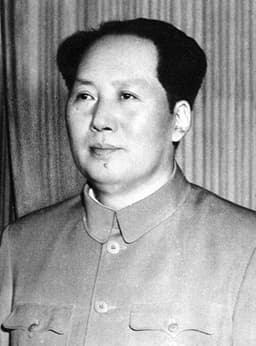
Mao Zedong
Politician · Modern
79.4Total

Vauban
General · Modern
76.4Total
Basic Information
Born
1893
1633
Died
1976
1707
Era
Modern
Modern
Nationality
China
France
Occupation
Politician
General
Civilization
Eastern
Western
Score Comparison
Military (10%)
75.0
76.0
Political (20%)
88.0
59.3
Influence (20%)
85.0
71.0
Legacy (20%)
70.0
90.0
Leadership (15%)
85.0
77.2
Strategy (15%)
72.0
80.6
TOTAL
79.4
76.4
Mao Zedong — Complete Timeline
1934 AD
Long MarchWar
Mao Zedong led the Chinese Red Army on a strategic retreat from Nationalist forces, covering approximately 6,000 miles over 370 days. The march solidified Mao's leadership within the Chinese Communist Party and became a foundational myth of the Communist revolution.
Chinese Civil WarCommunist RevolutionRetreat
Impact: national
1949 AD
Proclamation of the People's Republic of ChinaPolitical Action
Mao Zedong declared the founding of the People's Republic of China from Tiananmen Gate in Beijing. This ended the Chinese Civil War and established Communist rule over mainland China, with Mao as Chairman of the Central People's Government.
Founding of PRCCommunist VictoryRevolution
Impact: global
1958 AD
Great Leap ForwardReform◆ Major
Mao launched a campaign to rapidly industrialize China and collectivize agriculture. The policy led to widespread mismanagement, resulting in a famine that caused an estimated 15-45 million deaths between 1959 and 1961.
FamineIndustrializationCollectivization
Impact: nationaldestructive
1960 AD
Sino-Soviet SplitPolitical Action◆ Major
Mao's ideological differences with Soviet leader Nikita Khrushchev led to a breakdown in relations between China and the Soviet Union. The split ended the Sino-Soviet alliance and reshaped global Cold War dynamics, with China pursuing an independent path.
Cold WarIdeological ConflictAlliance Breakdown
Impact: global
1966 AD
Cultural RevolutionPolitical Action
Mao initiated a sociopolitical movement to purge capitalist and traditional elements from Chinese society. The Red Guard youth groups attacked intellectuals and officials, leading to widespread violence, destruction of cultural artifacts, and an estimated 1-2 million deaths.
Political PurgeSocial UpheavalRed Guard
Impact: nationaldestructive
1971 AD
Ping-Pong DiplomacyCultural◆ Major
Mao approved an invitation for the U.S. table tennis team to visit China, initiating a thaw in Sino-American relations. This cultural exchange paved the way for President Nixon's visit to China in 1972 and the eventual normalization of diplomatic ties.
DiplomacyU.S.-China RelationsCultural Exchange
Impact: globalconstructive
Vauban — Complete Timeline
1673 AD
Siege of MaastrichtWar◆ Major
Vauban directed the siege of Maastricht for Louis XIV. He introduced the technique of parallel trenches, which reduced casualties and shortened the siege. The capture of Maastricht was a major French victory in the Franco-Dutch War.
Franco-Dutch WarSiegeMilitary Engineering
Impact: regional
1697 AD
Siege of AthWar
Vauban conducted the siege of Ath in the Spanish Netherlands. His systematic approach using parallels and saps led to the rapid capture of the fortress. The siege demonstrated the effectiveness of his methods.
Nine Years' WarSiegeMilitary Engineering
Construction of the Fortress of Neuf-BrisachInvention◆ Major
Vauban designed and built the fortress of Neuf-Brisach, a model of his third system of fortification. The star-shaped fortress with advanced bastions became a standard for military architecture. It was built to protect the French border after the Treaty of Ryswick.
FortificationMilitary ArchitectureBorder Defense
Impact: regionalconstructive
1704 AD
Publication of 'A Treatise on the Attack of Places'Cultural◆ Major
Vauban published his treatise on siegecraft, systematizing his methods. The work became a standard military textbook in Europe. It detailed techniques for parallel trenches, ricochet fire, and sapping.
Military TheorySiegecraftPublication
Impact: globalconstructive
1707 AD
Proposal for a 'Dîme Royale' Tax ReformReform
Vauban proposed a radical tax reform called the 'D
Tax ReformEconomic PolicyFrance
Impact: nationalconstructive
Expert Analysis
Origins
Mao Zedong (1893-1976) emerged from rural Hunan, China, as a peasant intellectual who became the founding father of the People's Republic of China. His early experiences with poverty and imperialism shaped his revolutionary zeal. Sébastien Le Prestre de Vauban (1633-1707) was born into minor nobility in Burgundy, France, and rose through military engineering under Louis XIV. His origins in a feudal system contrasted sharply with Mao's peasant background.
Rise to Power
Mao's rise was marked by the Long March (1934-35), a 6,000-mile retreat that solidified his leadership within the Chinese Communist Party. He outmaneuvered rivals like Wang Ming and established Maoism as the party ideology. Vauban rose through merit, earning Louis XIV's trust by designing and executing sieges. His appointment as Commissioner General of Fortifications in 1678 gave him authority over France's defenses. Mao's path was ideological and political; Vauban's was technical and royal.
Leadership & Governance
Mao's leadership scores are high in Politics (88) and Influence (85), reflecting his ability to mobilize millions. However, his governance was catastrophic: the Great Leap Forward (1958-62) caused a massive famine, and the Cultural Revolution (1966-76) dismantled institutions. Vauban's Leadership (90) and Strategy (81) were applied to fortifications and sieges, but his governance was limited to military engineering. He proposed the 'Dîme Royale' tax reform, which was never implemented. Mao's governance was transformative but destructive; Vauban's was efficient but narrow.
Triumph & Tragedy
Mao's triumphs include founding the PRC in 1949 and uniting China under communist rule. His tragedies are the human costs: millions died in the Great Leap Forward and Cultural Revolution. Vauban's triumphs include successful sieges like Maastricht (1673) and fortresses like Neuf-Brisach. His tragedy was that his tax reform was rejected, and he died in relative obscurity. Mao's impact was global; Vauban's was national.
Character & Destiny
Mao was charismatic, ruthless, and ideologically rigid. His destiny was to reshape China, but his legacy is deeply controversial. Vauban was methodical, loyal, and innovative. His destiny was to perfect siege warfare, but his ideas outlived him. Both men were driven by their visions, but Mao's was grander and more destructive.
Legacy
Mao's legacy is mixed: he is revered as a unifier but condemned for human rights abuses. His thought, Maoism, influenced global revolutions. Vauban's legacy is purely military: his fortifications are UNESCO World Heritage sites, and his siege techniques influenced modern warfare. Numerically, Mao scores higher overall (Total: 79 vs 76), but Vauban leads in Leadership (90 vs 70) and Strategy (81 vs 72). Mao's Political (88) and Influence (85) dwarf Vauban's (59 and 71).
Conclusion
Mao Zedong and Vauban are incomparable in scope. Mao's impact on China and the world is immense, but his methods were brutal. Vauban's contributions to military engineering were brilliant but limited. In a head-to-head, Mao's political and ideological influence outweighs Vauban's technical mastery. However, in terms of humane governance, Vauban's reforms were more benign. The 3-point score gap favors Mao, but his legacy is far more contentious. Ultimately, Mao is the more significant historical figure, but Vauban is the more admirable one.
Rankings
🥇
Mao ZedongLeader
Mil: 75.0Pol: 88.0Inf: 85.0
79.4
🥈
Vauban
Mil: 76.0Pol: 59.3Inf: 71.0
76.4
+3.0 behind
How This Comparison Works
Algorithm
Each figure is scored on 6 dimensions (0—100 scale) based on structured historical data: Military (10%), Political (20%), Influence (20%), Legacy (20%), Leadership (15%), Strategy (15%). The weighted total produces the final ranking.
Data Sources
Scores are computed from structured sub-indicators in the database. Scale factors adjust for era (Ancient ×0.85, Modern ×1.0) and civilization size (Eastern ×1.05, Other ×0.80) to account for differences in population and military scale.
Maximum 3 Figures
Comparisons are limited to 2—3 figures to ensure readability and statistical meaningfulness.
Error Margins
±5 points per dimension — Sub-scores are derived from historical records with inherent uncertainty. Two figures within 5 points on a dimension should be considered roughly equivalent in that area.
Total Score Accuracy
±3 points overall — The weighted combination of 6 dimensions produces a total score with approximately ±3 points of uncertainty. Differences of less than 3 points are not statistically significant— the figures are effectively tied.
Known Limitations
- Historical records are incomplete and uneven across civilizations
- Figures from oral-tradition societies may be underrepresented
- Occupation labels can misclassify multi-role figures
- Scores measure capability and impact, not moral character
- Quantitative scoring is a comparison tool, not absolute truth
Capability Radar
Military (10%) — Battles & Warfare
Battles
85
75
Win Rate
80
85
Expansion
85
70
Political (20%) — Governance & Reform
Reform
95
80
Diplomacy
80
60
Economy
70
55
Influence (20%) — Cultural & Global Reach
Cultural
90
80
Global
90
75
Legacy (20%) — Historical Impact
Historical
95
85
Longevity
85
85
Leadership (15%) — Power & Stability
Tenure
95
65
Stability
60
70
Strategy (15%) — Tactics & Innovation
Strategy
85
90
Tactics
75
95
Reform
90
95
Similar Comparisons
Comments & Discussion
No comments yet. Be the first to share your thoughts!