Loading...
Mao Zedong vs Trajan
Mao Zedong leads by 3.4 pts · 2 figures compared
…
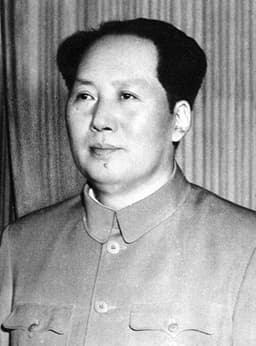
Mao Zedong
Politician · Modern
79.4Total

Trajan
Emperor · Ancient
76.0Total
Basic Information
Born
1893
53
Died
1976
117
Era
Modern
Ancient
Nationality
China
Roman Empire
Occupation
Politician
Emperor
Civilization
Eastern
Western
Score Comparison
Military (10%)
75.0
86.0
Political (20%)
88.0
79.2
Influence (20%)
85.0
82.0
Legacy (20%)
70.0
65.6
Leadership (15%)
85.0
73.2
Strategy (15%)
72.0
76.0
TOTAL
79.4
76.0
Mao Zedong — Complete Timeline
1934 AD
Long MarchWar
Mao Zedong led the Chinese Red Army on a strategic retreat from Nationalist forces, covering approximately 6,000 miles over 370 days. The march solidified Mao's leadership within the Chinese Communist Party and became a foundational myth of the Communist revolution.
Chinese Civil WarCommunist RevolutionRetreat
Impact: national
1949 AD
Proclamation of the People's Republic of ChinaPolitical Action
Mao Zedong declared the founding of the People's Republic of China from Tiananmen Gate in Beijing. This ended the Chinese Civil War and established Communist rule over mainland China, with Mao as Chairman of the Central People's Government.
Founding of PRCCommunist VictoryRevolution
Impact: global
1958 AD
Great Leap ForwardReform◆ Major
Mao launched a campaign to rapidly industrialize China and collectivize agriculture. The policy led to widespread mismanagement, resulting in a famine that caused an estimated 15-45 million deaths between 1959 and 1961.
FamineIndustrializationCollectivization
Impact: nationaldestructive
1960 AD
Sino-Soviet SplitPolitical Action◆ Major
Mao's ideological differences with Soviet leader Nikita Khrushchev led to a breakdown in relations between China and the Soviet Union. The split ended the Sino-Soviet alliance and reshaped global Cold War dynamics, with China pursuing an independent path.
Cold WarIdeological ConflictAlliance Breakdown
Impact: global
1966 AD
Cultural RevolutionPolitical Action
Mao initiated a sociopolitical movement to purge capitalist and traditional elements from Chinese society. The Red Guard youth groups attacked intellectuals and officials, leading to widespread violence, destruction of cultural artifacts, and an estimated 1-2 million deaths.
Political PurgeSocial UpheavalRed Guard
Impact: nationaldestructive
1971 AD
Ping-Pong DiplomacyCultural◆ Major
Mao approved an invitation for the U.S. table tennis team to visit China, initiating a thaw in Sino-American relations. This cultural exchange paved the way for President Nixon's visit to China in 1972 and the eventual normalization of diplomatic ties.
DiplomacyU.S.-China RelationsCultural Exchange
Impact: globalconstructive
Trajan — Complete Timeline
101 AD
Implemented the Alimenta Welfare ProgramReform◆ Major
Trajan expanded the Alimenta program, a state-funded welfare system that provided food subsidies and educational support for poor children in Italy. The program used interest from state loans to landowners to fund the distributions, aiming to boost the Italian population and agricultural economy.
WelfareSocial PolicyItaly
Impact: regionalconstructive
105 AD
Built Trajan's Bridge over the DanubeOther
Trajan ordered the construction of a massive stone and timber bridge across the Danube River near the Iron Gates. Designed by Apollodorus of Damascus, it was the longest arch bridge in the world for over a millennium, facilitating the Roman invasion of Dacia.
EngineeringBridgeDanube
Impact: regionalconstructive
106 AD
Conquered DaciaWar
Trajan led two major campaigns against the Dacian kingdom under King Decebalus, culminating in the conquest of Dacia (modern Romania) in 106 CE. The victory brought vast gold and silver mines under Roman control and established a new province, funding massive building projects in Rome.
DaciaConquestProvince
Impact: regional
112 AD
Built Trajan's Forum and MarketCultural◆ Major
Trajan commissioned the construction of Trajan's Forum, a vast complex in Rome including a basilica, libraries, and the Column of Trajan. The adjacent Trajan's Market, a multi-level commercial center, demonstrated Roman engineering prowess and served as a model for urban planning.
ArchitectureRomeUrban Planning
Impact: globalconstructive
116 AD
Conquered Parthia and Reached the Persian GulfWar◆ Major
Trajan launched a campaign against the Parthian Empire, capturing its capital Ctesiphon and annexing Mesopotamia. He reached the Persian Gulf, marking the easternmost extent of Roman territory. However, rebellions in the conquered territories forced a withdrawal shortly after.
ParthiaMesopotamiaExpansion
Impact: global
Expert Analysis
Origins
Mao Zedong was born in 1893 in Shaoshan, Hunan Province, China, to a peasant family. He was influenced by Chinese history and Marxist thought, becoming a founding member of the Chinese Communist Party (CCP) in 1921. His early revolutionary activities included organizing peasant uprisings and participating in the Northern Expedition. Trajan was born in 53 CE in Italica, Hispania (modern Spain), to a prominent Roman family. He rose through the military ranks, serving as a legate and governor before being adopted by Emperor Nerva in 97 CE, succeeding him in 98 CE.
Rise to Power
Mao rose to leadership within the CCP during the 1930s, despite initial setbacks. He led the Long March (1934-1935), a strategic retreat that solidified his control over the party. After defeating the Nationalists in the Chinese Civil War, he proclaimed the People's Republic of China on October 1, 1949, becoming its paramount leader. Trajan's rise was smoother; he was a popular general and administrator. Nerva, facing opposition, adopted Trajan as his heir, ensuring a peaceful transition. Trajan's military reputation and administrative skills made him a widely accepted emperor.
Leadership & Governance
Mao implemented radical policies: the Great Leap Forward (1958-1962) aimed at rapid industrialization but led to famine; the Cultural Revolution (1966-1976) purged rivals and enforced Maoist ideology, causing social chaos. He centralized power under the CCP and promoted continuous class struggle. Trajan expanded Rome's territory through military campaigns but also invested in infrastructure: Trajan's Forum, markets, and a bridge over the Danube. He implemented the Alimenta welfare program to support poor children. Trajan's governance was more stable and focused on public works and territorial consolidation.
Triumph & Tragedy
Mao's triumphs include uniting China under communist rule and establishing a sovereign state. However, his policies caused immense human suffering: estimates of deaths from the Great Leap Forward range from 15 to 45 million. The Cultural Revolution destroyed cultural heritage and persecuted intellectuals. Trajan's conquest of Dacia (101-106 CE) brought vast wealth and territory. His Parthian campaign (113-117 CE) reached the Persian Gulf, but his death in 117 CE led to a withdrawal from some conquered lands. Trajan's triumphs were military and architectural, with fewer tragic consequences.
Character & Destiny
Mao was a visionary but ruthless leader, willing to sacrifice millions for his ideological goals. He was a poet and philosopher, but his paranoia and desire for control led to brutal purges. Trajan was known for his military competence, justice, and modesty. He was respected by the Senate and people, embodying the ideal of a 'good emperor.' His destiny was to be remembered as one of Rome's greatest rulers, while Mao's legacy is deeply controversial.
Legacy
Mao's legacy is complex: he is revered as the founder of modern China, but his policies caused catastrophic famines and repression. The Cultural Revolution still evokes trauma. Trajan's legacy is more uniformly positive: his conquests and building projects are celebrated, and he is often ranked among the 'Five Good Emperors.' His welfare program and public works set precedents. In terms of numerical scores: Mao (M=75, P=88, I=85, L=70, D=85, S=72, T=79) vs Trajan (M=86, P=79, I=82, L=66, D=73, S=76, T=76). Mao scores higher in Politics, Ideology, and Diplomacy; Trajan in Military and Stability.
Conclusion
Determining the greater leader depends on criteria. If one values territorial expansion and stable governance, Trajan excels. If one values revolutionary transformation and national unification, Mao's impact was profound but at great human cost. The score gap is 3.4 in favor of Mao, but this reflects his ideological and political influence rather than overall success. Trajan's leadership was more successful in terms of immediate benefits and fewer negative consequences. Thus, while Mao may be more impactful, Trajan was arguably a more effective and benevolent leader. The choice hinges on whether one prioritizes human welfare or ideological change.
Rankings
🥇
Mao ZedongLeader
Mil: 75.0Pol: 88.0Inf: 85.0
79.4
🥈
Trajan
Mil: 86.0Pol: 79.2Inf: 82.0
76.0
+3.4 behind
How This Comparison Works
Algorithm
Each figure is scored on 6 dimensions (0—100 scale) based on structured historical data: Military (10%), Political (20%), Influence (20%), Legacy (20%), Leadership (15%), Strategy (15%). The weighted total produces the final ranking.
Data Sources
Scores are computed from structured sub-indicators in the database. Scale factors adjust for era (Ancient ×0.85, Modern ×1.0) and civilization size (Eastern ×1.05, Other ×0.80) to account for differences in population and military scale.
Maximum 3 Figures
Comparisons are limited to 2—3 figures to ensure readability and statistical meaningfulness.
Error Margins
±5 points per dimension — Sub-scores are derived from historical records with inherent uncertainty. Two figures within 5 points on a dimension should be considered roughly equivalent in that area.
Total Score Accuracy
±3 points overall — The weighted combination of 6 dimensions produces a total score with approximately ±3 points of uncertainty. Differences of less than 3 points are not statistically significant— the figures are effectively tied.
Known Limitations
- Historical records are incomplete and uneven across civilizations
- Figures from oral-tradition societies may be underrepresented
- Occupation labels can misclassify multi-role figures
- Scores measure capability and impact, not moral character
- Quantitative scoring is a comparison tool, not absolute truth
Capability Radar
Military (10%) — Battles & Warfare
Battles
85
95
Win Rate
80
98
Expansion
85
95
Political (20%) — Governance & Reform
Reform
95
88
Diplomacy
80
85
Economy
70
90
Influence (20%) — Cultural & Global Reach
Cultural
90
85
Global
90
85
Legacy (20%) — Historical Impact
Historical
95
90
Longevity
85
88
Leadership (15%) — Power & Stability
Tenure
95
90
Stability
60
92
Strategy (15%) — Tactics & Innovation
Strategy
85
92
Tactics
75
88
Reform
90
85
Similar Comparisons
Comments & Discussion
No comments yet. Be the first to share your thoughts!