Loading...
Mao Zedong vs Rurik
Mao Zedong leads by 19.8 pts · 2 figures compared
…
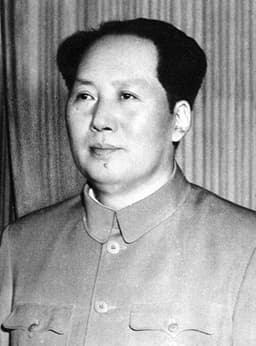
Mao Zedong
Politician · Modern
79.4Total
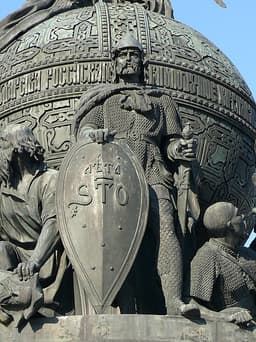
Rurik
Emperor · Medieval
59.6Total
Basic Information
Born
1893
830
Died
1976
879
Era
Modern
Medieval
Nationality
China
Kievan Rus
Occupation
Politician
Emperor
Civilization
Eastern
Western
Score Comparison
Military (10%)
75.0
50.0
Political (20%)
88.0
35.1
Influence (20%)
85.0
82.0
Legacy (20%)
70.0
68.0
Leadership (15%)
85.0
55.3
Strategy (15%)
72.0
35.7
TOTAL
79.4
59.6
Mao Zedong — Complete Timeline
1934 AD
Long MarchWar
Mao Zedong led the Chinese Red Army on a strategic retreat from Nationalist forces, covering approximately 6,000 miles over 370 days. The march solidified Mao's leadership within the Chinese Communist Party and became a foundational myth of the Communist revolution.
Chinese Civil WarCommunist RevolutionRetreat
Impact: national
1949 AD
Proclamation of the People's Republic of ChinaPolitical Action
Mao Zedong declared the founding of the People's Republic of China from Tiananmen Gate in Beijing. This ended the Chinese Civil War and established Communist rule over mainland China, with Mao as Chairman of the Central People's Government.
Founding of PRCCommunist VictoryRevolution
Impact: global
1958 AD
Great Leap ForwardReform◆ Major
Mao launched a campaign to rapidly industrialize China and collectivize agriculture. The policy led to widespread mismanagement, resulting in a famine that caused an estimated 15-45 million deaths between 1959 and 1961.
FamineIndustrializationCollectivization
Impact: nationaldestructive
1960 AD
Sino-Soviet SplitPolitical Action◆ Major
Mao's ideological differences with Soviet leader Nikita Khrushchev led to a breakdown in relations between China and the Soviet Union. The split ended the Sino-Soviet alliance and reshaped global Cold War dynamics, with China pursuing an independent path.
Cold WarIdeological ConflictAlliance Breakdown
Impact: global
1966 AD
Cultural RevolutionPolitical Action
Mao initiated a sociopolitical movement to purge capitalist and traditional elements from Chinese society. The Red Guard youth groups attacked intellectuals and officials, leading to widespread violence, destruction of cultural artifacts, and an estimated 1-2 million deaths.
Political PurgeSocial UpheavalRed Guard
Impact: nationaldestructive
1971 AD
Ping-Pong DiplomacyCultural◆ Major
Mao approved an invitation for the U.S. table tennis team to visit China, initiating a thaw in Sino-American relations. This cultural exchange paved the way for President Nixon's visit to China in 1972 and the eventual normalization of diplomatic ties.
DiplomacyU.S.-China RelationsCultural Exchange
Impact: globalconstructive
Rurik — Complete Timeline
860 AD
Sent Askold and Dir to ConstantinopleWar
According to tradition, Rurik sent his lieutenants Askold and Dir to raid Constantinople. While the historicity is uncertain, this event is associated with the first Rus' attack on the Byzantine Empire, highlighting early Rus' expansion.
RaidByzantine EmpireExpansion
Impact: regional
862 AD
Founded the Rurik dynastyPolitical Action
According to the Primary Chronicle, Rurik, a Varangian chieftain, was invited by Slavic and Finnic tribes to rule over them. He established his capital at Novgorod, founding the Rurik dynasty that would rule Kievan Rus' and later the Tsardom of Russia until 1598.
FoundationVarangianKievan Rus'
Impact: global
864 AD
Consolidated control over NovgorodPolitical Action◆ Major
Rurik consolidated his rule over Novgorod and the surrounding territories, suppressing a rebellion led by Vadim the Bold. He established a centralized authority that became the basis for the early Russian state.
ConsolidationNovgorodRebellion
Impact: regional
Expert Analysis
Mao Zedong vs Rurik
# The Chieftain and the Chairman
In the winter of 862, a Varangian warrior named Rurik stepped ashore on the marshy banks of Lake Ladoga, invited by warring Slavic tribes to bring order to their chaos. More than a millennium later, in the autumn of 1949, a peasant’s son named Mao Zedong stood atop the Gate of Heavenly Peace in Beijing, declaring to a billion people that the Chinese people had stood up. One founded a dynasty that would rule for seven centuries; the other launched a revolution that reshaped a quarter of humanity. Both men seized the currents of their times, but the rivers they rode were vastly different—and the destinations, even more so.
Origins
Rurik emerged from the mist of the Viking Age, a Varangian chieftain whose very existence is debated by historians. The *Primary Chronicle* tells us that in 862, Slavic and Finnic tribes, weary of internal strife, sent a message across the Baltic: “Our land is great and abundant, but there is no order in it. Come and rule over us.” Whether Rurik was a historical figure or a founding legend, he represents the collision of Scandinavian warrior culture with the sprawling river routes of Eastern Europe. He was a product of a world where power was personal, loyalty tribal, and legitimacy derived from the sword.
Mao Zedong was born in 1893 in Shaoshan, Hunan province, the son of a prosperous farmer. He grew up in a China crumbling under the weight of dynastic decay, foreign exploitation, and peasant misery. Where Rurik inherited a world of tribal feuds and open horizons, Mao inherited a civilization in collapse. The Opium Wars, the Taiping Rebellion, and the humiliation of foreign concessions shaped his worldview. He was a child of crisis, not of opportunity.
Rise to Power
Rurik’s path was swift and direct. According to tradition, he arrived in 862, built a fortress at Novgorod, and by 864 had suppressed a rebellion led by Vadim the Bold. He sent his lieutenants Askold and Dir south to raid Constantinople in 860, extending his influence along the Dnieper River. His rise was not ideological but practical: he was the strongman invited to end chaos, and he did so with Viking efficiency. There were no manifestos, no mass movements—just a chieftain and his retinue.
Mao’s ascent was a decades-long ordeal of survival and cunning. He joined the Chinese Communist Party in its infancy, survived purges, and emerged as a leader during the Long March of 1934—a 6,000-mile strategic retreat that became the founding myth of Communist China. Where Rurik conquered, Mao persuaded. Where Rurik ruled by presence, Mao ruled by ideas. His rise was not an invitation but a conquest of the mind.
Leadership & Governance
Rurik’s governance was personal and feudal. He consolidated Novgorod, established tribute systems, and laid the groundwork for the Kievan Rus’ state. His leadership score of 79.7 reflects a chieftain who commanded loyalty, but his political score of 51.2 reveals the limits of his system. He ruled through kinship and war bands, not bureaucracy or ideology. His legacy was a dynasty, not a doctrine.
Mao’s governance was total and transformative. With a political score of 82.0 and a strategy score of 76.5, he was a master of both theory and practice. He launched the Great Leap Forward in 1958 to industrialize China overnight—a catastrophic miscalculation that led to widespread famine. Then came the Cultural Revolution in 1966, a sociopolitical hurricane that purged dissent and destroyed institutions. Yet he also engineered the Sino-Soviet Split in 1960, asserting China’s independence from Moscow, and opened the door to the United States through Ping-Pong Diplomacy in 1971. His governance was a paradox of vision and devastation.
Triumph & Tragedy
Rurik’s greatest triumph was founding a dynasty that would rule until 1598. His tragedy is that we know so little of him—he remains a shadow, a symbol rather than a man. Askold and Dir’s raid on Constantinople may never have happened; the rebellion of Vadim the Bold may be myth. His life is a canvas for legend.
Mao’s triumph was undeniable: he united China, expelled foreign powers, and gave the poorest peasant a sense of dignity. His tragedy was the cost of that unity. The Great Leap Forward and Cultural Revolution killed millions. His legacy is a tightrope between liberation and tyranny.
Character & Destiny
Rurik’s character is inferred from his actions: pragmatic, decisive, and ruthless when necessary. He was a product of his environment—the Viking age demanded strength, not subtlety. His destiny was to be a founder, not a philosopher.
Mao was a poet, a strategist, and a destroyer. He wrote, “Political power grows out of the barrel of a gun,” and he meant it. His personality—grandiose, paranoid, visionary—shaped every decision. He believed in permanent revolution, and that belief consumed his country and his legacy.
Legacy
Rurik’s legacy is the Rurikid dynasty, which shaped Russia for centuries. His name lives in the Russian state, even if his historicity is uncertain. He is remembered as the Viking who became a Russian.
Mao’s legacy is China itself—modern, industrialized, confident. His influence score of 79.7 and legacy score of 69.9 reflect a man who remade a civilization. But his memory is contested: revered by some as a god, reviled by others as a tyrant.
Conclusion
Rurik and Mao stand at opposite ends of history’s spectrum. One founded a dynasty in a world of tribes and rivers; the other founded a nation in a world of empires and ideologies. Rurik’s story is a whisper from the past; Mao’s is a scream that still echoes. Both answered the call of their time, but the call itself was different—one for order, the other for revolution. In the end, they remind us that leadership is never abstract: it is always a conversation between a person and their moment. And the moment, more than the man, writes the final verdict.
Rankings
🥇
Mao ZedongLeader
Mil: 75.0Pol: 88.0Inf: 85.0
79.4
🥈
Rurik
Mil: 50.0Pol: 35.1Inf: 82.0
59.6
+19.8 behind
How This Comparison Works
Algorithm
Each figure is scored on 6 dimensions (0—100 scale) based on structured historical data: Military (10%), Political (20%), Influence (20%), Legacy (20%), Leadership (15%), Strategy (15%). The weighted total produces the final ranking.
Data Sources
Scores are computed from structured sub-indicators in the database. Scale factors adjust for era (Ancient ×0.85, Modern ×1.0) and civilization size (Eastern ×1.05, Other ×0.80) to account for differences in population and military scale.
Maximum 3 Figures
Comparisons are limited to 2—3 figures to ensure readability and statistical meaningfulness.
Error Margins
±5 points per dimension — Sub-scores are derived from historical records with inherent uncertainty. Two figures within 5 points on a dimension should be considered roughly equivalent in that area.
Total Score Accuracy
±3 points overall — The weighted combination of 6 dimensions produces a total score with approximately ±3 points of uncertainty. Differences of less than 3 points are not statistically significant— the figures are effectively tied.
Known Limitations
- Historical records are incomplete and uneven across civilizations
- Figures from oral-tradition societies may be underrepresented
- Occupation labels can misclassify multi-role figures
- Scores measure capability and impact, not moral character
- Quantitative scoring is a comparison tool, not absolute truth
Capability Radar
Military (10%) — Battles & Warfare
Battles
85
15
Win Rate
80
20
Expansion
85
30
Political (20%) — Governance & Reform
Reform
95
30
Diplomacy
80
35
Economy
70
25
Influence (20%) — Cultural & Global Reach
Cultural
90
50
Global
90
60
Legacy (20%) — Historical Impact
Historical
95
70
Longevity
85
80
Leadership (15%) — Power & Stability
Tenure
95
40
Stability
60
30
Strategy (15%) — Tactics & Innovation
Strategy
85
20
Tactics
75
15
Reform
90
10
Similar Comparisons
Comments & Discussion
Rurik the Ragnarok6/16/2026
Let's be real: Rurik probably didn't exist. Slavic tribes wouldn't invite a Viking to rule them—that's just medieval propaganda to justify Norman dominance. The Primary Chronicle was written 200 years later by monks cozying up to the Kievan Rus elite. Mao? He actually marched with millions. One's a foggy saga, the other reshaped geography. We're comparing a ghost to a glacier.
北欧破船王6/16/2026
拿维京传说跟中国革命比,这不是关公战秦琼吗?留里克连个青铜盔甲都没留下,毛主席可是真刀真枪打了二十多年。老祖宗说“道不同不相为谋”,一个靠剑和船,一个靠穷苦百姓。你们历史播客嗑瓜子的时候能不能讲点实在的?
Mao's Machete6/16/2026
Mao crushed landlords who owned 70% of China's land while 90% of peasants starved. That's a real enemy. Rurik's "invited rule" is just Varangian PR spin—Norse raiders took what they wanted. Plus, Mao's legacy includes nuclear weapons, mass literacy, and a standing army of millions. Rurik got a few sagas and a dynasty that later got Mongoled hard. That's not a comparison; it's a slaughter.
红太阳还是海盗头6/16/2026
留里克建立基辅罗斯的时候,连个文字记录都靠东正教传教士,毛主席领导抗战、解放全中国、搞土改,哪个不是实打实的历史转折?一个现代国家的诞生和一个中世纪的部落联盟,根本不是一个量级。留里克是条过江龙,毛主席那是开天辟地。
Classics Clash6/16/2026
Rurik's saga echoes the Aeneid—a founding myth for a new people. Mao's rise is more like Caesar crossing the Rubicon: a state-wide power grab disguised as revolution. Both claimed divine or historical inevitability. But Rurik's "Varangian invitation" narrative gets no modern traction; Mao's peasant mobilization still influences global guerrilla warfare theory. One gave us a dynasty; the other gave us a handbook.
古今纵横家6/16/2026
从历史地位说,留里克是东斯拉夫民族第一块拼图,毛主席是中国从农业国走向工业国的心脏。但是,留里克的历史几乎全是传说,连他是瑞典人还是丹麦人都说不清;毛主席的每一步都有档案、照片、录音为证。一个是神话,一个是丰碑,放在一起比,太委屈咱们主席了。
Data Decimator6/16/2026
Stat check: Rurik likely commanded maybe 200-400 Varangian warriors. Mao built an army of 4 million and mobilized 500 million peasants. Rurik's "realm" covered scattered river forts.