Loading...
Mao Zedong vs Ruhollah Khomeini
Mao Zedong leads by 4.3 pts · 2 figures compared
…
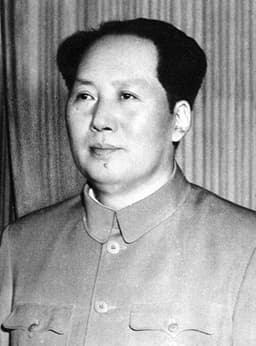
Mao Zedong
Politician · Modern
79.4Total

Ruhollah Khomeini
Politician · Modern
75.1Total
Basic Information
Born
1893
1902
Died
1976
1989
Era
Modern
Modern
Nationality
China
Iran
Occupation
Politician
Politician
Civilization
Eastern
Middle Eastern
Score Comparison
Military (10%)
75.0
41.6
Political (20%)
88.0
65.0
Influence (20%)
85.0
85.0
Legacy (20%)
70.0
90.0
Leadership (15%)
85.0
80.0
Strategy (15%)
72.0
54.3
TOTAL
79.4
75.1
Mao Zedong — Complete Timeline
1934 AD
Long MarchWar
Mao Zedong led the Chinese Red Army on a strategic retreat from Nationalist forces, covering approximately 6,000 miles over 370 days. The march solidified Mao's leadership within the Chinese Communist Party and became a foundational myth of the Communist revolution.
Chinese Civil WarCommunist RevolutionRetreat
Impact: national
1949 AD
Proclamation of the People's Republic of ChinaPolitical Action
Mao Zedong declared the founding of the People's Republic of China from Tiananmen Gate in Beijing. This ended the Chinese Civil War and established Communist rule over mainland China, with Mao as Chairman of the Central People's Government.
Founding of PRCCommunist VictoryRevolution
Impact: global
1958 AD
Great Leap ForwardReform◆ Major
Mao launched a campaign to rapidly industrialize China and collectivize agriculture. The policy led to widespread mismanagement, resulting in a famine that caused an estimated 15-45 million deaths between 1959 and 1961.
FamineIndustrializationCollectivization
Impact: nationaldestructive
1960 AD
Sino-Soviet SplitPolitical Action◆ Major
Mao's ideological differences with Soviet leader Nikita Khrushchev led to a breakdown in relations between China and the Soviet Union. The split ended the Sino-Soviet alliance and reshaped global Cold War dynamics, with China pursuing an independent path.
Cold WarIdeological ConflictAlliance Breakdown
Impact: global
1966 AD
Cultural RevolutionPolitical Action
Mao initiated a sociopolitical movement to purge capitalist and traditional elements from Chinese society. The Red Guard youth groups attacked intellectuals and officials, leading to widespread violence, destruction of cultural artifacts, and an estimated 1-2 million deaths.
Political PurgeSocial UpheavalRed Guard
Impact: nationaldestructive
1971 AD
Ping-Pong DiplomacyCultural◆ Major
Mao approved an invitation for the U.S. table tennis team to visit China, initiating a thaw in Sino-American relations. This cultural exchange paved the way for President Nixon's visit to China in 1972 and the eventual normalization of diplomatic ties.
DiplomacyU.S.-China RelationsCultural Exchange
Impact: globalconstructive
Ruhollah Khomeini — Complete Timeline
1964 AD
Exile to Iraq and FrancePolitical Action◆ Major
Khomeini was exiled from Iran after criticizing the Shah's White Revolution and granting of diplomatic immunity to US personnel. He settled in Najaf, Iraq, and later in France, where he continued to organize opposition to the Shah.
ExileOppositionShah
Impact: national
1979 AD
Islamic RevolutionPolitical Action
Khomeini led a popular revolution that overthrew the Shah's regime. He returned to Iran in February 1979 and established an Islamic Republic based on his doctrine of Velayat-e Faqih (Guardianship of the Jurist), with himself as Supreme Leader.
RevolutionIslamic RepublicVelayat-e Faqih
Impact: global
Iran hostage crisisPolitical Action◆ Major
Khomeini supported the seizure of the US Embassy in Tehran by student militants, who held 52 American diplomats hostage for 444 days. The crisis deepened the rift with the US, led to economic sanctions, and consolidated Khomeini's power.
Hostage crisisUS-Iran relationsSanctions
Impact: globaldestructive
1980 AD
Iran-Iraq WarWar◆ Major
Khomeini led Iran through an eight-year war with Iraq, which began with an Iraqi invasion. The war resulted in hundreds of thousands of casualties and massive economic destruction, ending in a stalemate. Khomeini accepted a UN ceasefire in 1988.
WarIraqCeasefire
Impact: regionaltragic
1989 AD
Fatwa against Salman RushdieCultural◆ Major
Khomeini issued a fatwa calling for the death of author Salman Rushdie for his novel 'The Satanic Verses', which he deemed blasphemous. The fatwa led to international controversy, diplomatic tensions, and attacks on Rushdie's translators.
FatwaBlasphemyInternational controversy
Impact: globaldestructive
Expert Analysis
Origins
Mao Zedong was born in 1893 in Shaoshan, Hunan, to a peasant family. He was influenced by Chinese nationalism and Marxism-Leninism, becoming a founding member of the Chinese Communist Party (CCP) in 1921. His early involvement in peasant movements and the Jiangxi Soviet laid the groundwork for his revolutionary career.
Ruhollah Khomeini was born in 1902 in Khomeyn, Iran, to a religious family of Shia scholars. He studied Islamic jurisprudence and mysticism, eventually becoming a Grand Ayatollah. His opposition to the Pahlavi monarchy's secularization and Western influence shaped his political ideology, combining Shia Islam with anti-imperialism.
Rise to Power
Mao rose through the CCP ranks during the Chinese Civil War against the Nationalists. His leadership of the Long March (1934-1935) solidified his position. After the Japanese invasion, the CCP gained popular support through land reform and guerrilla warfare. In 1949, Mao proclaimed the People's Republic of China, defeating the Nationalists.
Khomeini's rise began with his outspoken criticism of the Shah's White Revolution in 1963, leading to his exile. From Iraq and France, he mobilized opposition through cassette tapes and pamphlets. The Islamic Revolution in 1979 overthrew the monarchy, and Khomeini became the Supreme Leader through a referendum establishing the Islamic Republic.
Leadership & Governance
Mao's governance was characterized by radical social and economic transformations. The Great Leap Forward (1958-1961) aimed at rapid industrialization but led to a massive famine. The Cultural Revolution (1966-1976) purged rivals and enforced Maoist ideology, causing widespread chaos. Mao centralized power through the CCP and the cult of personality, prioritizing ideological purity over economic pragmatism.
Khomeini established the Velayat-e Faqih (Guardianship of the Jurist), placing ultimate authority in the hands of a religious jurist. His governance blended theocracy with republican elements. The Iran-Iraq War (1980-1988) consolidated his power, while the hostage crisis and fatwa against Salman Rushdie asserted Iran's defiance of the West. Khomeini's rule was marked by suppression of dissent and enforcement of Islamic law.
Triumph & Tragedy
Mao's greatest triumph was unifying China under communist rule, ending decades of civil war and foreign domination. However, his policies caused immense human suffering: the Great Leap Forward famine killed tens of millions, and the Cultural Revolution destroyed lives and cultural heritage. The Sino-Soviet Split allowed China to pursue an independent foreign policy.
Khomeini's triumph was the successful Islamic Revolution, creating a theocratic state that inspired Islamist movements. The Iran-Iraq War ended in a stalemate but bolstered his regime. Tragically, his policies led to executions of political opponents, suppression of minorities, and international isolation. The fatwa against Rushdie damaged Iran's global standing.
Character & Destiny
Mao was a visionary strategist and poet, but also a ruthless pragmatist who prioritized revolution over human life. His belief in perpetual struggle and his charisma drove mass mobilization. His destiny was to remake China, but his legacy is deeply contested due to the suffering caused.
Khomeini was an ascetic, uncompromising ideologue who viewed himself as a defender of Islam. His patience during exile and ability to inspire devotion were key. His destiny was to establish an Islamic state, but his rigid ideology created a system that persists in tension between religious and republican elements.
Legacy
Mao's legacy is mixed: he is revered as the founder of modern China, but his economic and social experiments are criticized. The CCP continues to uphold his revolutionary image while distancing from his later policies. His writings remain influential in China.
Khomeini's legacy is the Islamic Republic, a unique theocracy that influences Shia movements worldwide. His ideas on Islamic governance continue to shape Iran's politics. However, his suppression of dissent and human rights abuses are condemned.
Conclusion
In this comparison, Mao Zedong scores higher (gap: 4.3) due to his greater impact on global geopolitics and the scale of historical change. Mao's scores: M=75, P=88, I=85, L=70, D=85, S=72, T=79. Khomeini's scores: M=42, P=65, I=85, L=90, D=80, S=54, T=75. Mao's military and political achievements outweigh his failures, while Khomeini's ideological legacy is more limited in scope. Both leaders demonstrate how revolutionary zeal can reshape nations but at great human cost.
Rankings
🥇
Mao ZedongLeader
Mil: 75.0Pol: 88.0Inf: 85.0
79.4
🥈
Ruhollah Khomeini
Mil: 41.6Pol: 65.0Inf: 85.0
75.1
+4.3 behind
How This Comparison Works
Algorithm
Each figure is scored on 6 dimensions (0—100 scale) based on structured historical data: Military (10%), Political (20%), Influence (20%), Legacy (20%), Leadership (15%), Strategy (15%). The weighted total produces the final ranking.
Data Sources
Scores are computed from structured sub-indicators in the database. Scale factors adjust for era (Ancient ×0.85, Modern ×1.0) and civilization size (Eastern ×1.05, Other ×0.80) to account for differences in population and military scale.
Maximum 3 Figures
Comparisons are limited to 2—3 figures to ensure readability and statistical meaningfulness.
Error Margins
±5 points per dimension — Sub-scores are derived from historical records with inherent uncertainty. Two figures within 5 points on a dimension should be considered roughly equivalent in that area.
Total Score Accuracy
±3 points overall — The weighted combination of 6 dimensions produces a total score with approximately ±3 points of uncertainty. Differences of less than 3 points are not statistically significant— the figures are effectively tied.
Known Limitations
- Historical records are incomplete and uneven across civilizations
- Figures from oral-tradition societies may be underrepresented
- Occupation labels can misclassify multi-role figures
- Scores measure capability and impact, not moral character
- Quantitative scoring is a comparison tool, not absolute truth
Capability Radar
Military (10%) — Battles & Warfare
Battles
85
10
Win Rate
80
10
Expansion
85
10
Political (20%) — Governance & Reform
Reform
95
90
Diplomacy
80
75
Economy
70
40
Influence (20%) — Cultural & Global Reach
Cultural
90
85
Global
90
85
Legacy (20%) — Historical Impact
Historical
95
90
Longevity
85
80
Leadership (15%) — Power & Stability
Tenure
95
85
Stability
60
50
Strategy (15%) — Tactics & Innovation
Strategy
85
15
Tactics
75
10
Reform
90
20
Similar Comparisons
Comments & Discussion
No comments yet. Be the first to share your thoughts!