Loading...
Mao Zedong vs Pachacuti
Mao Zedong leads by 10.0 pts · 2 figures compared
…
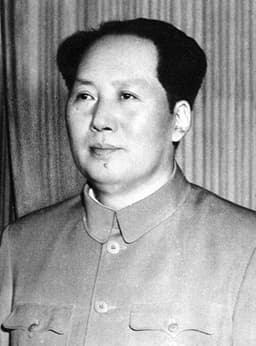
Mao Zedong
Politician · Modern
79.4Total
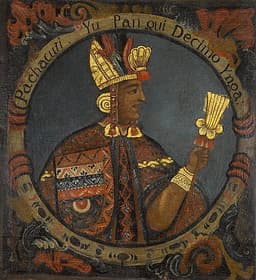
Pachacuti
Emperor · Medieval
69.4Total
Basic Information
Born
1893
1418
Died
1976
1472
Era
Modern
Medieval
Nationality
China
Inca Empire
Occupation
Politician
Emperor
Civilization
Eastern
Other
Score Comparison
Military (10%)
75.0
78.5
Political (20%)
88.0
58.1
Influence (20%)
85.0
65.0
Legacy (20%)
70.0
72.0
Leadership (15%)
85.0
78.0
Strategy (15%)
72.0
69.2
TOTAL
79.4
69.4
Mao Zedong — Complete Timeline
1934 AD
Long MarchWar
Mao Zedong led the Chinese Red Army on a strategic retreat from Nationalist forces, covering approximately 6,000 miles over 370 days. The march solidified Mao's leadership within the Chinese Communist Party and became a foundational myth of the Communist revolution.
Chinese Civil WarCommunist RevolutionRetreat
Impact: national
1949 AD
Proclamation of the People's Republic of ChinaPolitical Action
Mao Zedong declared the founding of the People's Republic of China from Tiananmen Gate in Beijing. This ended the Chinese Civil War and established Communist rule over mainland China, with Mao as Chairman of the Central People's Government.
Founding of PRCCommunist VictoryRevolution
Impact: global
1958 AD
Great Leap ForwardReform◆ Major
Mao launched a campaign to rapidly industrialize China and collectivize agriculture. The policy led to widespread mismanagement, resulting in a famine that caused an estimated 15-45 million deaths between 1959 and 1961.
FamineIndustrializationCollectivization
Impact: nationaldestructive
1960 AD
Sino-Soviet SplitPolitical Action◆ Major
Mao's ideological differences with Soviet leader Nikita Khrushchev led to a breakdown in relations between China and the Soviet Union. The split ended the Sino-Soviet alliance and reshaped global Cold War dynamics, with China pursuing an independent path.
Cold WarIdeological ConflictAlliance Breakdown
Impact: global
1966 AD
Cultural RevolutionPolitical Action
Mao initiated a sociopolitical movement to purge capitalist and traditional elements from Chinese society. The Red Guard youth groups attacked intellectuals and officials, leading to widespread violence, destruction of cultural artifacts, and an estimated 1-2 million deaths.
Political PurgeSocial UpheavalRed Guard
Impact: nationaldestructive
1971 AD
Ping-Pong DiplomacyCultural◆ Major
Mao approved an invitation for the U.S. table tennis team to visit China, initiating a thaw in Sino-American relations. This cultural exchange paved the way for President Nixon's visit to China in 1972 and the eventual normalization of diplomatic ties.
DiplomacyU.S.-China RelationsCultural Exchange
Impact: globalconstructive
Pachacuti — Complete Timeline
1438 AD
Conquest of the Chanka KingdomWar
Pachacuti led the Inca army to defeat the Chanka, a powerful rival, in a decisive battle near Cusco. This victory secured his position as Sapa Inca and initiated a period of rapid expansion, transforming the Inca from a small kingdom into a vast empire.
ConquestInca ExpansionChanka
Impact: regional
1440 AD
Reconstruction of CuscoCultural◆ Major
Pachacuti rebuilt Cusco as the imperial capital, designing it in the shape of a puma and constructing massive stone structures like Sacsayhuam
Urban PlanningArchitectureInca Empire
Impact: regionalconstructive
1450 AD
Initiation of Machu Picchu's ConstructionCultural◆ Major
Pachacuti ordered the construction of Machu Picchu, a royal estate and ceremonial site high in the Andes. The complex featured sophisticated dry-stone masonry and terraced agriculture, serving as a symbol of Inca engineering and a retreat for the emperor.
ArchitectureRoyal EstateInca Engineering
Impact: regionalconstructive
Expert Analysis
Mao Zedong vs Pachacuti
# The Mountain and the Storm
In 1438, a young Inca prince stood before the shattered walls of Cusco, his people reeling from a devastating Chanka assault. His father, the Sapa Inca, had fled. The empire seemed finished. Five centuries later, in 1934, another revolutionary led his broken army across snow-choked mountain passes, pursued by a superior enemy, his movement reduced to a desperate flight for survival. Both men would go on to reshape their worlds entirely, yet the paths they carved could not have been more different. One built a civilization of stone that still stands against the sky; the other unleashed a tempest that consumed everything in its path.
Origins
Pachacuti Inca Yupanqui was born into a world of stone and sky, the ninth son of a ruler whose kingdom barely extended beyond the Cusco valley. The Incas were then a minor Andean people, surrounded by powerful rivals like the Chanka. Young Yupanqui grew up in a society where the mountains themselves were gods, where the sun demanded blood, and where a ruler's legitimacy flowed from his ancestors' bones. The name his people would later give him—Pachacuti, meaning "Earth-Shaker" or "Transformer of the World"—was not his birthright but a title earned through sheer will.
Mao Zedong entered the world in 1893, in the twilight of China's last imperial dynasty. Born to a prosperous peasant family in Hunan province, he witnessed firsthand the collapse of the Qing Empire, the chaos of warlord factions, and the humiliation of foreign domination. Unlike Pachacuti's sacred mountain world, Mao's China was a civilization shattered by modernity—its ancient hierarchies crumbling, its people starving. Where Pachacuti inherited a stable religious framework that he could harness, Mao inherited a broken society desperate for a new faith.
Rise to Power
Pachacuti's ascent came through battlefield courage. When the Chanka attacked Cusco in 1438 and his father fled, the prince rallied the city's defenders, personally leading a desperate counterattack that routed the invaders. This victory was not merely military; it was spiritual. The Incas believed their ruler was the son of the sun god Inti. By saving his people when his father had failed, Yupanqui demonstrated divine favor. He seized power, exiled his father, and began his transformation into Pachacuti.
Mao's rise was slower, more political, and far more treacherous. The Long March of 1934-35 was his Chanka moment—a 6,000-mile retreat through China's harshest terrain that killed nine-tenths of his Red Army. But unlike Pachacuti's decisive victory, Mao's triumph was one of survival and political maneuvering. During the march, he outmaneuvered his Communist rivals at the Zunyi Conference, seizing party leadership not through divine right but through superior strategy and ruthlessness. Where Pachacuti inherited a throne through valor, Mao clawed his way to power through a decade of civil war, purges, and shifting alliances.
Leadership & Governance
As Sapa Inca, Pachacuti ruled through synthesis. He conquered neighboring peoples but incorporated their gods into the Inca pantheon, demanded loyalty but offered infrastructure, and imposed tribute but provided security. His reconstruction of Cusco—designed in the shape of a sacred puma—was not mere vanity but political theology: the capital itself became a prayer in stone. His initiation of Machu Picchu around 1450 created a mountain sanctuary that merged imperial power with cosmic order. Pachacuti's genius lay in understanding that empire required not just force but meaning.
Mao governed through perpetual revolution. The Great Leap Forward of 1958 was his attempt to industrialize China overnight—a campaign that, through catastrophic mismanagement, led to the deaths of tens of millions of peasants. Where Pachacuti built terraces to feed his people, Mao ordered backyard steel furnaces that produced useless metal while fields lay fallow. The Cultural Revolution, launched in 1966, was Mao's most radical innovation: a deliberate unleashing of chaos to destroy the bureaucratic class he feared was betraying his revolution. Pachacuti united his empire through shared ritual; Mao shattered his through ideological purity.
Triumph & Tragedy
Pachacuti's greatest achievement was the creation of an imperial system so efficient that it survived the Spanish conquest for decades. His network of roads, his system of storehouses, his mit'a labor tax—all transformed a small kingdom into the largest empire in the pre-Columbian Americas. Yet his tragedy was that his empire could not survive contact with a world he never imagined existed. The guns, horses, and diseases of the Spanish would destroy everything he built within a century of his death.
Mao's triumph was undeniable: he united China after a century of fragmentation, expelled foreign influence, and gave his people a sense of national pride they had not felt for generations. His 1971 Ping-Pong diplomacy with the United States was a masterstroke of strategic pragmatism. But his tragedy was the staggering human cost of his utopian experiments. The Long March saved the revolution; the Great Leap Forward nearly destroyed the nation. Pachacuti's miscalculations cost battles; Mao's cost generations.
Character & Destiny
Pachacuti was a builder. His personality—methodical, religious, hierarchical—shaped an empire of order. He believed that the universe had a structure, and his task was to align human society with that cosmic pattern. Mao was a destroyer. "Revolution is not a dinner party," he wrote, and he lived by those words. He saw stagnation as the ultimate enemy and believed that only constant upheaval could prevent China from returning to its feudal past. One man sought to carve eternity into stone; the other sought to burn away everything old to make room for the new.
Legacy
Today, Pachacuti's legacy is visible in the stonework of Machu Picchu, in the terraced mountainsides of Peru, in the Quechua language spoken by millions. He is remembered as the founder of Inca civilization—a figure of awe rather than controversy. Mao's legacy is more contested. He remains the father of modern China, his portrait still hanging in Tiananmen Square, yet his policies caused one of the greatest human catastrophes of the twentieth century. The Cultural Revolution destroyed countless artifacts, books, and lives—the opposite of Pachacuti's impulse to build and preserve.
Conclusion
Perhaps the deepest difference between these two earth-shakers lies in their relationship to time. Pachacuti believed the past was sacred, that his role was to connect his people to their ancestral gods. Mao believed the past was a prison, that revolution meant breaking every chain of tradition. One built a mountain palace that still draws pilgrims; the other launched a movement that devoured its own children. Both transformed their worlds, but transformation itself is neutral—it can raise cathedrals or open graves. The question their lives leave us is not whether to change the world, but what kind of world we want to build.
Rankings
🥇
Mao ZedongLeader
Mil: 75.0Pol: 88.0Inf: 85.0
79.4
🥈
Pachacuti
Mil: 78.5Pol: 58.1Inf: 65.0
69.4
+10.0 behind
How This Comparison Works
Algorithm
Each figure is scored on 6 dimensions (0—100 scale) based on structured historical data: Military (10%), Political (20%), Influence (20%), Legacy (20%), Leadership (15%), Strategy (15%). The weighted total produces the final ranking.
Data Sources
Scores are computed from structured sub-indicators in the database. Scale factors adjust for era (Ancient ×0.85, Modern ×1.0) and civilization size (Eastern ×1.05, Other ×0.80) to account for differences in population and military scale.
Maximum 3 Figures
Comparisons are limited to 2—3 figures to ensure readability and statistical meaningfulness.
Error Margins
±5 points per dimension — Sub-scores are derived from historical records with inherent uncertainty. Two figures within 5 points on a dimension should be considered roughly equivalent in that area.
Total Score Accuracy
±3 points overall — The weighted combination of 6 dimensions produces a total score with approximately ±3 points of uncertainty. Differences of less than 3 points are not statistically significant— the figures are effectively tied.
Known Limitations
- Historical records are incomplete and uneven across civilizations
- Figures from oral-tradition societies may be underrepresented
- Occupation labels can misclassify multi-role figures
- Scores measure capability and impact, not moral character
- Quantitative scoring is a comparison tool, not absolute truth
Capability Radar
Military (10%) — Battles & Warfare
Battles
85
85
Win Rate
80
90
Expansion
85
90
Political (20%) — Governance & Reform
Reform
95
92
Diplomacy
80
75
Economy
70
80
Influence (20%) — Cultural & Global Reach
Cultural
90
85
Global
90
65
Legacy (20%) — Historical Impact
Historical
95
80
Longevity
85
70
Leadership (15%) — Power & Stability
Tenure
95
85
Stability
60
82
Strategy (15%) — Tactics & Innovation
Strategy
85
88
Tactics
75
80
Reform
90
85
Similar Comparisons
Comments & Discussion
MountainSeer6/16/2026
Pachacuti wins hands down for sheer engineering grit. Ollantaytambo, Sacsayhuamán, Machu Picchu—these aren't just monuments, they're orbital defenses with 300-ton stones fitted so tight you can't slide a knife between them. Mao's Long March was dramatic but left behind corpses, not cathedrals. One built in stone for eternity; the other in ideology for a century. Give me the Earthquake-Transformer every time.
红土孤狼6/16/2026
别拿印加石头神化他。Pachacuti再牛也只是部落酋长中的卷王,扩张靠强行同化和人祭恐怖统治;而毛教员面对的是4亿人的半殖民地烂摊子,还要打八年抗战、三年内战。你说石头文明不朽?那怎么被168个西班牙人干翻了?古今成败,关键看组织能力,不是几块破石头。
ScriptDoctor6/16/2026
Data gap alert: Pachacuti's entire biography is reconstructed from Spanish colonial chronicles written 50 years post-conquest by priests with conversion agendas. We don't even have contemporary Quechua records. Mao's life is pixel-mapped: speeches, photos, thousands of confessions from enemies and allies alike. Comparing them is like comparing a mural with a surveillance tape. Hard to choose a winner when one is running a rigged race.
丝绸眼镜蛇6/16/2026
作为战略家,毛赢了太多。Pachacuti在安第斯山里搞扩张,对手是部落武装,没有跨区域协调能力。而毛泽东面对的对手从蒋光头到日军、从苏联到美国,个个都是现代工业战争机器。长跑看毅力,短跑看爆发力。印加一百年玩的是局域网单机版,新中国从零爆兵、两弹上天,那是全球联网打赢的史诗。格局完全不是一个量级。
StoneAndStorm6/16/2026
Final verdict: Pachacuti wins as a founder, Mao as a force of nature. The Inca Sapa built a civilization that unified a continent without wheels, writing, or iron. Think about that. Mao took an ancient civilization and broke it at the molecular level—for better or worse. Pachacuti is the mountain; Mao is the storm. Mountains endure, storms reshape landscapes. Depends what you value: longevity or transformation.