Loading...
Mao Zedong vs Nelson Mandela
Mao Zedong leads by 22.4 pts · 2 figures compared
…
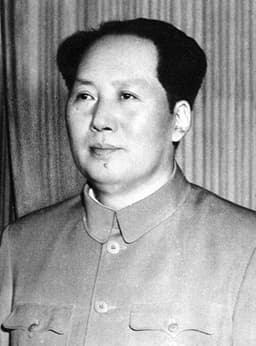
Mao Zedong
Politician · Modern
79.4Total
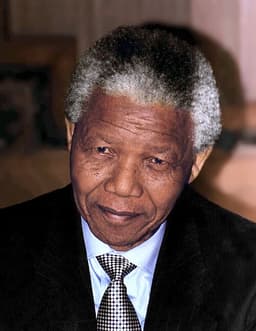
Nelson Mandela
Politician · Modern
57.0Total
Basic Information
Born
1893
1918
Died
1976
2013
Era
Modern
Modern
Nationality
China
South Africa
Occupation
Politician
Politician
Civilization
Eastern
Other
Score Comparison
Military (10%)
75.0
10.0
Political (20%)
88.0
78.0
Influence (20%)
85.0
40.0
Legacy (20%)
70.0
68.0
Leadership (15%)
85.0
82.0
Strategy (15%)
72.0
50.0
TOTAL
79.4
57.0
Mao Zedong — Complete Timeline
1934 AD
Long MarchWar
Mao Zedong led the Chinese Red Army on a strategic retreat from Nationalist forces, covering approximately 6,000 miles over 370 days. The march solidified Mao's leadership within the Chinese Communist Party and became a foundational myth of the Communist revolution.
Chinese Civil WarCommunist RevolutionRetreat
Impact: national
1949 AD
Proclamation of the People's Republic of ChinaPolitical Action
Mao Zedong declared the founding of the People's Republic of China from Tiananmen Gate in Beijing. This ended the Chinese Civil War and established Communist rule over mainland China, with Mao as Chairman of the Central People's Government.
Founding of PRCCommunist VictoryRevolution
Impact: global
1958 AD
Great Leap ForwardReform◆ Major
Mao launched a campaign to rapidly industrialize China and collectivize agriculture. The policy led to widespread mismanagement, resulting in a famine that caused an estimated 15-45 million deaths between 1959 and 1961.
FamineIndustrializationCollectivization
Impact: nationaldestructive
1960 AD
Sino-Soviet SplitPolitical Action◆ Major
Mao's ideological differences with Soviet leader Nikita Khrushchev led to a breakdown in relations between China and the Soviet Union. The split ended the Sino-Soviet alliance and reshaped global Cold War dynamics, with China pursuing an independent path.
Cold WarIdeological ConflictAlliance Breakdown
Impact: global
1966 AD
Cultural RevolutionPolitical Action
Mao initiated a sociopolitical movement to purge capitalist and traditional elements from Chinese society. The Red Guard youth groups attacked intellectuals and officials, leading to widespread violence, destruction of cultural artifacts, and an estimated 1-2 million deaths.
Political PurgeSocial UpheavalRed Guard
Impact: nationaldestructive
1971 AD
Ping-Pong DiplomacyCultural◆ Major
Mao approved an invitation for the U.S. table tennis team to visit China, initiating a thaw in Sino-American relations. This cultural exchange paved the way for President Nixon's visit to China in 1972 and the eventual normalization of diplomatic ties.
DiplomacyU.S.-China RelationsCultural Exchange
Impact: globalconstructive
Nelson Mandela — Complete Timeline
1964 AD
Rivonia TrialPolitical Action
Nelson Mandela and other anti-apartheid leaders were tried for sabotage and conspiracy. Mandela was sentenced to life imprisonment, delivering a speech from the dock that became a rallying cry against apartheid. The trial drew international attention to the anti-apartheid struggle.
Impact: global
1990 AD
Release from PrisonPolitical Action
After 27 years of imprisonment, Mandela was released from Victor Verster Prison by President F.W. de Klerk. His release was a pivotal moment in South Africa's transition from apartheid to multiracial democracy, leading to negotiations for a new constitution.
Impact: globalprogressive
1993 AD
Awarding of the Nobel Peace PrizeCultural◆ Major
Mandela and F.W. de Klerk were jointly awarded the Nobel Peace Prize for their roles in ending apartheid and laying the foundations for a democratic South Africa. The award recognized their peaceful transition and commitment to reconciliation.
Impact: globalprogressive
1994 AD
Inauguration as President of South AfricaPolitical Action
Mandela was inaugurated as South Africa's first Black president after the country's first fully democratic elections. His presidency focused on national reconciliation, establishing the Truth and Reconciliation Commission, and dismantling the legacy of apartheid.
Impact: globalprogressive
Expert Analysis
Mao Zedong vs Nelson Mandela
# The Prisoner and the Emperor
On February 11, 1990, a frail but dignified Nelson Mandela walked out of Victor Verster Prison, his hand clasped in that of his wife Winnie, his fist raised in quiet triumph. Half a world away and four decades earlier, on October 1, 1949, Mao Zedong stood atop Tiananmen Gate in Beijing, proclaiming to a sea of red flags that the Chinese people had stood up. One man emerged from captivity to lead a nation toward reconciliation; the other seized power to remake a civilization through revolution. What separates these two titans of the twentieth century is not merely geography or ideology, but the profound difference between a leader who endured suffering and one who inflicted it.
Origins
Nelson Mandela was born in 1918 into the Thembu royal family in the rural Eastern Cape of South Africa. His father was a chief, but Mandela's early education at Methodist mission schools exposed him to both Western learning and the bitter realities of racial subjugation. He would later describe his youth as one of "tribal tradition and colonial education"—a duality that shaped his lifelong quest to reconcile opposites.
Mao Zedong, born in 1893 in Shaoshan, Hunan, came from a prosperous peasant family. His father, a strict disciplinarian, drove young Mao to rebellion at home. By his own account, Mao devoured Chinese historical novels about bandits and rebels—stories of the outlaw heroes who defied the emperor. Where Mandela's world was shaped by the British Empire's color line, Mao's was forged in the crumbling of the Qing dynasty, foreign humiliation, and the search for a new Chinese identity.
Rise to Power
Mandela's path was that of a lawyer turned revolutionary. In 1944, he joined the African National Congress and helped found its Youth League, advocating for mass action against apartheid. The turning point came in 1964 at the Rivonia Trial, where Mandela and his co-accused faced the death penalty for sabotage and conspiracy. Standing in the dock, he declared: "I have cherished the ideal of a democratic and free society... It is an ideal which I hope to live for and to achieve. But if needs be, it is an ideal for which I am prepared to die." He was sentenced to life imprisonment.
Mao's rise was forged in war. In 1934, he led the Chinese Red Army on the Long March—a 6,000-mile strategic retreat through some of China's most hostile terrain. It was a journey of survival that transformed Mao from a party theoretician into a military legend. By the time the Communists defeated the Nationalists in 1949, Mao had become the undisputed helmsman of a new China. His ascent was not through courtroom eloquence but through guerrilla warfare, political purges, and the iron discipline of a revolutionary army.
Leadership & Governance
Mandela's presidency (1994–1999) was a masterclass in political reconciliation. He understood that South Africa's fragile democracy could not survive on vengeance. He invited his former jailers to his inauguration, wore the jersey of the predominantly white Springbok rugby team, and created the Truth and Reconciliation Commission. His military score of 10 reflects that he never commanded armies in war; his true genius was political—a strategy of forgiveness that disarmed enemies more effectively than any weapon.
Mao's rule was the opposite. His political score of 82 and military score of 65 reflect a leader who saw struggle as the engine of history. The Great Leap Forward (1958–1961) was intended to industrialize China overnight, but mismanagement and forced collectivization led to one of the deadliest famines in human history. The Cultural Revolution (1966–1976) was a sociopolitical movement to purge "bourgeois" elements—it unleashed chaos, destroyed cultural treasures, and sent millions to labor camps. Yet Mao also unified China, ended foreign domination, and, through Ping-Pong Diplomacy in 1971, reopened the door to the United States.
Triumph & Tragedy
Mandela's greatest triumph was the 1994 election that made him South Africa's first Black president—a peaceful transfer of power that defied predictions of civil war. His tragedy was personal: 27 years in prison, a broken marriage, and the knowledge that he had missed his children's childhoods. Yet he emerged without bitterness, a feat that still astonishes.
Mao's triumph was the liberation of China from a century of foreign exploitation and civil war. In 1949, he gave the Chinese people a sense of national pride they had not known for generations. His tragedy was that his utopian vision became a nightmare. The Great Leap Forward killed an estimated 20 to 45 million people; the Cultural Revolution destroyed lives and families on a scale that defies comprehension. Unlike Mandela, who saw his enemies as fellow humans, Mao saw opponents as class enemies to be crushed.
Character & Destiny
Mandela's character was shaped by endurance. Prison taught him patience, self-control, and the art of negotiation. He once said, "A good leader can engage in a debate frankly and thoroughly, knowing that at the end he and the other side must be closer, and thus emerge stronger." His destiny was to be a bridge between races, a symbol of moral authority.
Mao's character was shaped by defiance. He believed that "power grows out of the barrel of a gun" and that revolution required constant upheaval. His destiny was to be a destroyer and creator—a man who shattered the old China and built a new one, but at a cost that continues to be debated. Where Mandela sought consensus, Mao demanded conformity.
Legacy
Mandela's legacy is measured in scores of 80 for political influence and 78 for legacy—but numbers cannot capture the moral clarity he represents. He is remembered as a global icon of forgiveness, a man who proved that liberation need not be violent. His Nobel Peace Prize (1993) was shared with F.W. de Klerk, the man who released him—a gesture of shared credit that defined his leadership.
Mao's legacy is more contested. His total score of 76.4 is higher than Mandela's 67.3, reflecting his immense impact on world history. In China, he is still revered as the founding father; outside, he is judged for the human cost of his policies. The Cultural Revolution remains a wound in China's collective memory, while the Great Leap Forward stands as a cautionary tale of ideological hubris.
Conclusion
Standing at the end of their lives, these two men offer radically different answers to the same question: What does it mean to lead? Mandela, the prisoner who became president, showed that power can be wielded with humility. Mao, the peasant who became emperor, showed that power can be absolute. One chose reconciliation; the other chose revolution. One died in 2013 mourned by the world; the other died in 1976, leaving a nation that still struggles to reckon with his legacy. Perhaps the deepest difference is this: Mandela used his suffering to heal others; Mao used others' suffering to build his vision. In that contrast lies a lesson for all who seek to change the world.
Rankings
🥇
Mao ZedongLeader
Mil: 75.0Pol: 88.0Inf: 85.0
79.4
🥈
Nelson Mandela
Mil: 10.0Pol: 78.0Inf: 40.0
57.0
+22.4 behind
How This Comparison Works
Algorithm
Each figure is scored on 6 dimensions (0—100 scale) based on structured historical data: Military (10%), Political (20%), Influence (20%), Legacy (20%), Leadership (15%), Strategy (15%). The weighted total produces the final ranking.
Data Sources
Scores are computed from structured sub-indicators in the database. Scale factors adjust for era (Ancient ×0.85, Modern ×1.0) and civilization size (Eastern ×1.05, Other ×0.80) to account for differences in population and military scale.
Maximum 3 Figures
Comparisons are limited to 2—3 figures to ensure readability and statistical meaningfulness.
Error Margins
±5 points per dimension — Sub-scores are derived from historical records with inherent uncertainty. Two figures within 5 points on a dimension should be considered roughly equivalent in that area.
Total Score Accuracy
±3 points overall — The weighted combination of 6 dimensions produces a total score with approximately ±3 points of uncertainty. Differences of less than 3 points are not statistically significant— the figures are effectively tied.
Known Limitations
- Historical records are incomplete and uneven across civilizations
- Figures from oral-tradition societies may be underrepresented
- Occupation labels can misclassify multi-role figures
- Scores measure capability and impact, not moral character
- Quantitative scoring is a comparison tool, not absolute truth
Capability Radar
Military (10%) — Battles & Warfare
Battles
85
0
Win Rate
80
7
Expansion
85
9
Political (20%) — Governance & Reform
Reform
95
95
Diplomacy
80
95
Economy
70
60
Influence (20%) — Cultural & Global Reach
Cultural
90
85
Global
90
90
Legacy (20%) — Historical Impact
Historical
95
90
Longevity
85
80
Leadership (15%) — Power & Stability
Tenure
95
60
Stability
60
80
Strategy (15%) — Tactics & Innovation
Strategy
85
8
Tactics
75
12
Reform
90
17
Similar Comparisons
Comments & Discussion
MaoFist6/16/2026
Mandela walked free with dignity; Mao marched in with iron. The difference? Mandela spent 27 years in prison and became a global icon of forgiveness. Mao spent 27 years in power and left 40 million dead from famine alone. Let's not romanticize the peasant revolutionary—he inherited a broken China and broke it further with Great Leaps into mass graves. That's not leadership; that's tyranny with a little red book.
数据侦探6/16/2026
说两人都是"民族解放者"?那怎么解释1958年大跃进后的3500万死亡?曼德拉的真相与和解委员会公开了种族隔离的罪行,但毛泽东时代饥荒的死亡档案至今部分封存。比较道德高度前,先问谁允许历史被清算。一个拥抱透明,一个坚信"舆论一律"——这差距比地理大多了。
Classics Wreck6/16/2026
Calling both "revolutionaries" is like comparing Socrates to a Sophist. Mandela emerged from Robben Island quoting an Africana poem—"I am the master of my fate"—while Mao turned to Qin Shi Huang's Legalism: control through fear. One channeled moral philosophy into nation-building; the other weaponized dialectics to purge intellectuals. Not all change is equal. Mandela healed; Mao homogenized. That's not nuance; that's evidence.
旧书虫6/16/2026
曼德拉走出监狱时,带的是和解的橄榄枝;毛泽东在天安门城楼上,举的是继续革命的钢枪。两人都写过信,曼德拉从牢里写求助信给全世界,毛泽东在延安窑洞里写信动员整风。但前者把自己的囚号写进宪法的承诺里,后者把对手的名字写进肃反名单里。同样用文字,命运不同。
Reality Checker6/16/2026
Here's the cold hard fact: Mandela governed a democratic South Africa for one term; Mao ruled China for 27 years. Under Mandela, GDP grew 3-4% annually and the Truth Commission worked. Under Mao, China's economy shrunk during the Great Leap Forward (1958-62) and millions starved. Size matters, yes—but so does accountability. Mandela resigned voluntarily in 1999; Mao died in power. One trusted the people; the other feared them.