Loading...
This comparison has not been analyzed yet.
One-time AI generation (~1 minute). Scores and timeline are already available below.
Manuel Zelaya vs Tuilaepa Sailele Malielegaoi
Tuilaepa Sailele Malielegaoi leads by 4.9 pts · 2 figures compared
…
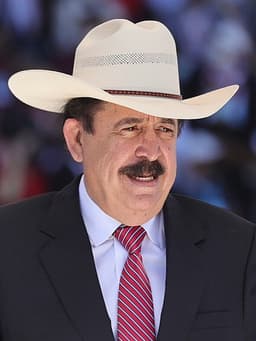
Manuel Zelaya
Politician · Modern
45.5Total

Tuilaepa Sailele Malielegaoi
Politician · Modern
50.4Total
Basic Information
Born
1952
1945
Died
—
—
Era
Modern
Modern
Nationality
Honduras
Samoa
Occupation
Politician
Politician
Civilization
Western
Other
Score Comparison
Military (10%)
50.0
16.3
Political (20%)
43.7
45.0
Influence (20%)
50.2
55.7
Legacy (20%)
40.0
49.2
Leadership (15%)
48.4
80.0
Strategy (15%)
41.7
38.1
TOTAL
45.5
50.4
Manuel Zelaya — Complete Timeline
2005 AD
Election as President of HondurasPolitical Action◆ Major
Zelaya was elected president as the candidate of the Liberal Party, defeating Porfirio Pepe Lobo. His campaign focused on poverty reduction and social programs, and he initially governed as a centrist before shifting leftward.
ElectionLiberal PartyPresidency
Impact: nationalconstructive
2008 AD
Ally with ALBA and Hugo ChávezPolitical Action◆ Major
Zelaya aligned Honduras with the Bolivarian Alliance for the Peoples of Our America (ALBA), led by Venezuela's Hugo Ch
ALBAChávezLeftist ShiftPetrocaribe
Impact: regional
2009 AD
2009 Honduran coup d'étatPolitical Action
Zelaya was ousted in a military coup and forced into exile in Costa Rica. The coup occurred after he pushed for a non-binding referendum on constitutional reform, which was deemed illegal by the Supreme Court. The OAS and UN condemned the coup.
CoupConstitutional CrisisExileOAS
Impact: regionaldestructive
Tuilaepa Sailele Malielegaoi — Complete Timeline
1998 AD
Became Prime Minister of SamoaPolitical Action◆ Major
Malielegaoi succeeded Tofilau Eti Alesana as Prime Minister, becoming the leader of the HRPP. He would go on to serve for 22 years, the longest continuous tenure of any Pacific leader.
Prime MinisterHRPPGovernment Formation
Impact: nationalconstructive
2008 AD
Introduced the Land Titles Registration ActReform◆ Major
Malielegaoi's government passed legislation to register customary land titles, aiming to formalize land ownership and facilitate economic development. The act faced opposition from traditional leaders who saw it as undermining customary systems.
Land ReformCustomary LandLegislation
Impact: national
2009 AD
Switched Samoa from right-hand to left-hand drivingReform◆ Major
Malielegaoi's government implemented a change from driving on the right to driving on the left, aligning Samoa with Australia and New Zealand. The switch aimed to reduce import costs for vehicles and improve road safety.
Traffic ReformInfrastructurePolicy Change
Impact: national
2021 AD
Lost re-election after 22 yearsPolitical Action◆ Major
Malielegaoi's HRPP lost the general election to the FAST party led by Naomi Mataafa. He initially refused to concede, leading to a constitutional crisis that was resolved by the Court of Appeal, ending his long tenure.
Election DefeatConstitutional CrisisPolitical Transition
Impact: national
This comparison has not been analyzed yet.
One-time AI generation (~1 minute). Scores and timeline are already available below.
Rankings
🥇
Tuilaepa Sailele MalielegaoiLeader
Mil: 16.3Pol: 45.0Inf: 55.7
50.4
🥈
Manuel Zelaya
Mil: 50.0Pol: 43.7Inf: 50.2
45.5
+4.9 behind
How This Comparison Works
Algorithm
Each figure is scored on 6 dimensions (0—100 scale) based on structured historical data: Military (10%), Political (20%), Influence (20%), Legacy (20%), Leadership (15%), Strategy (15%). The weighted total produces the final ranking.
Data Sources
Scores are computed from structured sub-indicators in the database. Scale factors adjust for era (Ancient ×0.85, Modern ×1.0) and civilization size (Eastern ×1.05, Other ×0.80) to account for differences in population and military scale.
Maximum 3 Figures
Comparisons are limited to 2—3 figures to ensure readability and statistical meaningfulness.
Error Margins
±5 points per dimension — Sub-scores are derived from historical records with inherent uncertainty. Two figures within 5 points on a dimension should be considered roughly equivalent in that area.
Total Score Accuracy
±3 points overall — The weighted combination of 6 dimensions produces a total score with approximately ±3 points of uncertainty. Differences of less than 3 points are not statistically significant— the figures are effectively tied.
Known Limitations
- Historical records are incomplete and uneven across civilizations
- Figures from oral-tradition societies may be underrepresented
- Occupation labels can misclassify multi-role figures
- Scores measure capability and impact, not moral character
- Quantitative scoring is a comparison tool, not absolute truth
Capability Radar
Military (10%) — Battles & Warfare
Battles
28
19
Win Rate
31
24
Expansion
36
25
Political (20%) — Governance & Reform
Reform
40
60
Diplomacy
35
65
Economy
30
55
Influence (20%) — Cultural & Global Reach
Cultural
20
40
Global
20
35
Legacy (20%) — Historical Impact
Historical
25
50
Longevity
15
45
Leadership (15%) — Power & Stability
Tenure
30
85
Stability
10
70
Strategy (15%) — Tactics & Innovation
Strategy
36
32
Tactics
40
35
Reform
44
38
Similar Comparisons
Comments & Discussion
No comments yet. Be the first to share your thoughts!