Loading...
This comparison has not been analyzed yet.
One-time AI generation (~1 minute). Scores and timeline are already available below.
Manik Sarkar vs Vjekoslav Bevanda
Manik Sarkar leads by 7.6 pts · 2 figures compared
…
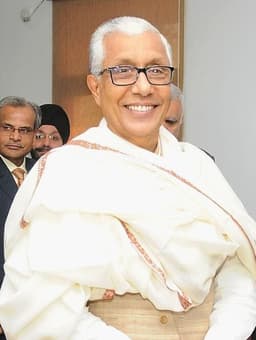
Manik Sarkar
Politician · Modern
50.7Total

Vjekoslav Bevanda
Politician · Modern
43.1Total
Basic Information
Born
1949
1956
Died
—
—
Era
Modern
Modern
Nationality
India
Bosnia
Occupation
Politician
Politician
Civilization
Indian
Western
Score Comparison
Military (10%)
37.6
48.8
Political (20%)
46.6
33.6
Influence (20%)
47.9
45.5
Legacy (20%)
40.0
36.7
Leadership (15%)
79.8
55.3
Strategy (15%)
60.0
43.1
TOTAL
50.7
43.1
Manik Sarkar — Complete Timeline
1998 AD
Became Chief Minister of TripuraPolitical Action
Manik Sarkar became Chief Minister of Tripura for the first time, leading a Left Front government. He would go on to serve four consecutive terms, making him one of India's longest-serving chief ministers.
Chief MinisterTripuraLeft Front
Impact: regionalconstructive
Known for frugal lifestyleOther
Throughout his tenure, Sarkar was noted for his simple and frugal lifestyle, living in a modest government quarter and driving an old car. This earned him a reputation as an honest and accessible leader.
LifestyleHonestyTripura
Impact: regionalconstructive
2013 AD
Won 2013 Tripura Assembly electionPolitical Action◆ Major
Sarkar led the CPI(M)-led Left Front to victory in the Tripura assembly election, winning 49 of 60 seats. This was his fourth consecutive term as chief minister.
ElectionTripuraLeft Front
Impact: regionalconstructive
2018 AD
Lost 2018 Tripura Assembly electionPolitical Action
Sarkar's Left Front government was defeated by the BJP-IPFT alliance, winning only 16 seats. This ended his 20-year tenure as chief minister, marking a major political shift in the state.
ElectionTripuraDefeat
Impact: regionaltragic
Vjekoslav Bevanda — Complete Timeline
2012 AD
Appointed Prime Minister of Bosnia and HerzegovinaPolitical Action◆ Major
Bevanda was appointed as the Chairman of the Council of Ministers (Prime Minister) of Bosnia and Herzegovina, leading a coalition government. His tenure focused on economic reforms and fulfilling conditions for EU candidate status.
AppointmentPrime MinisterGovernment
Impact: national
2015 AD
Appointed Minister of Finance and TreasuryPolitical Action
Bevanda was appointed as the Minister of Finance and Treasury of Bosnia and Herzegovina in the government of Denis Zvizdic. He managed the state budget and fiscal policy, overseeing international financial agreements and debt management.
AppointmentFinance MinisterGovernment
Impact: national
2019 AD
Re-appointed Minister of Finance and TreasuryPolitical Action
Bevanda was re-appointed as Minister of Finance and Treasury in the government of Zoran Tegeltija. He continued to manage state finances during a period of political deadlock and economic challenges, including the COVID-19 pandemic.
Re-appointmentFinance MinisterCOVID-19
Impact: national
This comparison has not been analyzed yet.
One-time AI generation (~1 minute). Scores and timeline are already available below.
Rankings
🥇
Manik SarkarLeader
Mil: 37.6Pol: 46.6Inf: 47.9
50.7
🥈
Vjekoslav Bevanda
Mil: 48.8Pol: 33.6Inf: 45.5
43.1
+7.6 behind
How This Comparison Works
Algorithm
Each figure is scored on 6 dimensions (0—100 scale) based on structured historical data: Military (10%), Political (20%), Influence (20%), Legacy (20%), Leadership (15%), Strategy (15%). The weighted total produces the final ranking.
Data Sources
Scores are computed from structured sub-indicators in the database. Scale factors adjust for era (Ancient ×0.85, Modern ×1.0) and civilization size (Eastern ×1.05, Other ×0.80) to account for differences in population and military scale.
Maximum 3 Figures
Comparisons are limited to 2—3 figures to ensure readability and statistical meaningfulness.
Error Margins
±5 points per dimension — Sub-scores are derived from historical records with inherent uncertainty. Two figures within 5 points on a dimension should be considered roughly equivalent in that area.
Total Score Accuracy
±3 points overall — The weighted combination of 6 dimensions produces a total score with approximately ±3 points of uncertainty. Differences of less than 3 points are not statistically significant— the figures are effectively tied.
Known Limitations
- Historical records are incomplete and uneven across civilizations
- Figures from oral-tradition societies may be underrepresented
- Occupation labels can misclassify multi-role figures
- Scores measure capability and impact, not moral character
- Quantitative scoring is a comparison tool, not absolute truth
Capability Radar
Military (10%) — Battles & Warfare
Battles
46
31
Win Rate
47
31
Expansion
48
35
Political (20%) — Governance & Reform
Reform
40
20
Diplomacy
45
25
Economy
30
25
Influence (20%) — Cultural & Global Reach
Cultural
15
5
Global
10
5
Legacy (20%) — Historical Impact
Historical
20
10
Longevity
20
10
Leadership (15%) — Power & Stability
Tenure
70
30
Stability
60
20
Strategy (15%) — Tactics & Innovation
Strategy
51
39
Tactics
56
39
Reform
58
46
Similar Comparisons
Comments & Discussion
No comments yet. Be the first to share your thoughts!