Loading...
Ludwig Erhard vs Shehu Shagari
Ludwig Erhard leads by 18.8 pts · 2 figures compared
…
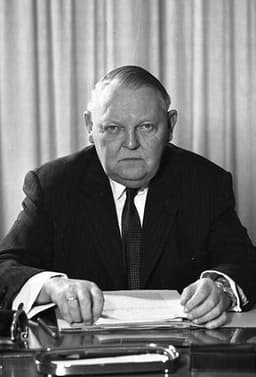
Ludwig Erhard
Politician · Modern
70.9Total

Shehu Shagari
Politician · Modern
52.1Total
Basic Information
Born
1897
1925
Died
1977
—
Era
Modern
Modern
Nationality
Germany
Nigeria
Occupation
Politician
Politician
Civilization
Western
Other
Score Comparison
Military (10%)
47.5
44.2
Political (20%)
75.0
68.0
Influence (20%)
88.0
52.5
Legacy (20%)
68.0
41.7
Leadership (15%)
78.0
65.0
Strategy (15%)
42.4
41.9
TOTAL
70.9
52.1
Ludwig Erhard — Complete Timeline
1948 AD
Currency Reform and Abolition of Price ControlsReform
Erhard oversaw the introduction of the Deutsche Mark and simultaneously abolished most price controls and rationing. This bold move, against Allied advice, triggered the 'economic miracle' by stimulating production and ending the black market.
Currency ReformEconomic MiracleFree Market
Impact: nationalconstructive
Appointment as Director of the Economic Policy DepartmentPolitical Action◆ Major
Ludwig Erhard was appointed Director of the Economic Policy Department in the Bizone, effectively becoming the chief architect of West Germany's economic policy. This position allowed him to implement his free-market ideas.
Economic PolicyWest GermanyPost-War
Impact: nationalconstructive
1963 AD
Election as Chancellor of West GermanyPolitical Action◆ Major
Erhard succeeded Konrad Adenauer as Chancellor of West Germany. His chancellorship continued the economic policies of the 'social market economy' but faced challenges from a slowing economy and coalition tensions.
ChancellorWest GermanyCDU
Impact: nationalconstructive
1966 AD
Resignation as ChancellorPolitical Action◆ Major
Erhard resigned as Chancellor after the Free Democratic Party (FDP) left his coalition government over budget disputes. His resignation marked the end of his political career and led to the formation of the Grand Coalition under Kiesinger.
ResignationCoalition CollapsePolitical End
Impact: national
Shehu Shagari — Complete Timeline
1979 AD
Elected first Executive President of NigeriaPolitical Action
Shehu Shagari won the 1979 presidential election under the National Party of Nigeria, becoming the first executive president of Nigeria's Second Republic. His victory marked the end of 13 years of military rule and a return to civilian democracy.
ElectionSecond RepublicDemocracy
Impact: nationalconstructive
1983 AD
Re-elected in 1983 amid allegations of fraudPolitical Action◆ Major
Shagari won re-election in August 1983, but the election was marred by widespread allegations of rigging and violence. The opposition rejected the results, leading to political instability and a breakdown of public trust.
ElectionFraudControversy
Impact: nationaldestructive
Overthrown in 1983 military coupPolitical Action◆ Major
Shagari was overthrown in a military coup led by General Muhammadu Buhari on December 31, 1983. The coup was justified by allegations of corruption and economic mismanagement, ending the Second Republic and returning Nigeria to military rule.
CoupOverthrowBuhari
Impact: nationaldestructive
Expert Analysis
Origins
Ludwig Erhard was born on February 4, 1897, in Fürth, Bavaria, into a Protestant family. His father was a textile merchant. Erhard studied economics at the University of Frankfurt, earning a doctorate in 1925 under the guidance of Franz Oppenheimer, a proponent of market-oriented reforms. He worked as a market researcher and later as an economic advisor during the Nazi era, maintaining a distance from the regime.
Shehu Shagari was born on February 25, 1925, in Shagari village, Sokoto Province, Northern Nigeria, into a Fulani Muslim family. He trained as a teacher and later studied at the University of London. He entered politics in the 1950s, serving as a federal minister after Nigeria's independence in 1960.
Rise to Power
Erhard's rise began after World War II when he was appointed Director of the Economic Policy Department of the Bizone in 1948. He played a central role in the currency reform that introduced the Deutsche Mark on June 20, 1948, simultaneously abolishing most price controls and rationing. This bold move, against Allied advice, kickstarted the German economic miracle. He became Minister of Economics under Chancellor Adenauer in 1949 and succeeded him as Chancellor in 1963.
Shagari rose through Nigerian politics, serving as Minister of Finance and later as a member of the Constituent Assembly. In 1979, he won the presidential election under the National Party of Nigeria, becoming the first executive president of Nigeria's Second Republic, with a political score of 68.0.
Leadership & Governance
Erhard championed the 'social market economy,' combining free-market capitalism with social welfare. His leadership style was technocratic and focused on economic stability. He resisted cartels and promoted competition, leading to sustained growth. However, as Chancellor, he struggled with coalition politics and failed to manage the 1965 recession effectively.
Shagari governed a fragile democracy amid ethnic and religious tensions. He implemented a policy of 'indigenization' to increase Nigerian control over the economy. His administration faced challenges of corruption and declining oil revenues. Shagari's leadership score of 65.0 reflects his consensus-building but also his inability to curb systemic graft.
Triumph & Tragedy
Erhard's greatest triumph was the German economic miracle, with GDP growth averaging 8% annually in the 1950s. His currency reform is a landmark in economic history. His tragedy was his chancellorship: he resigned in 1966 after a budget crisis and loss of coalition support, scoring 47.5 in military but 78.0 in leadership.
Shagari's triumph was overseeing Nigeria's transition to civilian rule and his election as president. His tragedy was the 1983 military coup that ended his tenure, justified by allegations of election fraud and corruption. His legacy score of 41.7 reflects the collapse of the Second Republic.
Character & Destiny
Erhard was a pragmatic economist, decisive in policy but less adept at political maneuvering. His character shaped his fate: his economic vision succeeded, but his political skills failed him. Historians note his honesty but also his aloofness.
Shagari was a cautious, consensus-driven leader. His reluctance to confront corruption and electoral malpractice led to his downfall. His destiny was tied to Nigeria's turbulent political landscape, where military interventions were common.
Legacy
Erhard's legacy is profound: the social market economy remains the foundation of modern Germany. His influence score of 88.0 reflects how his policies shaped post-war Europe. The German economic model inspired other nations.
Shagari's legacy is mixed. He is remembered as a symbol of Nigeria's Second Republic, but his tenure is often associated with political instability. His influence score of 52.5 indicates limited long-term impact, as the country soon returned to military rule.
Conclusion
Ludwig Erhard had a greater impact than Shehu Shagari. Erhard's economic reforms transformed Germany from rubble to an industrial powerhouse, with lasting global influence. Shagari's presidency, while historically significant for Nigeria, ended in failure and did not establish durable institutions. The score gap of 18.8 points underscores Erhard's superior performance in leadership, influence, and legacy. Erhard's vision created a model that endured, while Shagari's tenure was a brief interlude in Nigeria's authoritarian cycle.
Rankings
🥇
Ludwig ErhardLeader
Mil: 47.5Pol: 75.0Inf: 88.0
70.9
🥈
Shehu Shagari
Mil: 44.2Pol: 68.0Inf: 52.5
52.1
+18.8 behind
How This Comparison Works
Algorithm
Each figure is scored on 6 dimensions (0—100 scale) based on structured historical data: Military (10%), Political (20%), Influence (20%), Legacy (20%), Leadership (15%), Strategy (15%). The weighted total produces the final ranking.
Data Sources
Scores are computed from structured sub-indicators in the database. Scale factors adjust for era (Ancient ×0.85, Modern ×1.0) and civilization size (Eastern ×1.05, Other ×0.80) to account for differences in population and military scale.
Maximum 3 Figures
Comparisons are limited to 2—3 figures to ensure readability and statistical meaningfulness.
Error Margins
±5 points per dimension — Sub-scores are derived from historical records with inherent uncertainty. Two figures within 5 points on a dimension should be considered roughly equivalent in that area.
Total Score Accuracy
±3 points overall — The weighted combination of 6 dimensions produces a total score with approximately ±3 points of uncertainty. Differences of less than 3 points are not statistically significant— the figures are effectively tied.
Known Limitations
- Historical records are incomplete and uneven across civilizations
- Figures from oral-tradition societies may be underrepresented
- Occupation labels can misclassify multi-role figures
- Scores measure capability and impact, not moral character
- Quantitative scoring is a comparison tool, not absolute truth
Capability Radar
Military (10%) — Battles & Warfare
Battles
28
23
Win Rate
35
27
Expansion
37
25
Political (20%) — Governance & Reform
Reform
85
35
Diplomacy
75
45
Economy
95
30
Influence (20%) — Cultural & Global Reach
Cultural
60
25
Global
75
20
Legacy (20%) — Historical Impact
Historical
80
30
Longevity
70
20
Leadership (15%) — Power & Stability
Tenure
65
40
Stability
80
20
Strategy (15%) — Tactics & Innovation
Strategy
35
32
Tactics
41
35
Reform
46
36
Similar Comparisons
Comments & Discussion
No comments yet. Be the first to share your thoughts!