Loading...
Lu Xun vs Qin Shi Huang
Qin Shi Huang leads by 25.2 pts · 2 figures compared
…

Lu Xun
General · Ancient
60.0Total
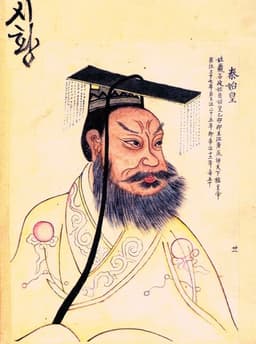
Qin Shi Huang
Emperor · Ancient
85.2Total
Basic Information
Born
183
-259
Died
245
-210
Era
Ancient
Ancient
Nationality
China
China
Occupation
General
Emperor
Civilization
Eastern
Eastern
Score Comparison
Military (10%)
65.0
80.0
Political (20%)
57.3
90.0
Influence (20%)
55.0
85.0
Legacy (20%)
52.0
90.0
Leadership (15%)
73.2
78.0
Strategy (15%)
72.0
82.0
TOTAL
60.0
85.2
Lu Xun — Complete Timeline
222 AD
Battle of YilingWar
Lu Xun, as commander of Eastern Wu forces, defeated Liu Bei's Shu Han army at Yiling. He used a scorched earth strategy and fire attack, destroying Shu's invasion force. This victory secured Wu's western border.
BattleEastern WuShu HanThree Kingdoms
Impact: regionalconstructive
228 AD
Battle of ShitingWar
Lu Xun defeated a Cao Wei invasion at Shiting, using a feigned retreat to ambush the Wei forces. This victory repelled the Wei attack and maintained Wu's territorial integrity.
BattleEastern WuCao WeiThree Kingdoms
Impact: regionalconstructive
244 AD
Appointment as Chancellor of Eastern WuPolitical Action◆ Major
Sun Quan appointed Lu Xun as Chancellor of Eastern Wu, the highest civil office. Lu Xun served as chancellor until his death, helping to administer the state and maintain stability.
AppointmentEastern WuGovernment
Impact: nationalconstructive
245 AD
Death and LegacyOther
Lu Xun died in 245 AD. His victory at Yiling was a defining moment of the Three Kingdoms period. He was remembered as a brilliant strategist and loyal minister of Eastern Wu.
DeathEastern WuLegacy
Impact: national
Qin Shi Huang — Complete Timeline
246 BC
Construction of the Mausoleum and Terracotta ArmyOther◆ Major
Qin Shi Huang commissioned a vast mausoleum complex near Xi'an, guarded by thousands of life-sized terracotta soldiers, horses, and chariots. The project employed hundreds of thousands of workers and reflected his obsession with immortality and imperial power.
Impact: global
230 BC
Conquest of the Six Warring StatesWar
From 230 to 221 BCE, Ying Zheng led the Qin state in a series of campaigns that conquered the Han, Zhao, Wei, Chu, Yan, and Qi states. This unified China under a single ruler for the first time, ending the Warring States period.
Impact: global
221 BC
Standardization of Writing, Currency, and MeasurementsReform◆ Major
Qin Shi Huang ordered the standardization of Chinese script, currency, and weights and measures across the unified empire. This facilitated administration, trade, and cultural integration, laying a foundation for future dynasties.
Impact: globalconstructive
Proclamation of the Qin DynastyPolitical Action
After conquering the last independent state, Ying Zheng declared himself Shi Huangdi (First Emperor), founding the Qin Dynasty. He adopted a new title to signify his supreme authority and initiated centralized imperial rule.
Impact: global
214 BC
Initiation of the Great Wall ConstructionOther◆ Major
Qin Shi Huang ordered the connection and extension of existing northern fortifications to create a unified defensive wall against nomadic Xiongnu raids. This project involved massive conscripted labor and became the precursor to the later Great Wall.
Impact: regional
213 BC
Burning of Books and Burying of ScholarsPolitical Action◆ Major
On the advice of Li Si, Qin Shi Huang ordered the burning of historical records and philosophical texts not aligned with Legalist doctrine. He also had 460 Confucian scholars buried alive to suppress dissent and consolidate ideological control.
Impact: nationaldestructive
Expert Analysis
lu-xun-vs-qin-shi-huang
# The First Emperor and the Last General: Two Titans Who Shaped China
On a spring morning in 222 AD, along the banks of the Yangtze River, a general named Lu Xun watched flames consume the camp of Liu Bei, the man who claimed to be the rightful heir of the Han Dynasty. The fire was not accidental—it was Lu Xun's design, a scorched-earth gambit that would end one of the most ambitious invasions in Chinese history. Four centuries earlier, another man had watched flames consume something else: the books of a hundred schools of thought, burned on his orders to forge a single, uniform empire. Qin Shi Huang and Lu Xun never met, never could have met, yet their lives trace the arc of China's transformation from a fractured land of warring states to a civilization defined by unity—and the terrible costs that unity demanded.
Origins
Qin Shi Huang was born Ying Zheng in 259 BC, the son of a king and a concubine, in the western state of Qin. His childhood was shadowed by political intrigue: his father had been a hostage in the neighboring state of Zhao, and young Zheng grew up in a court where betrayal was as common as morning tea. The Warring States period had raged for two centuries, and the Qin state, with its harsh Legalist philosophy, was the most ruthless of them all. Zheng learned early that mercy was weakness, that unity required violence, and that history belonged to those who wrote it.
Lu Xun, born in 183 AD in the coastal region of Wu, came of age in a different world. The Han Dynasty, which had succeeded Qin, was collapsing into chaos. The Yellow Turban Rebellion had shattered imperial authority, and warlords carved up the land. Lu Xun was a scholar's son, well-read in the classics, but he entered service under Sun Quan, the young lord of the southeast, as a military advisor. Where Qin Shi Huang inherited a machine of conquest, Lu Xun inherited a realm under siege—a kingdom that needed not a conqueror but a defender.
Rise to Power
Qin Shi Huang's path was one of relentless expansion. At thirteen, he ascended the throne of Qin. By twenty-two, he had crushed a rebellion led by his own chancellor, Lao Ai, and eliminated his mother's lover. Then, from 230 to 221 BC, he unleashed his armies. Kingdom after kingdom fell: Han, Zhao, Wei, Chu, Yan, Qi. He did not negotiate; he annihilated. When he declared himself Shi Huangdi—the First Emperor—in 221 BC, he was not merely claiming a title. He was declaring that the old world of competing states was dead, and a new world, his world, had begun.
Lu Xun rose differently. He did not conquer; he waited. In 222 AD, Liu Bei, the founder of Shu Han, launched a massive invasion of Wu to avenge the death of his sworn brother Guan Yu. Sun Quan's generals clamored for immediate battle, but Lu Xun, then a relatively junior commander, argued for patience. He withdrew deep into Wu territory, scorching the earth behind him, stretching Liu Bei's supply lines across five hundred miles of mountain and river. For months, he refused to fight. His own officers accused him of cowardice. Then, when Liu Bei's army was exhausted and camped in a forest, Lu Xun struck—with fire. The victory at Yiling was not a conquest but a masterpiece of defensive strategy, a lesson that sometimes the greatest power lies in restraint.
Leadership & Governance
As emperor, Qin Shi Huang governed through terror and standardization. He ordered the burning of all books not related to medicine, agriculture, or Qin history, and buried 460 scholars alive for criticizing his rule. He imposed a single script, a single currency, a single axle length for carts. He connected the northern walls into what would become the Great Wall, conscripting millions of laborers, many of whom died in the construction. His mausoleum, guarded by the Terracotta Army, was a monument not just to his greatness but to his obsession with control—even in death, he would command an army.
Lu Xun governed differently. As Chancellor of Eastern Wu from 244 AD, he was known for moderation and consultation. He advised Sun Quan to reduce taxes, to promote agriculture, to avoid costly wars. He understood that a kingdom built on fear could not endure. Yet he was no weakling: when the Wei general Cao Xiu invaded in 228, Lu Xun lured him into a trap at Shiting, feigning a retreat and then springing an ambush that crushed the invasion. His leadership was a balance of wisdom and steel, a recognition that power must be earned, not imposed.
Triumph & Tragedy
Qin Shi Huang's triumph was the unification of China—a feat so monumental that it became the template for every dynasty that followed. But his tragedy was that he could not hold it together. He died in 210 BC while on a tour of his empire, and within three years, the Qin Dynasty collapsed in rebellion. His harsh laws, his forced labor, his burning of books—all of it created an empire that was brittle, that shattered the moment he was gone.
Lu Xun's triumph was Yiling, a victory that saved Wu from destruction and defined the Three Kingdoms balance of power for decades. His tragedy was subtler: he died in 245 AD, still loyal to Sun Quan, but having witnessed his lord grow paranoid and suspicious. Sun Quan, once his friend, had become a tyrant in his own right, and Lu Xun died with the knowledge that the kingdom he had defended was turning against the very principles he had fought for.
Character & Destiny
Qin Shi Huang believed that history could be commanded. He saw himself as a god, the embodiment of cosmic order, and he acted accordingly: ruthlessly, systematically, without mercy. His personality was his destiny—the same paranoia that drove him to unify China also drove him to crush dissent, and that crushing bred the rebellion that undid him.
Lu Xun believed that history was a river that could be guided but not controlled. He was patient, pragmatic, and deeply aware of human limits. His personality was his protection: he did not seek glory, only survival. And yet, that same caution meant he never reached for more—he defended Wu but could not transform it. He was the perfect general for a failing dynasty, not the founder of a new one.
Legacy
Qin Shi Huang's legacy is the Great Wall, the Terracotta Army, and the idea of China itself. Every emperor who came after him, from the Han to the Qing, ruled in his shadow. He is remembered as both a tyrant and a unifier, a man who burned books but also standardized writing—a contradiction that still defines China's relationship with its past.
Lu Xun's legacy is narrower but no less profound. In Chinese history, he is the archetype of the loyal general, the wise strategist who saves his lord from disaster. His victory at Yiling is studied in military academies to this day. But he is also a cautionary tale: that even the most brilliant defense cannot save a kingdom that has lost its way.
Conclusion
Standing at the edge of the Terracotta Army, looking at those thousands of silent soldiers, one thinks of Qin Shi Huang's dream of eternal control. Standing at the site of Yiling, where the forest has grown back over the ashes of Liu Bei's army, one thinks of Lu Xun's patient fire. One man tried to freeze time; the other learned to bend with it. Both succeeded, and both failed. Their stories remind us that the greatest leaders are not those who impose their will on history, but those who understand that history will have its way with them—and choose, nonetheless, to act.
Rankings
🥇
Qin Shi HuangLeader
Mil: 80.0Pol: 90.0Inf: 85.0
85.2
🥈
Lu Xun
Mil: 65.0Pol: 57.3Inf: 55.0
60.0
+25.2 behind
How This Comparison Works
Algorithm
Each figure is scored on 6 dimensions (0—100 scale) based on structured historical data: Military (10%), Political (20%), Influence (20%), Legacy (20%), Leadership (15%), Strategy (15%). The weighted total produces the final ranking.
Data Sources
Scores are computed from structured sub-indicators in the database. Scale factors adjust for era (Ancient ×0.85, Modern ×1.0) and civilization size (Eastern ×1.05, Other ×0.80) to account for differences in population and military scale.
Maximum 3 Figures
Comparisons are limited to 2—3 figures to ensure readability and statistical meaningfulness.
Error Margins
±5 points per dimension — Sub-scores are derived from historical records with inherent uncertainty. Two figures within 5 points on a dimension should be considered roughly equivalent in that area.
Total Score Accuracy
±3 points overall — The weighted combination of 6 dimensions produces a total score with approximately ±3 points of uncertainty. Differences of less than 3 points are not statistically significant— the figures are effectively tied.
Known Limitations
- Historical records are incomplete and uneven across civilizations
- Figures from oral-tradition societies may be underrepresented
- Occupation labels can misclassify multi-role figures
- Scores measure capability and impact, not moral character
- Quantitative scoring is a comparison tool, not absolute truth
Capability Radar
Military (10%) — Battles & Warfare
Battles
75
85
Win Rate
80
90
Expansion
65
90
Political (20%) — Governance & Reform
Reform
55
95
Diplomacy
72
75
Economy
60
90
Influence (20%) — Cultural & Global Reach
Cultural
70
95
Global
55
85
Legacy (20%) — Historical Impact
Historical
75
95
Longevity
70
95
Leadership (15%) — Power & Stability
Tenure
70
70
Stability
68
65
Strategy (15%) — Tactics & Innovation
Strategy
82
85
Tactics
85
80
Reform
60
95
Similar Comparisons
Comments & Discussion
EternalBookBurner6/17/2026
Qin Shi Huang wasn't "unifying" Chinese thought—he was executing a targeted censorship campaign that would make Stalin blush. The First Emperor burned philosophical texts from rival schools, not records of medicine or agriculture. That's politics. Lu Xun's fire was battlefield tactics, targeting enemy supplies. Qin's fire targeted ideas. One is a military decision, the other is intellectual genocide. Stop romanticizing book burning as nation-building.
烽火书生6/17/2026
说陆逊火烧连营是"点燃了东方帝国的融合之火"?这太荒谬了。陆逊是战略家,不是哲学家。他的火是为了保护东吴,不是为了统一中国。刘备入侵失败,不是中华文明的胜利。这就像说足球赛中的红牌促进了规则统一——无关因果,只是强行解读。请尊重历史细节。
DataCowboy6/17/2026
The comparison ignores scale entirely. Qin's empire ruled roughly 20 million people across 2 million square kilometers. Lu Xun commanded maybe 50,000 troops in a regional battle. The "arc of China's transformation" isn't traced by a naval skirmish in 222 AD. It's traced by standardized weights, measures, and script—actual administrative data. Lu Xun's victory delayed reunification by decades. He's a footnote, not a titan.
洛阳纸贵6/17/2026
把秦始皇和陆逊并列,是低估了秦朝的制度创新。郡县制、同文同轨、灵渠——这些都是文明级的遗产。陆逊最大的贡献是抵御了一次失败的复仇进攻。他打赢了,然后呢?吴国二十年后还是被灭。而秦的制度,影响了中国两千年。不是一个量级,别硬凑。
JadeEmperor'sCritic6/17/2026
我是老派史家,必须指出:秦始皇和陆逊的时代背景天差地别。一个在战国末期的铁血竞争中推行统一,一个在汉末剧变的乱世中保住一方。你拿陆逊的局部战术火攻,去比秦始皇帝的全局战略焚书?这就像拿蜡烛比太阳。陆逊是名将,秦始皇是划时代的天子。放在一起,不公平,也不准确。