Loading...
This comparison has not been analyzed yet.
One-time AI generation (~1 minute). Scores and timeline are already available below.
Louis-Nicolas Davout vs Mulugeta Yeggazu
Louis-Nicolas Davout leads by 20.3 pts · 2 figures compared
…
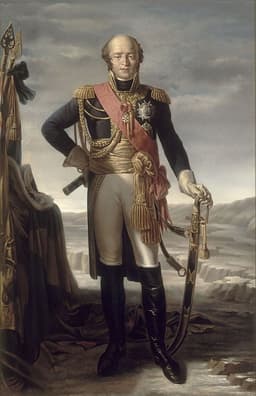
Louis-Nicolas Davout
General · Modern
66.2Total

Mulugeta Yeggazu
General · Modern
45.9Total
Basic Information
Born
1770
1870
Died
1823
1936
Era
Modern
Modern
Nationality
France
Ethiopia
Occupation
General
General
Civilization
Western
Other
Score Comparison
Military (10%)
65.0
25.0
Political (20%)
68.0
35.1
Influence (20%)
55.0
54.9
Legacy (20%)
72.0
43.3
Leadership (15%)
70.0
50.7
Strategy (15%)
72.0
60.0
TOTAL
66.2
45.9
Louis-Nicolas Davout — Complete Timeline
1805 AD
Battle of AusterlitzWar
Davout commanded the III Corps on the right flank, holding off the main Austrian-Russian attack while Napoleon crushed the center. His corps marched 120 km in 48 hours to reach the battlefield. This victory destroyed the Third Coalition and established French dominance in Europe.
Napoleonic WarsBattleDecisive Victory
Impact: global
1806 AD
Battle of AuerstedtWar◆ Major
Davout's single corps of 26,000 men defeated the main Prussian army of 63,000 under the Duke of Brunswick. He used aggressive tactics and superior discipline to rout the Prussians. This victory, on the same day as Napoleon's victory at Jena, led to the collapse of Prussia.
Napoleonic WarsBattlePrussian Campaign
Impact: regional
1807 AD
Governor-General of the Duchy of WarsawPolitical Action
Davout was appointed governor-general of the newly created Duchy of Warsaw. He organized the Polish army and administration, implementing French legal and military reforms. His efficient governance helped secure Polish support for Napoleon's campaigns.
AdministrationPolandReform
Impact: regionalconstructive
1812 AD
Battle of BorodinoWar◆ Major
Davout commanded the I Corps in the center of the French line, leading assaults on the Russian fortifications. He was wounded but continued to command. The battle was a tactical draw but a strategic disaster for Napoleon, as the Russians withdrew and later forced the French retreat.
Napoleonic WarsBattleRussian Campaign
Impact: regional
1813 AD
Defended Hamburg during the War of the Sixth CoalitionWar◆ Major
Davout held Hamburg against a Prussian-Russian siege for over a year, using harsh measures including expelling civilians. He surrendered only after Napoleon's abdication. His defense was militarily competent but criticized for its brutality, tarnishing his reputation.
Napoleonic WarsSiegeControversy
Impact: regionaldestructive
1814 AD
Switched allegiance to Louis XVIII after Napoleon's first abdicationPolitical Action
After Napoleon's abdication, Davout submitted to the Bourbon monarchy and was made a peer of France. He did not join Napoleon during the Hundred Days until ordered to do so by the king. This pragmatic decision allowed him to retain his titles and avoid execution.
Political SurvivalBourbon RestorationAllegiance
Impact: national
Mulugeta Yeggazu — Complete Timeline
1935 AD
Appointment as Commander-in-Chief of the Ethiopian ArmyPolitical Action◆ Major
Mulugeta Yeggazu was appointed Commander-in-Chief of the Ethiopian Imperial Army as the Second Italo-Ethiopian War approached. He was tasked with organizing the defense against the Italian invasion.
AppointmentSecond Italo-Ethiopian WarDefense
Impact: national
1936 AD
Command at the Battle of MaychewWar◆ Major
Mulugeta Yeggazu commanded the Ethiopian northern front at the Battle of Maychew. His forces were defeated by the Italian army under Marshal Pietro Badoglio, which used superior firepower and chemical weapons.
Battle of MaychewItalyDefeat
Impact: regionaltragic
Death during the retreat from MaychewWar◆ Major
After the defeat at Maychew, Mulugeta Yeggazu was killed during the chaotic retreat. His death, along with the loss of many troops, marked a catastrophic collapse of Ethiopian resistance on the northern front.
DeathRetreatSecond Italo-Ethiopian War
Impact: nationaltragic
This comparison has not been analyzed yet.
One-time AI generation (~1 minute). Scores and timeline are already available below.
Rankings
🥇
Louis-Nicolas DavoutLeader
Mil: 65.0Pol: 68.0Inf: 55.0
66.2
🥈
Mulugeta Yeggazu
Mil: 25.0Pol: 35.1Inf: 54.9
45.9
+20.3 behind
How This Comparison Works
Algorithm
Each figure is scored on 6 dimensions (0—100 scale) based on structured historical data: Military (10%), Political (20%), Influence (20%), Legacy (20%), Leadership (15%), Strategy (15%). The weighted total produces the final ranking.
Data Sources
Scores are computed from structured sub-indicators in the database. Scale factors adjust for era (Ancient ×0.85, Modern ×1.0) and civilization size (Eastern ×1.05, Other ×0.80) to account for differences in population and military scale.
Maximum 3 Figures
Comparisons are limited to 2—3 figures to ensure readability and statistical meaningfulness.
Error Margins
±5 points per dimension — Sub-scores are derived from historical records with inherent uncertainty. Two figures within 5 points on a dimension should be considered roughly equivalent in that area.
Total Score Accuracy
±3 points overall — The weighted combination of 6 dimensions produces a total score with approximately ±3 points of uncertainty. Differences of less than 3 points are not statistically significant— the figures are effectively tied.
Known Limitations
- Historical records are incomplete and uneven across civilizations
- Figures from oral-tradition societies may be underrepresented
- Occupation labels can misclassify multi-role figures
- Scores measure capability and impact, not moral character
- Quantitative scoring is a comparison tool, not absolute truth
Capability Radar
Military (10%) — Battles & Warfare
Battles
85
45
Win Rate
95
40
Expansion
80
20
Political (20%) — Governance & Reform
Reform
55
20
Diplomacy
50
25
Economy
45
15
Influence (20%) — Cultural & Global Reach
Cultural
60
25
Global
60
15
Legacy (20%) — Historical Impact
Historical
75
30
Longevity
65
20
Leadership (15%) — Power & Stability
Tenure
60
30
Stability
55
20
Strategy (15%) — Tactics & Innovation
Strategy
88
45
Tactics
92
50
Reform
75
30
Similar Comparisons
Comments & Discussion
No comments yet. Be the first to share your thoughts!