Loading...
Li Xuan vs Yelu Deguang
Yelu Deguang leads by 11.4 pts · 2 figures compared
…
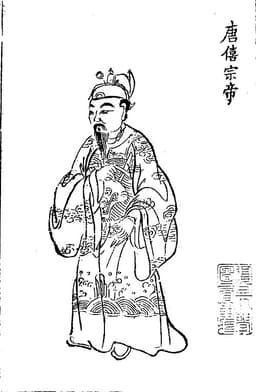
Li Xuan
Emperor · Medieval
40.9Total

Yelu Deguang
Emperor · Medieval
52.3Total
Basic Information
Born
862
902
Died
888
947
Era
Medieval
Medieval
Nationality
China
Khitan Empire
Occupation
Emperor
Emperor
Civilization
Eastern
Eastern
Score Comparison
Military (10%)
50.0
61.7
Political (20%)
35.0
48.0
Influence (20%)
46.3
51.8
Legacy (20%)
37.5
45.0
Leadership (15%)
39.0
65.0
Strategy (15%)
38.6
50.0
TOTAL
40.9
52.3
Li Xuan — Complete Timeline
880 AD
Fled Chang'an to ChengduPolitical Action
When Huang Chao's rebel army approached the Tang capital Chang'an, Li Xuan (Tang Xizong) abandoned the city and fled to Chengdu in Sichuan. This flight left the capital undefended and marked the collapse of central authority during the Huang Chao Rebellion.
FlightHuang Chao RebellionCapital Lost
Impact: nationaltragic
885 AD
Recalled to Chang'an After Huang Chao's DefeatPolitical Action◆ Major
After Huang Chao was defeated by the Shatuo Turk Li Keyong and other warlords, Li Xuan returned to Chang'an. However, the city was in ruins and the Tang court was now dependent on regional military governors, further weakening imperial power.
ReturnWarlord EraTang Decline
Impact: national
Yelu Deguang — Complete Timeline
927 AD
Accession as Second Liao EmperorPolitical Action◆ Major
Yelu Deguang succeeded his father, Abaoji, as the second emperor of the Liao dynasty. His reign marked the continuation of Khitan expansion into northern China and the consolidation of the Liao state.
Liao dynastySuccessionKhitan
Impact: regional
947 AD
Capture of KaifengWar
Yelu Deguang led a Liao army south and captured Kaifeng, the capital of the Later Jin dynasty. He briefly held the city, but was forced to withdraw due to supply issues and resistance, marking the peak of Liao expansion into central China.
Liao conquestKaifengLater Jin
Impact: regional
Death on Retreat from KaifengOther◆ Major
After withdrawing from Kaifeng, Yelu Deguang died suddenly during the retreat. His death led to a succession crisis within the Liao dynasty, as his nephew Yelu Ruan seized power.
Liao dynastyDeathSuccession crisis
Impact: regionaltragic
Expert Analysis
Origins
Li Xuan, born in 862, was the son of Emperor Yizong of Tang. His family background was the once-glorious Tang dynasty, which by his birth was in severe decline. He received a standard imperial education but was ill-prepared for the chaos that engulfed the realm. Yelu Deguang, born in 902, was the second son of Abaoji, the founder of the Liao dynasty. His upbringing was among the Khitan steppe warriors, learning horsemanship and archery from a young age. His father's conquests shaped his worldview of expansion.
Rise to Power
Li Xuan became emperor in 873 at age 11 after his father's death, inheriting a crumbling empire. His reign was dominated by eunuchs and court factions; he had little personal agency. In 880, when Huang Chao's rebel army approached Chang'an, Li Xuan fled to Chengdu, effectively abandoning the capital. Yelu Deguang succeeded his father in 926, continuing the Khitan expansion into northern China. He capitalized on the fragmentation of the Five Dynasties, extracting tribute and territory. In 947, he led a campaign into the Central Plains, capturing Kaifeng, the capital of Later Jin, temporarily establishing himself as emperor of China.
Leadership & Governance
Li Xuan's leadership was passive; he relied on eunuchs and warlords like Li Keyong to suppress rebellions. He failed to provide coherent direction, leading to the Tang's effective collapse during his reign. Yelu Deguang, by contrast, actively commanded armies and implemented dual administration for Khitan and Chinese subjects. He adopted Chinese court rituals but maintained Khitan military structures. His governance was pragmatic but lacked deep institutional roots in conquered territories.
Triumph & Tragedy
Li Xuan's greatest achievement was surviving the Huang Chao rebellion and returning to Chang'an in 885, though the city was ruined. His tragedy was that his reign marked the terminal decline of Tang: after his death, the dynasty collapsed within two decades. Yelu Deguang's triumph was capturing Kaifeng and briefly ruling over a vast area, achieving the peak of Liao expansion. His tragedy came when guerrilla resistance and supply issues forced him to retreat; he died on the way back, throwing the Liao dynasty into succession crisis.
Character & Destiny
Li Xuan was indecisive and easily swayed by courtiers. His flight from Chang'an demonstrated a survival instinct but also a lack of resolve. He scored 39.0 in leadership, reflecting his inability to command loyalty. Yelu Deguang was ambitious and militarily competent, scoring 65.0 in leadership. However, his overreach in holding Kaifeng without consolidating support led to his downfall. Historians note his strategic miscalculation in not securing his lines of communication.
Legacy
Li Xuan's legacy is that of an emperor who presided over the Tang's final disintegration. His flight and return are symbolic of the dynasty's impotence. The Tang officially ended in 907, shortly after his death. Yelu Deguang expanded Liao's influence deep into China, setting the stage for future Khitan-Chinese interactions. The Liao dynasty continued for another century, and his conquests demonstrated that northern regimes could challenge Chinese dynasties. His military score of 61.7 reflects his achievements, while his political score of 48.0 shows his difficulties in governance.
Conclusion
Yelu Deguang had a greater impact than Li Xuan. With a total score of 52.3 versus Li Xuan's 40.9, Yelu Deguang's military campaigns and expansion shaped the Liao dynasty's trajectory, while Li Xuan's reign merely marked the end of Tang. Yelu Deguang's capture of Kaifeng, though temporary, demonstrated Khitan power and altered the political landscape of northern China. Li Xuan's passive rule contributed to the Tang's collapse, but he was more a victim of circumstances than an agent of change. Therefore, Yelu Deguang's actions had more lasting consequences.
Rankings
🥇
Yelu DeguangLeader
Mil: 61.7Pol: 48.0Inf: 51.8
52.3
🥈
Li Xuan
Mil: 50.0Pol: 35.0Inf: 46.3
40.9
+11.4 behind
How This Comparison Works
Algorithm
Each figure is scored on 6 dimensions (0—100 scale) based on structured historical data: Military (10%), Political (20%), Influence (20%), Legacy (20%), Leadership (15%), Strategy (15%). The weighted total produces the final ranking.
Data Sources
Scores are computed from structured sub-indicators in the database. Scale factors adjust for era (Ancient ×0.85, Modern ×1.0) and civilization size (Eastern ×1.05, Other ×0.80) to account for differences in population and military scale.
Maximum 3 Figures
Comparisons are limited to 2—3 figures to ensure readability and statistical meaningfulness.
Error Margins
±5 points per dimension — Sub-scores are derived from historical records with inherent uncertainty. Two figures within 5 points on a dimension should be considered roughly equivalent in that area.
Total Score Accuracy
±3 points overall — The weighted combination of 6 dimensions produces a total score with approximately ±3 points of uncertainty. Differences of less than 3 points are not statistically significant— the figures are effectively tied.
Known Limitations
- Historical records are incomplete and uneven across civilizations
- Figures from oral-tradition societies may be underrepresented
- Occupation labels can misclassify multi-role figures
- Scores measure capability and impact, not moral character
- Quantitative scoring is a comparison tool, not absolute truth
Capability Radar
Military (10%) — Battles & Warfare
Battles
5
65
Win Rate
5
70
Expansion
0
70
Political (20%) — Governance & Reform
Reform
5
45
Diplomacy
5
50
Economy
5
40
Influence (20%) — Cultural & Global Reach
Cultural
10
30
Global
5
20
Legacy (20%) — Historical Impact
Historical
15
40
Longevity
10
30
Leadership (15%) — Power & Stability
Tenure
20
55
Stability
5
45
Strategy (15%) — Tactics & Innovation
Strategy
5
65
Tactics
5
60
Reform
0
40
Similar Comparisons
Comments & Discussion
No comments yet. Be the first to share your thoughts!