Loading...
Li Si vs Qin Shi Huang
Qin Shi Huang leads by 20.9 pts · 2 figures compared
…

Li Si
Politician · Ancient
64.3Total
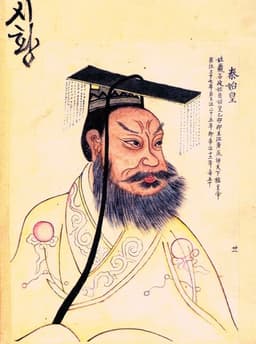
Qin Shi Huang
Emperor · Ancient
85.2Total
Basic Information
Born
-280
-259
Died
-208
-210
Era
Ancient
Ancient
Nationality
China
China
Occupation
Politician
Emperor
Civilization
Eastern
Eastern
Score Comparison
Military (10%)
40.8
80.0
Political (20%)
75.0
90.0
Influence (20%)
40.0
85.0
Legacy (20%)
90.0
90.0
Leadership (15%)
78.0
78.0
Strategy (15%)
48.1
82.0
TOTAL
64.3
85.2
Li Si — Complete Timeline
221 BC
Standardization of ScriptReform◆ Major
As Chancellor of Qin, Li Si oversaw the standardization of Chinese script, replacing regional variations with a uniform writing system. This reform facilitated communication and administration across the newly unified empire.
StandardizationWriting SystemAdministration
Impact: globalconstructive
Standardization of Weights and MeasuresReform◆ Major
Li Si implemented uniform standards for weights, measures, and axle lengths across the Qin Empire. This reform facilitated trade, taxation, and transportation, contributing to economic integration and central control.
StandardizationEconomyTrade
Impact: nationalconstructive
214 BC
Construction of the Great WallOther◆ Major
Li Si oversaw the construction and linking of existing fortifications into a unified Great Wall to protect the Qin Empire from northern nomadic incursions. The project required massive conscript labor and resulted in many deaths.
ConstructionDefenseInfrastructure
Impact: regional
213 BC
Burning of Books and Burying of ScholarsPolitical Action◆ Major
Li Si advised Emperor Qin Shi Huang to burn historical records, philosophical texts, and poetry that criticized Legalism, and to bury alive 460 Confucian scholars who opposed the regime. This act aimed to suppress dissent and enforce ideological uniformity.
CensorshipRepressionIdeological Control
Impact: nationaldestructive
208 BC
Execution of Li SiOther◆ Major
After the death of Qin Shi Huang, Li Si was involved in a power struggle with the eunuch Zhao Gao. Zhao Gao falsely accused Li Si of treason, and he was executed by the Five Pains method (dismemberment). His family was also exterminated.
ExecutionPolitical FallPower Struggle
Impact: nationaltragic
Qin Shi Huang — Complete Timeline
246 BC
Construction of the Mausoleum and Terracotta ArmyOther◆ Major
Qin Shi Huang commissioned a vast mausoleum complex near Xi'an, guarded by thousands of life-sized terracotta soldiers, horses, and chariots. The project employed hundreds of thousands of workers and reflected his obsession with immortality and imperial power.
Impact: global
230 BC
Conquest of the Six Warring StatesWar
From 230 to 221 BCE, Ying Zheng led the Qin state in a series of campaigns that conquered the Han, Zhao, Wei, Chu, Yan, and Qi states. This unified China under a single ruler for the first time, ending the Warring States period.
Impact: global
221 BC
Standardization of Writing, Currency, and MeasurementsReform◆ Major
Qin Shi Huang ordered the standardization of Chinese script, currency, and weights and measures across the unified empire. This facilitated administration, trade, and cultural integration, laying a foundation for future dynasties.
Impact: globalconstructive
Proclamation of the Qin DynastyPolitical Action
After conquering the last independent state, Ying Zheng declared himself Shi Huangdi (First Emperor), founding the Qin Dynasty. He adopted a new title to signify his supreme authority and initiated centralized imperial rule.
Impact: global
214 BC
Initiation of the Great Wall ConstructionOther◆ Major
Qin Shi Huang ordered the connection and extension of existing northern fortifications to create a unified defensive wall against nomadic Xiongnu raids. This project involved massive conscripted labor and became the precursor to the later Great Wall.
Impact: regional
213 BC
Burning of Books and Burying of ScholarsPolitical Action◆ Major
On the advice of Li Si, Qin Shi Huang ordered the burning of historical records and philosophical texts not aligned with Legalist doctrine. He also had 460 Confucian scholars buried alive to suppress dissent and consolidate ideological control.
Impact: nationaldestructive
Expert Analysis
li-si-vs-qin-shi-huang
# The Emperor and the Architect
On a winter morning in 208 BCE, an old man knelt in the marketplace of Xianyang, his body broken by five brutal punishments. Li Si, once the most powerful minister in the world’s largest empire, was being executed by the very system he had helped create. Just two years earlier, his master Qin Shi Huang had died on a tour of his domain, his body hidden in a carriage of rotting fish to conceal the succession crisis brewing within. The First Emperor and his Chancellor—two men who had forged a unified China from centuries of chaos—had both met their ends in tragedy. But why did one become an immortal symbol of unification, while the other became a cautionary tale of ambition consumed by its own machinery?
Origins
Qin Shi Huang was born Ying Zheng in 259 BCE, a prince of the western state of Qin, a realm considered semi-barbaric by the more cultured states to the east. His father was a hostage in Zhao, and his mother, Zhao Ji, was a concubine of uncertain origins. The boy grew up surrounded by suspicion and violence—his father died when he was thirteen, and his early reign was dominated by the merchant-turned-politician Lü Buwei and his mother’s lover, the eunuch Lao Ai. When Lao Ai launched a rebellion, the young king crushed it with ruthless efficiency, banishing his own mother and forcing Lü Buwei to commit suicide. These early betrayals forged a ruler who trusted no one and saw power as the only reality.
Li Si, born around 280 BCE, came from an entirely different world. He was a commoner from the state of Chu, a man who rose through merit rather than blood. As a young official, he studied under the Confucian philosopher Xunzi, but he rejected the master’s moral teachings in favor of Legalist doctrine—the belief that strict laws and harsh punishments, not virtue, held society together. Li Si once observed that rats in the granaries grew fat while rats in the sewers starved, and he concluded that a man’s station determined his fate. He would choose the granary, even if it meant serving a brutal master.
Rise to Power
Ying Zheng’s path to power was paved with steel. From 230 to 221 BCE, he led Qin’s armies in a series of campaigns that annihilated six rival states—Han, Zhao, Wei, Chu, Yan, and Qi. Each conquest was a masterpiece of strategy and terror: he bribed ministers, assassinated generals, and flooded cities. When the last king of Qi surrendered, Ying Zheng proclaimed himself *Shi Huangdi*—“First Emperor”—in 221 BCE, declaring that his dynasty would last ten thousand generations.
Li Si’s rise was quieter but equally decisive. He had come to Qin as a minor advisor, but his brilliance in administrative reform caught the attention of the king. When conservative scholars argued for restoring the feudal system of the Zhou dynasty, Li Si penned a devastating rebuttal: “The past is not to be imitated; the present is not to be despised.” He argued that only a centralized bureaucracy could hold the empire together. The Emperor agreed, and Li Si became Chancellor, the second most powerful man in China.
Leadership & Governance
Their ruling styles were complementary but distinct. Qin Shi Huang was the force of nature—the conqueror who personally toured his empire five times, erecting stone stelae to celebrate his achievements. He believed that his will alone could reshape reality. He standardized writing, currency, and measurements across the realm, ordering that all axle lengths be uniform so that carts could travel the same ruts on imperial roads. He began linking the northern fortifications into what would become the Great Wall, a project that consumed millions of lives.
Li Si was the engineer of this transformation. It was he who designed the bureaucratic machinery: the non-hereditary officials, the uniform legal code, the system of prefectures and counties that replaced feudal lords. When the Emperor ordered the “Burning of Books and Burying of Scholars” in 213 BCE—destroying historical records and philosophical texts that challenged Legalism, and executing 460 scholars who resisted—it was Li Si who advised the policy. He saw dissent as a disease, and censorship as the cure.
Yet here lies the crucial difference. Qin Shi Huang’s vision was cosmic and personal—he sought immortality, sending expeditions for the elixir of life and building a mausoleum guarded by the Terracotta Army, a silent legion of eight thousand warriors to serve him in the afterlife. Li Si’s vision was systemic and cold—he believed that laws, not men, should rule. But in serving an absolute monarch, he made himself utterly dependent on that monarch’s favor.
Triumph & Tragedy
Their greatest triumph was shared: the unification of China, a feat that had eluded all previous rulers. For the first time, a single script, a single currency, and a single legal code bound the Yellow River valley together. The Qin Dynasty lasted only fifteen years, but its administrative framework would endure for two millennia.
Their tragedies, however, diverged. Qin Shi Huang’s obsession with immortality became his undoing. He swallowed mercury pills prescribed by alchemists, poisoning himself slowly. He died in 210 BCE at the age of forty-nine, his body already decaying as his entourage rushed back to the capital. His son, the feeble Hu Hai, was placed on the throne by the eunuch Zhao Gao, and the empire descended into civil war within three years.
Li Si’s fall was more grotesque. After the Emperor’s death, he conspired with Zhao Gao to hide the news and forge a decree ordering the eldest son, Fusu, to commit suicide. But Zhao Gao, a master of palace intrigue, turned on him. Li Si was arrested, tortured until he confessed to treason, and executed in the marketplace. His last letter to the Emperor went unread; his family was wiped out to the third generation.
Character & Destiny
What drove these different outcomes? Qin Shi Huang was a megalomaniac, but his megalomania was rooted in genuine achievement. He had conquered the world; he believed he could conquer death. Li Si was a pragmatist, but his pragmatism had no moral anchor. He had risen from nothing through sheer ability, but he had no loyalty beyond self-preservation. When the crisis came, he chose survival over principle—and lost both.
The First Emperor’s flaw was hubris; the Chancellor’s was cowardice. One reached too high; the other stooped too low.
Legacy
Qin Shi Huang remains a titan of Chinese history—admired for unification, reviled for tyranny. The Terracotta Army, discovered in 1974, has made him a global icon. But his dynasty collapsed so quickly that later historians, especially the Confucians who wrote the official records, painted him as a monstrous tyrant. The real man—complex, visionary, paranoid—lies somewhere between the legend and the slander.
Li Si’s legacy is more ambiguous. His administrative reforms shaped every Chinese dynasty that followed, yet he is remembered primarily as the architect of the book burning, the man who chose power over knowledge. His name appears in Chinese history as a warning: the brilliant servant who became the tyrant’s tool.
Conclusion
Standing before the silent ranks of the Terracotta Army, one feels the weight of Qin Shi Huang’s ambition—an emperor who tried to freeze time itself. And reading the story of Li Si, one sees the tragedy of the man who built the machine that ate him. Together, they show us that even the greatest achievements are fragile, and that the men who shape history are often shaped—and destroyed—by the forces they unleash. The empire they built fell, but the idea of a unified China endured. In that sense, both the emperor and the architect won—and lost—everything.
Rankings
🥇
Qin Shi HuangLeader
Mil: 80.0Pol: 90.0Inf: 85.0
85.2
🥈
Li Si
Mil: 40.8Pol: 75.0Inf: 40.0
64.3
+20.9 behind
How This Comparison Works
Algorithm
Each figure is scored on 6 dimensions (0—100 scale) based on structured historical data: Military (10%), Political (20%), Influence (20%), Legacy (20%), Leadership (15%), Strategy (15%). The weighted total produces the final ranking.
Data Sources
Scores are computed from structured sub-indicators in the database. Scale factors adjust for era (Ancient ×0.85, Modern ×1.0) and civilization size (Eastern ×1.05, Other ×0.80) to account for differences in population and military scale.
Maximum 3 Figures
Comparisons are limited to 2—3 figures to ensure readability and statistical meaningfulness.
Error Margins
±5 points per dimension — Sub-scores are derived from historical records with inherent uncertainty. Two figures within 5 points on a dimension should be considered roughly equivalent in that area.
Total Score Accuracy
±3 points overall — The weighted combination of 6 dimensions produces a total score with approximately ±3 points of uncertainty. Differences of less than 3 points are not statistically significant— the figures are effectively tied.
Known Limitations
- Historical records are incomplete and uneven across civilizations
- Figures from oral-tradition societies may be underrepresented
- Occupation labels can misclassify multi-role figures
- Scores measure capability and impact, not moral character
- Quantitative scoring is a comparison tool, not absolute truth
Capability Radar
Military (10%) — Battles & Warfare
Battles
22
85
Win Rate
25
90
Expansion
26
90
Political (20%) — Governance & Reform
Reform
95
95
Diplomacy
70
75
Economy
90
90
Influence (20%) — Cultural & Global Reach
Cultural
85
95
Global
80
85
Legacy (20%) — Historical Impact
Historical
90
95
Longevity
90
95
Leadership (15%) — Power & Stability
Tenure
85
70
Stability
60
65
Strategy (15%) — Tactics & Innovation
Strategy
32
85
Tactics
32
80
Reform
36
95
Similar Comparisons
Comments & Discussion
TheButcherOfChaos6/17/2026
As a military historian, I say Qin Shi Huang was the real deal. While Li Si wrote the rulebook, the First Emperor rode at the head of his armies, crushing six kingdoms like tin cans. In 230 BCE, he personally oversaw the fall of Han—the opening move in a decadelong slaughter. Li Si was a brilliant bureaucrat, but he never swung a sword. Qin Shi Huang unified China by force, not pen strokes. The Chancellor advised; the Emperor conquered. That's why we remember the warrior, not the scribe. Reign o
数据屠夫6/17/2026
数据专家必须拆台。说"焚书坑儒"是统一思想?实际数字冷冰冰:司马迁的《史记》里只提到"坑术士四百六十余人",根本不是什么大规模屠杀儒生。更关键的是,秦朝灭亡后,先秦典籍照样传承下来。Li Si这个政策最多干掉460个方士,对历史影响微乎其微。别被"暴政"叙事洗脑了,数字不会说谎。Li Si的所谓"书同文"才是真贡献,焚书就是个政治秀。
ClassicsConsigliere6/17/2026
From a classical texts perspective, Li Si was the true architect of Chinese civilization. Before him, writing was a chaotic mess—six different scripts across the warring states. He standardized the seal script, creating the first national written language. Want proof? The Stone Drums of Wei are a beautiful example of pre-Qin calligraphy he ordered preserved. Li Si’s political philosophy in his "Memorial on the Burning of Books" is pure Legalist genius: control the narrative, unify the state. Qin
历史幸存者6/17/2026
我不是马后炮,但秦朝灭亡的种子是Li Si亲手埋下的。公元前210年,沙丘之变时他选择合谋篡改遗诏,立胡亥杀扶苏。这操作直接导致秦朝两年后崩盘。他明明是老狐狸,却蠢到相信赵高——一个阉人!结果自己五马分尸。更讽刺的是,Li Si在《谏逐客书》里写的"泰山不让土壤,河海不择细流",吹得天花乱坠,最后自己却搞排除异己。Qin Shi Huang至少死得像个皇帝(虽然烂在鱼车里),Li Si死得像个叛徒。历史从不留情。
TheUnityCrank6/17/2026
Forget the drama—what matters is that both men, flaws and all, created the blueprint for China. Qin Shi Huang's Great Wall isn't just stone; it's a psychological barrier that defined "us vs. them" for two millennia. Li Si's administrative reforms