Loading...
Analysis will be generated on first visit.
Scores and timeline are available below. The page will refresh automatically when ready.
Li Keqiang vs Napoleon Bonaparte
Napoleon Bonaparte leads by 12.9 pts · 2 figures compared
…

Li Keqiang
Politician · Modern
69.5Total
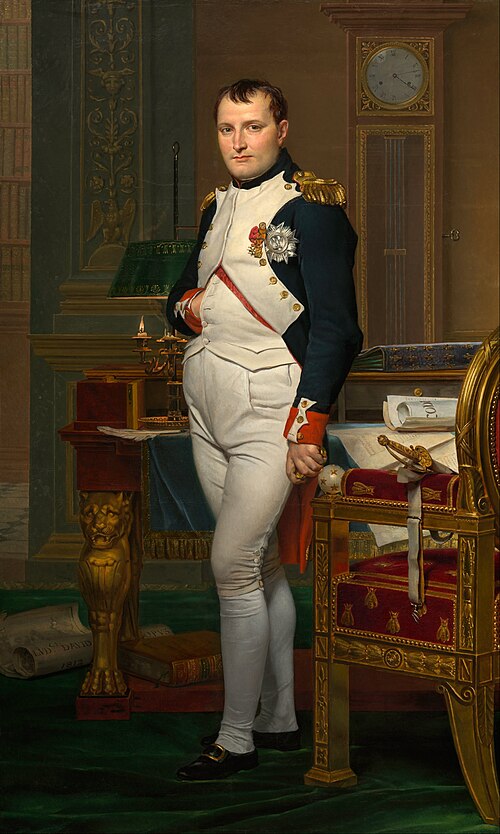
Napoleon Bonaparte
General · Modern
82.4Total
Basic Information
Born
1955
1769
Died
—
1821
Era
Modern
Modern
Nationality
China
France
Occupation
Politician
General
Civilization
Eastern
Western
Score Comparison
Military (10%)
22.8
94.0
Political (20%)
79.7
75.0
Influence (20%)
77.6
82.0
Legacy (20%)
66.8
78.0
Leadership (15%)
89.7
80.0
Strategy (15%)
59.6
93.0
TOTAL
69.5
82.4
Rankings
🥇
Napoleon BonaparteLeader
Mil: 94.0Pol: 75.0Inf: 82.0
82.4
🥈
Li Keqiang
Mil: 22.8Pol: 79.7Inf: 77.6
69.5
+12.9 behind
How This Comparison Works
Algorithm
Each figure is scored on 6 dimensions (0—100 scale) based on structured historical data: Military (10%), Political (20%), Influence (20%), Legacy (20%), Leadership (15%), Strategy (15%). The weighted total produces the final ranking.
Data Sources
Scores are computed from structured sub-indicators in the database. Scale factors adjust for era (Ancient ×0.85, Modern ×1.0) and civilization size (Eastern ×1.05, Other ×0.80) to account for differences in population and military scale.
Maximum 3 Figures
Comparisons are limited to 2—3 figures to ensure readability and statistical meaningfulness.
Error Margins
±5 points per dimension — Sub-scores are derived from historical records with inherent uncertainty. Two figures within 5 points on a dimension should be considered roughly equivalent in that area.
Total Score Accuracy
±3 points overall — The weighted combination of 6 dimensions produces a total score with approximately ±3 points of uncertainty. Differences of less than 3 points are not statistically significant— the figures are effectively tied.
Known Limitations
- Historical records are incomplete and uneven across civilizations
- Figures from oral-tradition societies may be underrepresented
- Occupation labels can misclassify multi-role figures
- Scores measure capability and impact, not moral character
- Quantitative scoring is a comparison tool, not absolute truth
Capability Radar
Military (10%) — Battles & Warfare
Battles
14
95
Win Rate
15
90
Expansion
20
95
Political (20%) — Governance & Reform
Reform
65
95
Diplomacy
60
80
Economy
70
85
Influence (20%) — Cultural & Global Reach
Cultural
40
85
Global
55
90
Legacy (20%) — Historical Impact
Historical
45
95
Longevity
30
90
Leadership (15%) — Power & Stability
Tenure
75
85
Stability
65
70
Strategy (15%) — Tactics & Innovation
Strategy
24
95
Tactics
24
98
Reform
29
92
Analysis will be generated on first visit.
Scores and timeline are available below. The page will refresh automatically when ready.
Li Keqiang — Complete Timeline
2013 AD
Appointed Premier of the State CouncilPolitical Action◆ Major
Li Keqiang was appointed Premier of China's State Council at the National People's Congress. He succeeded Wen Jiabao and became the head of government, responsible for economic policy. His tenure focused on market-oriented reforms and promoting innovation.
LeadershipGovernment
Impact: national
Implemented the 'Belt and Road Initiative' ProjectsPolitical Action◆ Major
As Premier, Li oversaw the implementation of the Belt and Road Initiative, coordinating infrastructure projects across Asia, Africa, and Europe. He promoted Chinese investment and loans for railways, ports, and energy projects. The initiative expanded China's influence but also raised debt concerns.
InfrastructureForeign Policy
Impact: global
2014 AD
Promoted the 'Mass Entrepreneurship and Innovation' PolicyReform◆ Major
Li Keqiang launched a policy encouraging entrepreneurship and innovation to drive economic growth. The initiative included tax breaks, startup funding, and simplified business registration. It led to a surge in new businesses but also faced challenges like overcapacity and debt.
Economic ReformInnovation
Impact: nationalconstructive
2015 AD
Announced the 'Made in China 2025' PlanReform◆ Major
Li's government unveiled the 'Made in China 2025' industrial policy to upgrade manufacturing in high-tech sectors like robotics, aerospace, and AI. The plan aimed to reduce reliance on foreign technology. It drew criticism from the U.S. and EU for state-led intervention and intellectual property concerns.
Industrial PolicyTechnology
Impact: globalconstructive
2020 AD
Oversaw the COVID-19 Economic StimulusPolitical Action
Li Keqiang's government introduced a fiscal stimulus package to counter the economic impact of COVID-19. Measures included tax cuts, infrastructure spending, and support for small businesses. The stimulus helped stabilize the economy but also increased local government debt.
Economic PolicyPandemic Response
Impact: nationalconstructive
2023 AD
Retired as PremierPolitical Action
Li Keqiang stepped down as Premier at the 14th National People's Congress, replaced by Li Qiang. His departure marked the end of a decade in office. He was praised for economic reforms but criticized for limited political influence compared to Xi Jinping.
Leadership Transition
Impact: national
Similar Comparisons
Comments & Discussion
No comments yet. Be the first to share your thoughts!