Loading...
Le Hoan vs Minkyinyo
Le Hoan leads by 7.1 pts · 2 figures compared
…
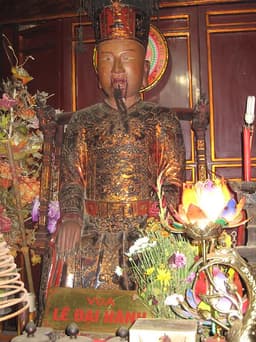
Le Hoan
Emperor · Medieval
57.4Total

Minkyinyo
Emperor · Medieval
50.3Total
Basic Information
Born
941
1459
Died
1005
1530
Era
Medieval
Medieval
Nationality
Vietnam
Myanmar
Occupation
Emperor
Emperor
Civilization
Eastern
Eastern
Score Comparison
Military (10%)
70.0
10.0
Political (20%)
68.0
54.7
Influence (20%)
59.0
53.3
Legacy (20%)
50.0
45.8
Leadership (15%)
47.9
74.0
Strategy (15%)
58.0
51.7
TOTAL
57.4
50.3
Le Hoan — Complete Timeline
980 AD
Foundation of the Former Le DynastyPolitical Action◆ Major
After the assassination of Dinh Tien Hoang, Le Hoan was proclaimed emperor by the army and court officials. He founded the Former Le dynasty, taking the reign name Le Dai Hanh. His rule stabilized the country and continued the work of unifying Vietnam.
Dynasty FoundingSuccessionStabilization
Impact: nationalconstructive
981 AD
Repulsion of the Song InvasionWar
Le Hoan, as commander of the Vietnamese army, defeated a Song Chinese invasion force at the Battle of Bach Dang River. He used a strategy of placing iron-tipped stakes in the riverbed to impale enemy ships. The victory secured Vietnamese independence and established his legitimacy.
BattleSong DynastyVietnamese Independence
Impact: regionalconstructive
982 AD
Campaigns against ChampaWar◆ Major
Le Hoan launched a military campaign against the Champa kingdom to the south, sacking the Cham capital of Indrapura. The campaign expanded Vietnamese territory and secured the southern border. It also forced Champa to become a tributary state.
Military CampaignChampaTerritorial Expansion
Impact: regional
Minkyinyo — Complete Timeline
1510 AD
Minkyinyo's military campaigns against AvaWar◆ Major
Minkyinyo led a series of military campaigns against the Ava Kingdom, gradually expanding Toungoo's territory. He captured key towns and fortresses, weakening Ava and establishing Toungoo as a major power in Upper Burma.
WarExpansionAva
Impact: regional
Minkyinyo's administrative reformsReform
Minkyinyo implemented administrative reforms to centralize power and improve governance in the Toungoo kingdom. He established a system of provincial governors and standardized taxation, which strengthened the state's ability to wage war and maintain order.
ReformAdministrationCentralization
Impact: regionalconstructive
Founding of the Toungoo dynastyPolitical Action
Minkyinyo declared independence from the Ava Kingdom and established the Toungoo dynasty at the city of Toungoo. He consolidated control over central Burma and laid the foundation for the reunification of the country after the collapse of the Pagan Empire.
DynastyIndependenceUnification
Impact: regionalconstructive
Expert Analysis
Origins
Le Hoan was born in 941 in the Giao Châu region (modern northern Vietnam). His family was of modest means, but he rose through the ranks of the military under the Đinh dynasty. He served as a general under Đinh Bộ Lĩnh, the founder of the Đinh dynasty. Le Hoan's early life was marked by constant warfare, which shaped his military acumen.
Minkyinyo was born in 1459 in Toungoo (present-day Myanmar). He was a descendant of the Pinya dynasty. His father, Maha Thinkara, was a governor under the Ava Kingdom. Minkyinyo grew up in the turbulent period of the Ava Kingdom's decline, witnessing political fragmentation and war.
Rise to Power
Le Hoan's rise began after the assassination of Emperor Đinh Tiên Hoàng in 979. The court was in chaos, and the Song Dynasty saw an opportunity to invade. Le Hoan, as commander of the army, was proclaimed emperor by the troops and court officials to lead the defense. He founded the Former Lê Dynasty in 980, taking the reign name Lê Đại Hành. His legitimacy was cemented by his victory over the Song.
Minkyinyo declared independence from the Ava Kingdom in 1486, establishing the Toungoo dynasty at the city of Toungoo. He gradually consolidated control over central Burma through a series of military campaigns against Ava. By 1510, he had secured Toungoo's independence and began expanding its territory. His rise was less dramatic than Le Hoan's, relying on steady military and political consolidation.
Leadership & Governance
Le Hoan's leadership was characterized by decisive military action and pragmatic governance. He focused on defending Vietnam's borders and expanding southward. He implemented administrative reforms to stabilize the new dynasty, including appointing loyal officials and establishing a tax system. His governance was hands-on, often leading troops personally.
Minkyinyo's leadership score of 74.0 reflects his effective governance and strategic patience. He centralized power in Toungoo by implementing provincial administration, reducing the power of local lords. He promoted Buddhism as a unifying force. Unlike Le Hoan, who faced a major invasion early, Minkyinyo's reign was marked by gradual expansion and institution-building.
Triumph & Tragedy
Le Hoan's greatest triumph was the repulsion of the Song invasion at the Battle of Bạch Đằng River in 981. He used a strategy of placing iron-tipped stakes in the riverbed, similar to the earlier victory of Ngô Quyền, to trap Song ships. This victory secured Vietnam's independence for centuries. However, his campaign against Champa in 982, while successful in sacking the capital Indrapura, led to prolonged conflict and instability on the southern border. His legacy is also tarnished by the assassination of Đinh Tiên Hoàng, which he may have been complicit in.
Minkyinyo's triumph was founding the Toungoo dynasty, which would later unify Burma under his son Tabinshwehti. He successfully defended Toungoo against Ava and expanded its territory. His administrative reforms created a stable foundation for future expansion. However, his military score of 10.0 indicates limited battlefield success; his campaigns were cautious and avoided decisive battles. His failure to capture Ava itself meant his expansion was incomplete, leaving a fragmented kingdom.
Character & Destiny
Le Hoan was a pragmatic and ruthless leader. His decision to seize power after Đinh Tiên Hoàng's death showed ambition, but his ability to rally the nation against the Song demonstrated strategic acumen. He was a hands-on commander, sharing hardships with his troops. His character shaped a destiny of national defense and southern expansion, but also of political intrigue.
Minkyinyo was a patient and methodical ruler. He avoided risky gambles, preferring to build power slowly. His low military score (10.0) suggests he was not a great field commander, but his political and leadership scores (54.7 and 74.0) indicate he was an effective administrator. His character of caution allowed the Toungoo dynasty to survive and eventually thrive under his successors.
Legacy
Le Hoan's legacy is as a national hero in Vietnam for repelling the Song invasion. The Former Lê Dynasty lasted only 29 years (980-1009), but his victory at Bạch Đằng became a symbol of Vietnamese resistance. His campaigns against Champa set a precedent for southward expansion. He scored 50.0 in legacy.
Minkyinyo's legacy is as the founder of the Toungoo dynasty, which unified Burma and became a major power in Southeast Asia. His administrative reforms influenced later Burmese governance. He scored 45.8 in legacy, reflecting his role as a founder but overshadowed by his son's achievements.
Conclusion
Le Hoan had greater immediate impact by repelling a major invasion and securing Vietnam's independence, which influenced the region for centuries. While Minkyinyo founded a dynasty that later united Burma, his personal achievements were less dramatic. Le Hoan's total score of 57.4 versus Minkyinyo's 50.3 reflects this. Le Hoan's military victory (70.0) and political acumen (68.0) outweigh Minkyinyo's higher leadership (74.0). Thus, Le Hoan had greater impact as a decisive military leader who preserved his nation's sovereignty.
Rankings
🥇
Le HoanLeader
Mil: 70.0Pol: 68.0Inf: 59.0
57.4
🥈
Minkyinyo
Mil: 10.0Pol: 54.7Inf: 53.3
50.3
+7.1 behind
How This Comparison Works
Algorithm
Each figure is scored on 6 dimensions (0—100 scale) based on structured historical data: Military (10%), Political (20%), Influence (20%), Legacy (20%), Leadership (15%), Strategy (15%). The weighted total produces the final ranking.
Data Sources
Scores are computed from structured sub-indicators in the database. Scale factors adjust for era (Ancient ×0.85, Modern ×1.0) and civilization size (Eastern ×1.05, Other ×0.80) to account for differences in population and military scale.
Maximum 3 Figures
Comparisons are limited to 2—3 figures to ensure readability and statistical meaningfulness.
Error Margins
±5 points per dimension — Sub-scores are derived from historical records with inherent uncertainty. Two figures within 5 points on a dimension should be considered roughly equivalent in that area.
Total Score Accuracy
±3 points overall — The weighted combination of 6 dimensions produces a total score with approximately ±3 points of uncertainty. Differences of less than 3 points are not statistically significant— the figures are effectively tied.
Known Limitations
- Historical records are incomplete and uneven across civilizations
- Figures from oral-tradition societies may be underrepresented
- Occupation labels can misclassify multi-role figures
- Scores measure capability and impact, not moral character
- Quantitative scoring is a comparison tool, not absolute truth
Capability Radar
Military (10%) — Battles & Warfare
Battles
65
40
Win Rate
70
45
Expansion
50
45
Political (20%) — Governance & Reform
Reform
55
50
Diplomacy
70
40
Economy
50
35
Influence (20%) — Cultural & Global Reach
Cultural
45
30
Global
40
20
Legacy (20%) — Historical Impact
Historical
55
40
Longevity
50
35
Leadership (15%) — Power & Stability
Tenure
60
55
Stability
58
30
Strategy (15%) — Tactics & Innovation
Strategy
72
40
Tactics
68
35
Reform
55
50
Similar Comparisons
Comments & Discussion
No comments yet. Be the first to share your thoughts!