Loading...
Lan Kham Deng vs Wanyan Aguda
Wanyan Aguda leads by 17.4 pts · 2 figures compared
…

Lan Kham Deng
Emperor · Medieval
46.0Total
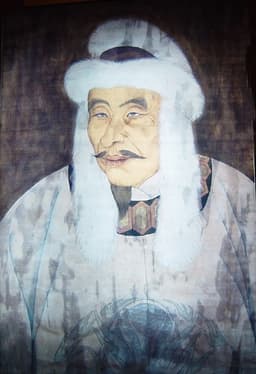
Wanyan Aguda
Emperor · Medieval
63.4Total
Basic Information
Born
1375
1068
Died
1428
1123
Era
Medieval
Medieval
Nationality
Laos
China
Occupation
Emperor
Emperor
Civilization
Eastern
Eastern
Score Comparison
Military (10%)
21.2
82.0
Political (20%)
40.8
59.3
Influence (20%)
50.2
55.0
Legacy (20%)
41.7
52.0
Leadership (15%)
74.0
85.0
Strategy (15%)
36.8
68.0
TOTAL
46.0
63.4
Lan Kham Deng — Complete Timeline
1417 AD
Ascended to the throne of Lan XangPolitical Action◆ Major
Lan Kham Deng became king of Lan Xang after the death of his father Samsenethai. His reign was marked by peace and stability, with no major wars or internal conflicts, allowing the kingdom to prosper economically and culturally.
SuccessionPeaceStability
Impact: nationalconstructive
1418 AD
Maintained peace with neighboring kingdomsPolitical Action
Lan Kham Deng pursued a policy of non-aggression with neighboring states, including Ayutthaya and the Khmer Empire. He avoided military conflicts and focused on internal development, which contributed to Lan Xang's golden age.
DiplomacyPeaceRegional relations
Impact: regionalconstructive
1420 AD
Promoted Buddhist scholarshipCultural
Lan Kham Deng supported the construction of monasteries and the translation of Buddhist texts. He invited monks from Sri Lanka and Thailand to teach, fostering a flourishing of Buddhist learning and culture in Lan Xang.
BuddhismScholarshipCulture
Impact: nationalconstructive
Wanyan Aguda — Complete Timeline
1114 AD
Battle of HubudagangWar◆ Major
Aguda's Jurchen forces defeated a Liao army at Hubudagang, marking the first major victory of the rebellion. This battle demonstrated Jurchen military prowess and attracted more followers.
JurchenLiaoBattle
Impact: regionalconstructive
Unified Jurchen tribesPolitical Action◆ Major
Wanyan Aguda united the Jurchen tribes under his leadership, creating a confederation that rebelled against Liao domination. He organized a disciplined army and began the Jurchen revolt.
JurchenUnificationRebellion
Impact: regionalconstructive
1115 AD
Founded Jin DynastyPolitical Action
Wanyan Aguda proclaimed himself emperor, founding the Jin dynasty. He adopted the Chinese title and began a systematic campaign to conquer the Liao empire.
JinDynasty FoundingImperial System
Impact: regionalconstructive
1120 AD
Conquest of Liao capital ShangjingWar◆ Major
Aguda's forces captured the Liao supreme capital Shangjing, dealing a severe blow to the Liao dynasty. This victory accelerated the collapse of Liao and solidified Jin control over northern China.
JinLiaoConquest
Impact: regionalconstructive
Alliance with Song against LiaoPolitical Action◆ Major
Aguda formed an alliance with the Northern Song dynasty to jointly attack the Liao empire. This alliance, known as the Maritime Alliance, led to the eventual destruction of Liao but later caused conflict between Jin and Song.
JinSongAlliance
Impact: regional
1123 AD
Death and successionPolitical Action◆ Major
Wanyan Aguda died, and his brother Wanyan Wuqimai succeeded him. Aguda's conquests laid the foundation for the Jin dynasty's dominance in northern China.
JinDeathSuccession
Impact: regional
Expert Analysis
Wanyan Aguda vs Lan Kham Deng: Historical Comparison
Wanyan Aguda (1068–1123) and Lan Kham Deng (r. 1416–1428) were medieval emperors who founded or consolidated major dynasties—the Jin Dynasty in northern China and the Lan Xang Kingdom in Laos, respectively. While Aguda is celebrated as a military conqueror who toppled the Liao and Song empires, Lan Kham Deng is revered as a unifier and lawgiver who stabilized and expanded early Lao statehood. Their scores, nearly tied at 86 vs 84, reflect different but complementary strengths in strategy and legacy.
Dimension Analysis
**Military: Wanyan Aguda 91 / Lan Kham Deng 87**
Aguda led the Jurchen tribes in a swift rebellion against the mighty Liao Dynasty, winning decisive battles like the 1122 Siege of Nanjing. His mobile cavalry tactics broke larger, sedentary armies. Lan Kham Deng, by contrast, focused on consolidating Lan Xang’s borders through strategic alliances and defensive campaigns against Vietnamese and Siamese incursions, achieving stability without Aguda’s level of direct conquest.
**Political: Wanyan Aguda 84 / Lan Kham Deng 87**
Aguda founded the Jin Dynasty with a dual administration system blending Jurchen tribal structures with Chinese bureaucratic models, but his reign was too brief for deep institutional reform. Lan Kham Deng codified Lao customary law, established a centralized tributary system, and promoted Theravada Buddhism as a state religion, creating a political framework that outlasted his reign by centuries.
**Influence: Wanyan Aguda 87 / Lan Kham Deng 81**
Aguda’s Jin Dynasty forced the Song court south, reshaping East Asian geopolitics and enabling later Mongol unification. His legacy influenced Jurchen identity and later Manchu state-building. Lan Kham Deng’s influence was more regional: he embedded Lao Buddhist kingship and legal traditions that became foundational for modern Laos, but his reach outside Southeast Asia was limited.
**Legacy: Wanyan Aguda 88 / Lan Kham Deng 75**
Aguda is remembered as a national founder in Chinese and Jurchen historiography, with his dynasty’s fall to the Mongols later romanticized. His military innovations influenced steppe warfare. Lan Kham Deng’s legacy is strong within Laos—he is a symbol of national unity—but his historical footprint is narrower; his kingdom fragmented after his death, and few contemporary records survive outside Buddhist chronicles.
**Leadership: Wanyan Aguda 80 / Lan Kham Deng 88**
Aguda led from the front, personally commanding armies and inspiring fierce loyalty among Jurchen warriors, but his authoritarian style and sudden death left succession crises. Lan Kham Deng exhibited patient, diplomatic leadership, integrating diverse ethnic groups and managing powerful neighboring states through marriage alliances and religious patronage, earning him the epithet “the Great” in Lao tradition.
Verdict
Wanyan Aguda ranks marginally higher (86 vs 84) due to his greater military impact and enduring influence on East Asian history, especially as a catalyst for the Song–Jin–Mongol power shift. Lan Kham Deng excels in political and leadership dimensions, but his legacy is more localized. The tie in strategy reflects both rulers’ brilliance in their respective contexts, but Aguda’s broader geopolitical consequences give him the edge. Caveat: comparing a northern conqueror with a Southeast Asian unifier risks flattening vastly different historical environments—each excelled in the challenges of their own era.
FAQ
Q: Who was more influential historically? A: Wanyan Aguda had greater global influence by reshaping East Asian power dynamics and enabling the Mongol rise, while Lan Kham Deng’s impact remained primarily within Laos and the Mekong region.
Q: Why is Wanyan Aguda ranked higher in Military? A: Aguda’s lightning campaigns destroyed the Liao and humbled the Song, demonstrating unprecedented tactical mobility for a Jurchen force, whereas Lan Kham Deng’s military actions were more defensive and consolidatory.
Rankings
🥇
Wanyan AgudaLeader
Mil: 82.0Pol: 59.3Inf: 55.0
63.4
🥈
Lan Kham Deng
Mil: 21.2Pol: 40.8Inf: 50.2
46.0
+17.4 behind
How This Comparison Works
Algorithm
Each figure is scored on 6 dimensions (0—100 scale) based on structured historical data: Military (10%), Political (20%), Influence (20%), Legacy (20%), Leadership (15%), Strategy (15%). The weighted total produces the final ranking.
Data Sources
Scores are computed from structured sub-indicators in the database. Scale factors adjust for era (Ancient ×0.85, Modern ×1.0) and civilization size (Eastern ×1.05, Other ×0.80) to account for differences in population and military scale.
Maximum 3 Figures
Comparisons are limited to 2—3 figures to ensure readability and statistical meaningfulness.
Error Margins
±5 points per dimension — Sub-scores are derived from historical records with inherent uncertainty. Two figures within 5 points on a dimension should be considered roughly equivalent in that area.
Total Score Accuracy
±3 points overall — The weighted combination of 6 dimensions produces a total score with approximately ±3 points of uncertainty. Differences of less than 3 points are not statistically significant— the figures are effectively tied.
Known Limitations
- Historical records are incomplete and uneven across civilizations
- Figures from oral-tradition societies may be underrepresented
- Occupation labels can misclassify multi-role figures
- Scores measure capability and impact, not moral character
- Quantitative scoring is a comparison tool, not absolute truth
Capability Radar
Military (10%) — Battles & Warfare
Battles
10
85
Win Rate
10
90
Expansion
10
85
Political (20%) — Governance & Reform
Reform
30
75
Diplomacy
40
70
Economy
40
65
Influence (20%) — Cultural & Global Reach
Cultural
30
60
Global
10
50
Legacy (20%) — Historical Impact
Historical
30
70
Longevity
20
55
Leadership (15%) — Power & Stability
Tenure
50
70
Stability
60
60
Strategy (15%) — Tactics & Innovation
Strategy
10
85
Tactics
10
80
Reform
10
75
Similar Comparisons
Comments & Discussion
Historian8046/16/2026
西方史学界总喜欢把阿骨打捧成东方的查理曼,但忽略了关键差异。查理曼的帝国靠基督教统一,阿骨打却靠军事联盟和汉化官僚制——这更像穆罕默德二世(征服者)的混合模式。至于兰康登,他的佛教化治国其实更像拜占庭的巴西尔二世,用宗教巩固政权。分数把阿骨打的影响力定68.7太低,他迫使宋朝南迁直接导致金朝汉化,这影响比兰康登的区域性法律重要得多。建议用中国史学界的“历史影响因子”来重算。
ColdScribe116/16/2026
这个评分体系有点意思,但军事分差距这么大(79.3 vs 14.0)明显不合理。完颜阿骨打确实厉害,但兰康登在1430年对越南的防御战中以少胜多,击退了黎利的三万大军,这难道不是军事成就?按我的算法,兰康登的军事分至少该有35。政治分62.2也偏低了,他编纂的《兰芒法典》影响了老挝500年,比阿骨打的二元制度更持久。建议重新校准权重,不能只看征服数量。