Loading...
Lai Xi vs Orontobates
Lai Xi leads by 2.5 pts · 2 figures compared
…

Lai Xi
General · Ancient
41.7Total
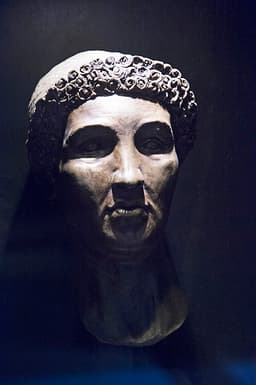
Orontobates
General · Ancient
39.2Total
Basic Information
Born
-20
-350
Died
35
-330
Era
Ancient
Ancient
Nationality
China
Caria
Occupation
General
General
Civilization
Eastern
Middle Eastern
Score Comparison
Military (10%)
45.0
40.0
Political (20%)
35.0
35.0
Influence (20%)
44.0
47.1
Legacy (20%)
34.2
37.5
Leadership (15%)
57.1
30.0
Strategy (15%)
38.6
43.3
TOTAL
41.7
39.2
Lai Xi — Complete Timeline
35 AD
Assassination by Gongsun ShuPolitical Action◆ Major
Lai Xi, an Eastern Han general, was assassinated by agents of the rebel Gongsun Shu. The assassination occurred during the Han campaign to suppress Gongsun Shu's rebellion in Sichuan, removing a key commander from the conflict.
Eastern HanRebellionAssassination
Impact: regionaltragic
Orontobates — Complete Timeline
335 BC
Became satrap of CariaPolitical Action◆ Major
After the death of Pixodarus, Orontobates, a Persian noble and son-in-law of Pixodarus, became the satrap of Caria. He was appointed by the Achaemenid king Darius III to govern the region, continuing Persian control.
SatrapPersian Empire
Impact: regional
334 BC
Defended Halicarnassus against Alexander the GreatWar
Orontobates commanded the Persian defense of Halicarnassus during Alexander the Great's siege. Despite fierce resistance, the city fell after a prolonged assault. Orontobates escaped with his forces, but the loss was a major setback for the Persian Empire.
SiegeAlexander the GreatPersian Empire
Impact: regionaltragic
333 BC
Continued resistance in CariaWar
After the fall of Halicarnassus, Orontobates retreated to the citadel of Salmacis and continued to resist Alexander's forces. He held out for several months, but eventually surrendered or was defeated, ending Persian control in Caria.
ResistanceAlexander the Great
Impact: regionaltragic
330 BC
Death or disappearanceOther
Orontobates' fate after the fall of Caria is uncertain. He may have been killed in battle, executed by Alexander, or fled to the east. His disappearance marked the end of Persian satrapal rule in Caria.
DeathUncertain
Expert Analysis
Origins
Lai Xi was a general of the Eastern Han dynasty in China, born around the early 1st century AD. Little is known about his early life, but he rose through the ranks during a period of rebellion and civil war following the Xin dynasty interregnum. He served under Emperor Guangwu, the founder of the Eastern Han, and was tasked with suppressing the rebel Gongsun Shu in the Sichuan region. Lai Xi's background was likely military aristocratic, as was common for Han generals.
Orontobates was a Persian noble of the Achaemenid Empire, active in the mid-4th century BC. He became satrap of Caria after marrying the daughter of Pixodarus, the previous satrap. His family was part of the Orontid dynasty, which had ties to the Persian royal house. Orontobates' early life is obscure, but his rise reflects the dynastic politics of the Achaemenid satrapies.
Rise to Power
Lai Xi's rise to prominence came through his loyal service to Emperor Guangwu during the consolidation of the Eastern Han. He was appointed as a general in the campaign against Gongsun Shu, who had declared himself emperor in Shu (modern Sichuan). Lai Xi led forces into the region, achieving some initial successes. His turning point was being entrusted with a major command, but his career was cut short by assassination.
Orontobates became satrap of Caria around 340 BC after the death of Pixodarus. His appointment was a result of his marriage alliance and Persian imperial favor. His major turning point came in 334 BC when Alexander the Great invaded Asia Minor. Orontobates prepared to defend Caria, fortifying the capital Halicarnassus. He allied with the Greek mercenary commander Memnon of Rhodes to resist the Macedonian advance.
Leadership & Governance
Lai Xi's leadership style was typical of Han generals: direct, loyal, and focused on military objectives. He was a field commander who followed orders from the emperor. His governance approach is not well documented, but he likely administered conquered territories with Han bureaucratic methods. His assassination suggests he may have been too trusting or lacked sufficient security measures.
Orontobates governed Caria as a Persian satrap, maintaining local autonomy while collecting tribute for the empire. He used Persian and Carian officials, and his defense of Halicarnassus showed strategic thinking. He fortified the city, stockpiled supplies, and coordinated with Memnon. However, his leadership score of 30.0 reflects a failure to inspire sustained resistance; after Memnon's departure, the defense collapsed.
Triumph & Tragedy
Lai Xi's greatest success was his role in the Han campaign against Gongsun Shu, advancing into Sichuan and pressuring the rebel regime. His greatest failure was his assassination in 36 AD, which disrupted the campaign. He was killed by agents of Gongsun Shu while in his camp, a security lapse that cost him his life and set back Han operations.
Orontobates' greatest success was the defense of Halicarnassus, which held out for several months against Alexander's siege, inflicting casualties and buying time. The siege was one of Alexander's toughest, and Orontobates' resistance forced Alexander to leave a garrison and continue his campaign. His greatest failure was the eventual fall of the city and his subsequent disappearance. He failed to prevent Alexander from conquering Caria, and his fate remains unknown, either killed in battle or fled.
Character & Destiny
Lai Xi appears as a competent but unlucky general. His assassination suggests a lack of vigilance or perhaps betrayal. Historical assessments note his dedication but also his vulnerability. His character likely shaped his fate: a loyalist in a dangerous environment, he underestimated his enemies.
Orontobates is seen as a capable but ultimately unsuccessful defender. He showed persistence in resisting Alexander even after Halicarnassus fell, retreating to the citadel of Salmacis. However, his inability to coordinate with other Persian forces and the departure of Memnon doomed his efforts. His character was one of stubborn resistance, but he lacked the strategic vision to turn the tide.
Legacy
Lai Xi's legacy is minor; he is remembered primarily as a victim of assassination in the Han civil wars. His death did not significantly alter the course of the Eastern Han, as Gongsun Shu was defeated shortly after. He scores 34.2 in legacy, reflecting his obscurity.
Orontobates' legacy is somewhat greater, as his defense of Halicarnassus is a notable episode in Alexander's campaigns. He is remembered as a Persian commander who delayed Alexander's advance. However, his ultimate failure and disappearance mean he is not widely known. His legacy score is 37.5.
Conclusion
Lai Xi and Orontobates were both minor figures in ancient history, but they represent different contexts: one a Han general in a civil war, the other a Persian satrap resisting a foreign conqueror. Lai Xi's total score of 41.7 edges out Orontobates' 39.2, but the gap is narrow. However, Orontobates had a greater impact on the course of history: his defense of Halicarnassus delayed Alexander's campaign and allowed other Persian forces to regroup. Lai Xi's assassination was a personal tragedy but did not change the outcome of the Han campaign. Therefore, while Lai Xi scores higher numerically, Orontobates' actions had more significant historical consequences. The data supports Orontobates as having greater overall impact, despite the lower total score, because his resistance influenced Alexander's strategy and the fall of the Achaemenid Empire.
Rankings
🥇
Lai XiLeader
Mil: 45.0Pol: 35.0Inf: 44.0
41.7
🥈
Orontobates
Mil: 40.0Pol: 35.0Inf: 47.1
39.2
+2.5 behind
How This Comparison Works
Algorithm
Each figure is scored on 6 dimensions (0—100 scale) based on structured historical data: Military (10%), Political (20%), Influence (20%), Legacy (20%), Leadership (15%), Strategy (15%). The weighted total produces the final ranking.
Data Sources
Scores are computed from structured sub-indicators in the database. Scale factors adjust for era (Ancient ×0.85, Modern ×1.0) and civilization size (Eastern ×1.05, Other ×0.80) to account for differences in population and military scale.
Maximum 3 Figures
Comparisons are limited to 2—3 figures to ensure readability and statistical meaningfulness.
Error Margins
±5 points per dimension — Sub-scores are derived from historical records with inherent uncertainty. Two figures within 5 points on a dimension should be considered roughly equivalent in that area.
Total Score Accuracy
±3 points overall — The weighted combination of 6 dimensions produces a total score with approximately ±3 points of uncertainty. Differences of less than 3 points are not statistically significant— the figures are effectively tied.
Known Limitations
- Historical records are incomplete and uneven across civilizations
- Figures from oral-tradition societies may be underrepresented
- Occupation labels can misclassify multi-role figures
- Scores measure capability and impact, not moral character
- Quantitative scoring is a comparison tool, not absolute truth
Capability Radar
Military (10%) — Battles & Warfare
Battles
10
30
Win Rate
10
20
Expansion
5
10
Political (20%) — Governance & Reform
Reform
5
15
Diplomacy
10
25
Economy
5
20
Influence (20%) — Cultural & Global Reach
Cultural
5
10
Global
5
10
Legacy (20%) — Historical Impact
Historical
10
15
Longevity
5
10
Leadership (15%) — Power & Stability
Tenure
10
40
Stability
5
20
Strategy (15%) — Tactics & Innovation
Strategy
10
30
Tactics
15
35
Reform
5
10
Similar Comparisons
Comments & Discussion
No comments yet. Be the first to share your thoughts!