Loading...
Kulottunga I vs Li Chun
Kulottunga I leads by 4.5 pts · 2 figures compared
…
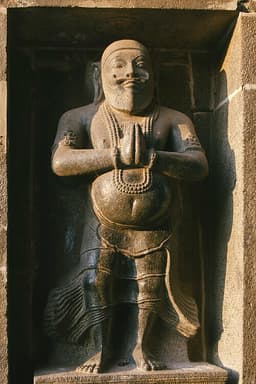
Kulottunga I
Emperor · Medieval
66.1Total

Li Chun
Emperor · Medieval
61.6Total
Basic Information
Born
1025
778
Died
1122
820
Era
Medieval
Medieval
Nationality
India
China
Occupation
Emperor
Emperor
Civilization
Indian
Eastern
Score Comparison
Military (10%)
78.0
60.0
Political (20%)
72.0
70.0
Influence (20%)
56.7
61.0
Legacy (20%)
58.0
52.0
Leadership (15%)
82.0
68.0
Strategy (15%)
65.4
66.3
TOTAL
66.1
61.6
Kulottunga I — Complete Timeline
1070 AD
Loss of control over Sri LankaWar◆ Major
During Kulottunga I's reign, the Chola hold over Sri Lanka weakened. The Sinhalese king Vijayabahu I expelled Chola forces from the island, ending Chola rule there after several decades.
Sri LankaCholaLoss of Territory
Impact: regionaldestructive
Accession to the Chola thronePolitical Action◆ Major
Kulottunga I became the Chola emperor, succeeding his cousin Adhirajendra. He was a descendant of both the Chola and Chalukya dynasties, and his accession united the two kingdoms under his rule, marking the beginning of the Chalukya-Chola period.
Chola DynastyChalukya DynastySuccession
Impact: regionalconstructive
1075 AD
War with the Western ChalukyasWar◆ Major
Kulottunga I fought a series of wars against the Western Chalukya king Vikramaditya VI. The conflict was over control of the Vengi region and resulted in a stalemate, with neither side achieving decisive victory.
Western ChalukyaVengiWar
Impact: regional
1080 AD
Administrative reforms and temple patronageReform
Kulottunga I implemented administrative reforms, including land revenue assessments and temple patronage. He granted lands to Brahmins and temples, particularly at Chidambaram and Kanchipuram, which strengthened his rule and religious legitimacy.
AdministrationTemple PatronageLand Grants
Impact: nationalconstructive
1096 AD
Campaign in KalingaWar
Kulottunga I led a military campaign into Kalinga (modern Odisha). The Chola army defeated the Kalinga forces and extracted tribute, extending Chola influence into the region.
KalingaMilitary CampaignTribute
Impact: regional
Li Chun — Complete Timeline
806 AD
Yuanhe Restoration CampaignsWar◆ Major
Li Chun launched a series of military campaigns to reassert central control over rebellious fanzhen. He defeated the warlords of Sichuan, Zhenhai, and other provinces, reducing their autonomy and restoring imperial authority.
Yuanhe RestorationFanzhen SuppressionMilitary Campaigns
Impact: nationalconstructive
812 AD
Defeat of the Fanzhen of ZhaoyiWar◆ Major
Li Chun's forces defeated the powerful Zhaoyi fanzhen, whose military governor had rebelled. This victory was a major achievement of the Yuanhe Restoration, demonstrating the Tang court's renewed military strength.
Yuanhe RestorationZhaoyiMilitary Victory
Impact: nationalconstructive
819 AD
Submission of the Fanzhen of ChengdePolitical Action◆ Major
After a long campaign, the Chengde fanzhen submitted to central authority. This was the last major fanzhen to be brought under control during Li Chun's reign, marking the peak of the Yuanhe Restoration.
Yuanhe RestorationChengdeSubmission
Impact: nationalconstructive
820 AD
Death of Li ChunOther
Li Chun died in 820, possibly poisoned by eunuchs. His death ended the Yuanhe Restoration, and subsequent emperors were unable to maintain the central authority he had reestablished.
DeathYuanhe Restoration EndEunuch Power
Impact: nationaltragic
Expert Analysis
Origins
Kulottunga I was born around 1025 CE as a prince of the Chalukya dynasty, son of the Eastern Chalukya king Rajaraja Narendra and a Chola princess. He was raised in the Chalukya court of Vengi, receiving education in administration and warfare. His dual lineage made him a unique figure, bridging two rival dynasties. Li Chun, born in 778 CE, was the eldest son of Emperor Tang Dezong. He grew up in the Tang imperial palace, witnessing the decline of central authority as regional military governors (fanzhen) grew powerful. His early education emphasized Confucian classics and statecraft, preparing him for restoration.
Rise to Power
Kulottunga I ascended the Chola throne in 1070 CE after the assassination of his cousin Adhirajendra. He had previously governed Vengi as a prince, and his claim was supported by the Chola court due to his maternal lineage. He immediately faced challenges from the Western Chalukyas, who contested his control over Vengi. Li Chun became emperor in 805 CE after his father's death. He inherited a fractured empire where fanzhen ignored central orders. His rise was marked by determination to reassert imperial power, beginning with the suppression of rebellious governors.
Leadership & Governance
Kulottunga I's leadership style was administrative and diplomatic. He reformed land revenue assessment, standardizing taxes and reducing corruption. He patronized temples and Brahmins, gaining religious legitimacy. In contrast, Li Chun focused on military centralization. He appointed loyal generals to key posts and used rewards to secure submission. Kulottunga scored 82.0 in leadership, reflecting his ability to unite two kingdoms; Li Chun scored 68.0, showing strong but less enduring control. Both faced internal opposition: Kulottunga managed succession smoothly, while Li Chun struggled with eunuch power.
Triumph & Tragedy
Kulottunga's greatest success was unifying the Chola and Chalukya domains, creating a stable realm for over 50 years. He also campaigned in Kalinga, extracting tribute. His tragedy was the loss of Sri Lanka: Vijayabahu I expelled Chola forces, ending 50 years of Chola rule. Li Chun's triumph was the Yuanhe Restoration; he defeated the fanzhen of Sichuan, Zhenhai, and Zhaoyi, and secured the submission of Chengde. His tragedy was his death in 820 CE, possibly poisoned by eunuchs. The restoration collapsed as successors failed to maintain control. Both leaders achieved temporary stability, but Li Chun's work was undone quickly.
Character & Destiny
Kulottunga I was pragmatic and patient, preferring diplomacy over war. He avoided major conflicts with the Western Chalukyas after initial battles, focusing on internal consolidation. His character enabled a long reign (1070-1122 CE). Li Chun was aggressive and determined, but his reliance on eunuchs and harsh methods created enemies. His death at 42 cut short his reforms. Historians note that Kulottunga's balanced approach led to lasting administrative changes, while Li Chun's military gains were fragile. In strategy, Kulottunga scored 65.4, Li Chun 66.3, reflecting similar tactical skill.
Legacy
Kulottunga I's legacy is the integration of Chola and Chalukya cultures. His land reforms influenced later Chola administration. The Chola empire continued for another century after him, though weakened. Li Chun's legacy is the Yuanhe Restoration, a brief resurgence of Tang power. He is remembered as a reformer, but his failure to curb eunuch influence led to the dynasty's decline. In influence, Kulottunga scored 56.7, Li Chun 61.0; in legacy, Kulottunga scored 58.0, Li Chun 52.0. Overall, Kulottunga's total score of 66.1 surpasses Li Chun's 61.6.
Conclusion
Kulottunga I had a greater impact than Li Chun. His unification of two major dynasties and administrative reforms endured for decades, while Li Chun's restoration collapsed within years of his death. Kulottunga's higher leadership score (82.0 vs 68.0) and total score (66.1 vs 61.6) reflect his more sustainable achievements. Though Li Chun's military campaigns were impressive, they did not outlast him. Kulottunga's legacy as a unifier is more significant in the long term.
Rankings
🥇
Kulottunga ILeader
Mil: 78.0Pol: 72.0Inf: 56.7
66.1
🥈
Li Chun
Mil: 60.0Pol: 70.0Inf: 61.0
61.6
+4.5 behind
How This Comparison Works
Algorithm
Each figure is scored on 6 dimensions (0—100 scale) based on structured historical data: Military (10%), Political (20%), Influence (20%), Legacy (20%), Leadership (15%), Strategy (15%). The weighted total produces the final ranking.
Data Sources
Scores are computed from structured sub-indicators in the database. Scale factors adjust for era (Ancient ×0.85, Modern ×1.0) and civilization size (Eastern ×1.05, Other ×0.80) to account for differences in population and military scale.
Maximum 3 Figures
Comparisons are limited to 2—3 figures to ensure readability and statistical meaningfulness.
Error Margins
±5 points per dimension — Sub-scores are derived from historical records with inherent uncertainty. Two figures within 5 points on a dimension should be considered roughly equivalent in that area.
Total Score Accuracy
±3 points overall — The weighted combination of 6 dimensions produces a total score with approximately ±3 points of uncertainty. Differences of less than 3 points are not statistically significant— the figures are effectively tied.
Known Limitations
- Historical records are incomplete and uneven across civilizations
- Figures from oral-tradition societies may be underrepresented
- Occupation labels can misclassify multi-role figures
- Scores measure capability and impact, not moral character
- Quantitative scoring is a comparison tool, not absolute truth
Capability Radar
Military (10%) — Battles & Warfare
Battles
75
70
Win Rate
80
75
Expansion
80
65
Political (20%) — Governance & Reform
Reform
70
85
Diplomacy
75
70
Economy
80
75
Influence (20%) — Cultural & Global Reach
Cultural
70
55
Global
55
50
Legacy (20%) — Historical Impact
Historical
65
70
Longevity
60
60
Leadership (15%) — Power & Stability
Tenure
85
60
Stability
75
65
Strategy (15%) — Tactics & Innovation
Strategy
75
70
Tactics
70
65
Reform
65
80
Similar Comparisons
Comments & Discussion
No comments yet. Be the first to share your thoughts!