Loading...
Kublai Khan vs Oduduwa
Kublai Khan leads by 14.6 pts · 2 figures compared
…
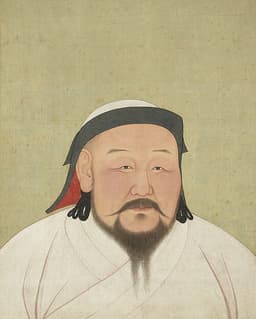
Kublai Khan
Emperor · Medieval
74.3Total
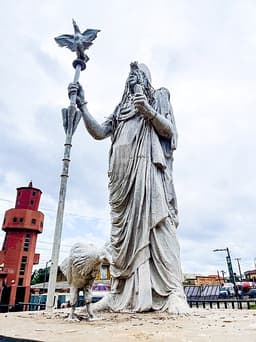
Oduduwa
Emperor · Medieval
59.7Total
Basic Information
Born
1215
950
Died
1294
1020
Era
Medieval
Medieval
Nationality
Mongolia
Ife
Occupation
Emperor
Emperor
Civilization
Eastern
Other
Score Comparison
Military (10%)
77.5
50.0
Political (20%)
79.2
46.6
Influence (20%)
75.0
68.0
Legacy (20%)
70.0
68.0
Leadership (15%)
72.0
67.0
Strategy (15%)
76.0
36.8
TOTAL
74.3
59.7
Kublai Khan — Complete Timeline
1260 AD
Adoption of Tibetan Buddhism as State ReligionCultural◆ Major
Kublai Khan appointed the Tibetan lama Drog
Tibetan BuddhismReligionMongol-Tibet Relations
Impact: regional
1271 AD
Proclamation of the Yuan DynastyPolitical Action◆ Major
Kublai Khan officially proclaimed the Yuan dynasty, adopting a Chinese-style dynastic name. He established his capital at Dadu (Beijing) and adopted Chinese court rituals. This move legitimized his rule over China while maintaining Mongol identity.
Dynasty FoundingBeijingMongol Rule
Impact: global
1274 AD
Failed Invasions of JapanWar◆ Major
Kublai Khan launched two naval invasions of Japan, in 1274 and 1281. Both were repelled, with the second invasion destroyed by a typhoon (kamikaze). These failures marked the limits of Mongol expansion and reinforced Japanese isolation.
Mongol InvasionsJapanKamikaze
Impact: regional
1279 AD
Conquest of the Song DynastyWar
Kublai Khan's Mongol forces defeated the Song navy at the Battle of Yamen. The last Song emperor drowned, ending the Song dynasty. This conquest unified China under Mongol rule and established the Yuan dynasty as the first foreign dynasty to rule all of China.
Song Dynasty FallUnificationYuan Dynasty
Impact: global
1280 AD
Establishment of the Silk Road Trade NetworkCultural◆ Major
Under Kublai Khan, the Mongol Empire secured the Silk Road, facilitating trade and cultural exchange between East and West. Marco Polo visited his court. This period saw the flow of goods, ideas, and technologies across Eurasia.
Silk RoadTradeCultural Exchange
Impact: globalconstructive
Oduduwa — Complete Timeline
1000 AD
Foundation of the Yoruba civilization at Ile-IfeCultural
According to Yoruba oral tradition, Oduduwa descended from heaven at Ile-Ife and founded the Yoruba civilization. He is credited with establishing the first Yoruba kingdom and the sacred city of Ile-Ife, which became the spiritual and cultural heartland of the Yoruba people.
Impact: regionalconstructive
1010 AD
Establishment of the Yoruba royal dynastiesPolitical Action◆ Major
Oduduwa is said to have sent his sons and grandsons to found the various Yoruba kingdoms, including Oyo, Benin, and Ketu. This act established the royal lineages that ruled these states for centuries, creating a network of related kingdoms under the spiritual authority of the Ooni of Ife.
Impact: regionalconstructive
Expert Analysis
Kublai Khan vs Oduduwa
# The Emperor and the Sky-King
In the winter of 1274, Kublai Khan stood on the deck of a Mongol warship, watching the grey waters of the Sea of Japan churn beneath him. He had built the largest navy Asia had ever seen—some nine hundred vessels—to conquer an island kingdom that refused his submission. Across the world, in the rainforests of West Africa, another ruler had faced no such resistance. Oduduwa, according to the oral histories of the Yoruba people, simply descended from the sky at Ile-Ife, and the earth received him as its master. One man conquered through storms of steel and gunpowder; the other, through myth and lineage. Their civilizations could not have been more different. Yet both built empires that would define their peoples for centuries.
Origins
Kublai Khan was born into the saddle. His grandfather was Genghis Khan, the man who had united the Mongol tribes and set them thundering across Asia. Kublai grew up in the felt tents of the steppe, learning to ride before he could walk, but he also absorbed something his grandfather never did: a fascination with Chinese civilization. While his brothers hunted and fought, Kublai studied the writings of Confucius and the administrative systems of the Song emperors. The Mongol world was one of blood and mobility; the Chinese world, of bureaucracy and permanence. Kublai lived between these two poles for his entire life.
Oduduwa emerged from a different kind of sky. The Yoruba oral tradition, recorded centuries later, tells of a time when the earth was only water. The supreme god, Olodumare, sent Oduduwa down on a chain from heaven, carrying a handful of soil and a five-toed chicken. He scattered the soil on the waters, the chicken scratched it into land, and Ile-Ife—the cradle of Yoruba civilization—was born. Whether Oduduwa was a historical figure or a divine archetype matters less than what he represented: a founding moment that gave the Yoruba people their identity, their kingship, and their sacred connection to the land.
Rise to Power
Kublai’s path to power was a civil war. When his brother, the Great Khan Möngke, died in 1259, Kublai and his younger brother Ariq Böke each claimed the throne. Kublai was in China, besieging a Song fortress; Ariq Böke was in the Mongol homeland, Karakorum. Kublai rushed back, convened his own kurultai, and had himself declared Great Khan in 1260. The resulting war lasted four years. Kublai won not because he was the better warrior—Ariq Böke was that—but because he controlled the wealth and grain of China. He starved his brother into submission.
Oduduwa needed no war. His rise was the founding itself. According to the tradition, he became the first Ooni (king) of Ife, and his children—sixteen sons and daughters—were sent out to establish the kingdoms that would form the Yoruba world: Oyo, Benin, Ketu, and others. There is no record of conquest, no battle of Yamen for Oduduwa. His power was genealogical. To be a Yoruba king was to trace your line back to him. The crown itself became sacred, and the king became the living embodiment of the ancestors.
Leadership & Governance
Kublai Khan governed China as a Mongol emperor who wanted to be a Chinese emperor. He adopted the name Yuan for his dynasty in 1271, built a new capital at Dadu (modern Beijing), and staffed his bureaucracy with Confucian scholars—but he also kept Mongols and Central Asians in the highest positions. He reduced taxes, repaired the Grand Canal, and issued paper currency that stabilized the economy. Yet he never fully trusted the Chinese, and he never fully abandoned the steppe. He spent summers in Shangdu (Xanadu), the summer palace that Coleridge would later imagine as a pleasure-dome of visions and dreams.
Oduduwa’s governance was not administrative but symbolic. He established the principle of *Ile*—the sacred house of the king—and the idea that the king ruled by divine appointment. The Ooni of Ife became the spiritual head of all Yoruba, even as political power shifted to Oyo and other kingdoms. Oduduwa did not create a centralized empire like Kublai; he created a web of related kingdoms, each with its own king, but all acknowledging Ife as their source. Governance was not about tax collection or military conscription. It was about ritual, lineage, and the maintenance of cosmic order.
Triumph & Tragedy
Kublai’s greatest triumph was the conquest of the Song Dynasty in 1279. At the Battle of Yamen, the last Song emperor—a child of seven—was drowned by a loyal minister rather than captured. Kublai had united all of China for the first time in three centuries. His greatest tragedy was the sea. Twice he tried to conquer Japan, in 1274 and 1281. Twice the *kamikaze*—the divine wind—rose up and shattered his fleets. Thousands of Mongol and Korean and Chinese soldiers drowned in the typhoons. The invasions were a catastrophic waste of lives and resources, born of Kublai’s inability to accept that a small island kingdom could defy him.
Oduduwa’s triumph was the foundation itself. He gave the Yoruba a homeland, a religion, and a kingship that has endured for a thousand years. His tragedy is harder to see, because it is the tragedy of prehistory. We do not know his failures, his doubts, his enemies. He exists only as a figure of light. The Yoruba tradition says he turned into stone at the end of his life, a petrified king watching over Ife. It is a beautiful image, but it hides the human cost of founding a civilization—the wars, the famines, the rivalries that oral memory has smoothed into myth.
Character & Destiny
Kublai Khan was pragmatic, curious, and ruthless. He welcomed Marco Polo to his court, listened to stories of distant lands, and allowed Buddhism, Islam, and Christianity to coexist in his empire. But he also executed his rivals, crushed rebellions, and sent thousands to their deaths in failed campaigns. His character was shaped by the tension between Mongol tradition and Chinese civilization. He wanted to be a universal emperor, but he could not escape the fact that he was a conqueror from the steppe.
Oduduwa’s character is unknowable. He is a figure of myth, not biography. But his destiny is clear: he became the father of a people. Where Kublai’s Yuan Dynasty collapsed within a century of his death—overthrown by the Ming in 1368—Oduduwa’s legacy grew. Every Yoruba king today, from the Ooni of Ife to the Alaafin of Oyo, traces his authority back to Oduduwa. The myth was more durable than the empire.
Legacy
Kublai Khan’s legacy is vast but fragile. He reopened the Silk Road, connecting Europe and Asia in a way that had not been possible since the Roman Empire. Marco Polo’s travels, which became the most famous travelogue in history, were only possible because of Kublai’s peace. But the Yuan Dynasty was short-lived, and the Mongols were eventually driven out of China. Kublai is remembered as a great emperor, but also as a foreign conqueror.
Oduduwa’s legacy is invisible to many outside West Africa, but it is alive. Ile-Ife remains the spiritual center of the Yoruba world. The Ooni of Ife still wears the sacred crown. Oduduwa is not a historical figure in the way Kublai is; he is a living ancestor, invoked in prayers and ceremonies. His legacy is not monuments or trade routes, but identity itself.
Conclusion
Two rulers, two worlds. Kublai Khan built an empire of iron and silk, stretching from Korea to Hungary, and saw it crumble within generations. Oduduwa built no empire at all—only a story, a lineage, a sacred city. And that story has outlasted every Mongol conquest. Perhaps the deepest difference between them is this: Kublai conquered the world, and the world forgot him. Oduduwa founded a people, and they have never forgotten him.
Rankings
🥇
Kublai KhanLeader
Mil: 77.5Pol: 79.2Inf: 75.0
74.3
🥈
Oduduwa
Mil: 50.0Pol: 46.6Inf: 68.0
59.7
+14.6 behind
How This Comparison Works
Algorithm
Each figure is scored on 6 dimensions (0—100 scale) based on structured historical data: Military (10%), Political (20%), Influence (20%), Legacy (20%), Leadership (15%), Strategy (15%). The weighted total produces the final ranking.
Data Sources
Scores are computed from structured sub-indicators in the database. Scale factors adjust for era (Ancient ×0.85, Modern ×1.0) and civilization size (Eastern ×1.05, Other ×0.80) to account for differences in population and military scale.
Maximum 3 Figures
Comparisons are limited to 2—3 figures to ensure readability and statistical meaningfulness.
Error Margins
±5 points per dimension — Sub-scores are derived from historical records with inherent uncertainty. Two figures within 5 points on a dimension should be considered roughly equivalent in that area.
Total Score Accuracy
±3 points overall — The weighted combination of 6 dimensions produces a total score with approximately ±3 points of uncertainty. Differences of less than 3 points are not statistically significant— the figures are effectively tied.
Known Limitations
- Historical records are incomplete and uneven across civilizations
- Figures from oral-tradition societies may be underrepresented
- Occupation labels can misclassify multi-role figures
- Scores measure capability and impact, not moral character
- Quantitative scoring is a comparison tool, not absolute truth
Capability Radar
Military (10%) — Battles & Warfare
Battles
95
10
Win Rate
90
10
Expansion
95
30
Political (20%) — Governance & Reform
Reform
88
50
Diplomacy
85
40
Economy
90
40
Influence (20%) — Cultural & Global Reach
Cultural
85
80
Global
85
70
Legacy (20%) — Historical Impact
Historical
90
80
Longevity
80
80
Leadership (15%) — Power & Stability
Tenure
90
40
Stability
80
50
Strategy (15%) — Tactics & Innovation
Strategy
92
10
Tactics
85
10
Reform
88
10
Similar Comparisons
Comments & Discussion
GANGLAND GRANDSON6/16/2026
The real story here isn't about sky gods or divine kings—it's about logistics. Kublai's 900-ship navy in 1274 was a logistical nightmare that actually failed twice against Japan due to typhoons. Meanwhile, Oduduwa's "descent from heaven" conveniently skips over the fact that Ife's iron-smelting technology predated him by centuries. Myth makes for great nationalism, but give me a census record any day.
铁蹄书虫6/16/2026
说Oduduwa是“从天而降”的始祖,可非洲考古学界的同位素分析早已证明,西非的冶铁技术是本土独立发展的,把神话当正史实在太天真。Kublai至少留下了实实在在的户口册和纸币系统,而Oduduwa的故事更像是后期政权为了合法性编造的“神授”叙事。要比较,请用碳14测年和文献考据说话,别拿传说糊弄人。
OCEAN'S REVENGE6/16/2026
Let's be clear: Kublai's naval ambitions weren't just imperial vanity—they were a strategic necessity. After conquering Song China, he needed to neutralize Japan as a potential haven for Song loyalists. The 1274 invasion force of 23,000 troops was actually well-planned, but the Samurai defense-in-depth and that August typhoon (not a divine wind myth yet) wrecked his timetable. Oduduwa never had to worry about weather or logistics—that's the luxury of founding myths.
天命破译者6/16/2026
认真读历史的人都知道,Kublai在1274年首次征日时配备了火器——那是历史上第一次有记载的跨海火药战。可惜元军不熟悉季风规律,而Oduduwa的“天空降临”连基本的天文坐标都留白。东方帝王至少用火药和税赋丈量帝国,西非鼻祖却只用铜器和祭祀传说。这不是文明高下,是实证与空想的分野。
BUREAUCRAT'S BLADE6/16/2026
Let's talk about what actually holds an empire together: not divine blood, but administrative paperwork. Kublai divided his realm into provinces, issued paper currency, and even commissioned a census in 1290 that recorded 58 million households. Oduduwa's legacy rests entirely on oral tradition and the Oyo Empire's later dynastic claims. One ruler gave us the first reliable population statistics in East Asian history; the other gave us a creation myth. I know which one I'd trust with tax collecti
刀锋与星宿6/16/2026
军事上,Kublai在1274年动用了高丽和南宋降将的联合舰队,这是跨文化协同作战的早期范例。而Oduduwa的“16个儿子建立16个王国”的说法,更像是后期城邦联盟为了平衡权力而编造的政治