Loading...
This comparison has not been analyzed yet.
One-time AI generation (~1 minute). Scores and timeline are already available below.
Koprulu Mehmed Pasha vs Nuon Chea
Koprulu Mehmed Pasha leads by 14.8 pts · 2 figures compared
…
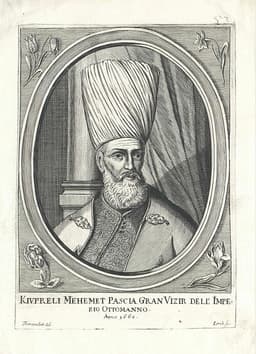
Koprulu Mehmed Pasha
Politician · Modern
61.6Total

Nuon Chea
Politician · Modern
46.8Total
Basic Information
Born
1575
1926
Died
1661
—
Era
Modern
Modern
Nationality
Ottoman Empire
Cambodia
Occupation
Politician
Politician
Civilization
Middle Eastern
Eastern
Score Comparison
Military (10%)
30.0
41.6
Political (20%)
62.7
26.4
Influence (20%)
72.0
50.2
Legacy (20%)
55.0
43.3
Leadership (15%)
78.0
65.7
Strategy (15%)
57.5
54.6
TOTAL
61.6
46.8
Koprulu Mehmed Pasha — Complete Timeline
1656 AD
Reform of the Ottoman Military and BureaucracyReform◆ Major
Koprulu Mehmed Pasha implemented sweeping reforms, including purging corrupt officials, restoring discipline in the Janissary corps, and reorganizing the tax system. These measures stabilized the empire and restored its military effectiveness after years of decline.
ReformOttoman AdministrationMilitary
Impact: nationalconstructive
Appointment as Grand VizierPolitical Action
Koprulu Mehmed Pasha was appointed Grand Vizier by Sultan Mehmed IV during a period of crisis. He was granted unprecedented authority to restore order, marking the beginning of the Koprulu era of reform and revitalization of the Ottoman state.
Koprulu EraReformOttoman Politics
Impact: nationalconstructive
1657 AD
Suppression of the Venetian Blockade of the DardanellesWar◆ Major
Koprulu Mehmed Pasha led a campaign to break the Venetian blockade of the Dardanelles. The Ottoman navy defeated the Venetian fleet, securing the sea route to Istanbul and restoring Ottoman naval power in the Aegean.
Ottoman-Venetian WarNaval BattleDardanelles
Impact: regionalconstructive
Execution of Patriarch Parthenius IIIPolitical Action
Koprulu Mehmed Pasha ordered the execution of Greek Orthodox Patriarch Parthenius III, accusing him of treason and correspondence with the Venetians. This act demonstrated his harsh methods in suppressing dissent and consolidating control.
ExecutionReligious PoliticsRepression
destructive
Nuon Chea — Complete Timeline
1960 AD
Joined Khmer Rouge LeadershipPolitical Action◆ Major
Nuon Chea joined the Communist Party of Kampuchea and became a close associate of Pol Pot. He was later designated Brother Number Two, second-in-command of the Khmer Rouge regime.
Khmer RougeLeadership
Impact: national
1975 AD
Democratic Kampuchea RegimePolitical Action
Nuon Chea served as Vice Chairman of the Communist Party of Kampuchea and President of the People's Representative Assembly during the Khmer Rouge regime (1975-1979). He was a key architect of the regime's policies.
Khmer RougeGenocideRegime
Impact: globaldestructive
2007 AD
Arrested by Cambodian TribunalPolitical Action◆ Major
Nuon Chea was arrested by the Extraordinary Chambers in the Courts of Cambodia (ECCC) for crimes against humanity, genocide, and war crimes committed during the Khmer Rouge era.
ArrestTribunalJustice
Impact: global
2018 AD
Convicted of GenocidePolitical Action
Nuon Chea was convicted of genocide, crimes against humanity, and war crimes by the ECCC. He received a life sentence for his role in the Khmer Rouge's atrocities, including the genocide of the Cham minority.
ConvictionGenocideInternational Justice
Impact: global
This comparison has not been analyzed yet.
One-time AI generation (~1 minute). Scores and timeline are already available below.
Rankings
🥇
Koprulu Mehmed PashaLeader
Mil: 30.0Pol: 62.7Inf: 72.0
61.6
🥈
Nuon Chea
Mil: 41.6Pol: 26.4Inf: 50.2
46.8
+14.8 behind
How This Comparison Works
Algorithm
Each figure is scored on 6 dimensions (0—100 scale) based on structured historical data: Military (10%), Political (20%), Influence (20%), Legacy (20%), Leadership (15%), Strategy (15%). The weighted total produces the final ranking.
Data Sources
Scores are computed from structured sub-indicators in the database. Scale factors adjust for era (Ancient ×0.85, Modern ×1.0) and civilization size (Eastern ×1.05, Other ×0.80) to account for differences in population and military scale.
Maximum 3 Figures
Comparisons are limited to 2—3 figures to ensure readability and statistical meaningfulness.
Error Margins
±5 points per dimension — Sub-scores are derived from historical records with inherent uncertainty. Two figures within 5 points on a dimension should be considered roughly equivalent in that area.
Total Score Accuracy
±3 points overall — The weighted combination of 6 dimensions produces a total score with approximately ±3 points of uncertainty. Differences of less than 3 points are not statistically significant— the figures are effectively tied.
Known Limitations
- Historical records are incomplete and uneven across civilizations
- Figures from oral-tradition societies may be underrepresented
- Occupation labels can misclassify multi-role figures
- Scores measure capability and impact, not moral character
- Quantitative scoring is a comparison tool, not absolute truth
Capability Radar
Military (10%) — Battles & Warfare
Battles
55
10
Win Rate
60
10
Expansion
45
10
Political (20%) — Governance & Reform
Reform
85
20
Diplomacy
70
10
Economy
65
5
Influence (20%) — Cultural & Global Reach
Cultural
50
10
Global
55
30
Legacy (20%) — Historical Impact
Historical
70
40
Longevity
65
20
Leadership (15%) — Power & Stability
Tenure
60
60
Stability
80
5
Strategy (15%) — Tactics & Innovation
Strategy
65
15
Tactics
50
15
Reform
75
20
Similar Comparisons
Comments & Discussion
No comments yet. Be the first to share your thoughts!