Loading...
This comparison has not been analyzed yet.
One-time AI generation (~1 minute). Scores and timeline are already available below.
Konstantin Rokossovsky vs Walter Model
Konstantin Rokossovsky leads by 20.8 pts · 2 figures compared
…

Konstantin Rokossovsky
General · Modern
73.8Total
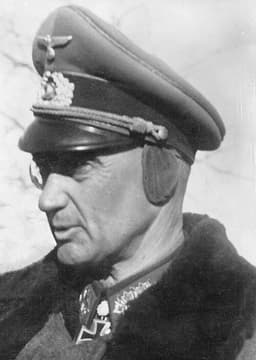
Walter Model
General · Modern
53.0Total
Basic Information
Born
1896
1891
Died
1968
1945
Era
Modern
Modern
Nationality
USSR
Germany
Occupation
General
General
Civilization
Western
Western
Score Comparison
Military (10%)
74.0
78.0
Political (20%)
72.0
27.9
Influence (20%)
82.0
58.0
Legacy (20%)
72.0
54.0
Leadership (15%)
68.0
36.9
Strategy (15%)
69.2
75.0
TOTAL
73.8
53.0
Konstantin Rokossovsky — Complete Timeline
1941 AD
Commanded 16th Army in the Battle of MoscowWar◆ Major
Rokossovsky commanded the 16th Army during the Battle of Moscow. His forces defended the Volokolamsk Highway and participated in the Soviet counteroffensive that pushed German forces back from the capital. His leadership was crucial in stabilizing the front.
World War IIBattle of MoscowEastern Front
Impact: regionalconstructive
1943 AD
Commanded Don Front at the Battle of StalingradWar
Rokossovsky commanded the Don Front during Operation Uranus, the Soviet encirclement of the German 6th Army at Stalingrad. His forces played a key role in closing the encirclement and later in the final defeat of the trapped German forces. This victory was a turning point in the war.
World War IIBattle of StalingradTurning Point
Impact: globalconstructive
1944 AD
Commanded 1st Belorussian Front in Operation BagrationWar
Rokossovsky commanded the 1st Belorussian Front during Operation Bagration, the Soviet offensive that destroyed German Army Group Center. His forces advanced through Belarus and into Poland, reaching the Vistula River. The operation was one of the largest Soviet victories of the war.
World War IIOperation BagrationEastern Front
Impact: globalconstructive
1945 AD
Commanded the Moscow Victory ParadeCultural◆ Major
Rokossovsky was chosen to command the Moscow Victory Parade on June 24, 1945, celebrating the Soviet Union's victory over Nazi Germany. He rode a white horse through Red Square, leading the parade. This event symbolized Soviet military triumph and his personal prestige.
World War IIVictory ParadeSoviet Union
Impact: nationalconstructive
Walter Model — Complete Timeline
1941 AD
Commanded 9th Army in Operation BarbarossaWar◆ Major
Model commanded the 3rd Panzer Division and later the 9th Army during the invasion of the Soviet Union. He participated in the encirclement battles at Bialystok and Minsk, and later in the advance on Moscow. His aggressive tactics earned him a reputation as a defensive specialist.
World War IIOperation BarbarossaEastern Front
Impact: regionaldestructive
1942 AD
Defensive Victory at the Rzhev SalientWar◆ Major
Model commanded the 9th Army in the Rzhev salient, where he conducted a successful defensive battle against Soviet offensives. He used counterattacks and elastic defense to inflict heavy casualties on the Red Army, stabilizing the German line despite being outnumbered.
World War IIEastern FrontRzhev
Impact: regionaldestructive
1944 AD
Commanded Army Group B in Normandy and the Ruhr PocketWar
Model was transferred to the Western Front to command Army Group B after the Allied invasion of Normandy. He failed to stop the Allied breakout and was later encircled in the Ruhr Pocket in April 1945. Facing capture, he shot himself on April 21, 1945.
World War IIWestern FrontRuhr PocketSuicide
Impact: globaltragic
Appointed Commander of Army Group NorthPolitical Action◆ Major
Model was appointed commander of Army Group North in January 1944 after the Soviet Leningrad-Novgorod Offensive. He stabilized the front and prevented a complete collapse, earning Hitler's trust as a 'fireman' who could salvage desperate situations.
World War IIEastern FrontArmy Group North
Impact: regional
This comparison has not been analyzed yet.
One-time AI generation (~1 minute). Scores and timeline are already available below.
Rankings
🥇
Konstantin RokossovskyLeader
Mil: 74.0Pol: 72.0Inf: 82.0
73.8
🥈
Walter Model
Mil: 78.0Pol: 27.9Inf: 58.0
53.0
+20.8 behind
How This Comparison Works
Algorithm
Each figure is scored on 6 dimensions (0—100 scale) based on structured historical data: Military (10%), Political (20%), Influence (20%), Legacy (20%), Leadership (15%), Strategy (15%). The weighted total produces the final ranking.
Data Sources
Scores are computed from structured sub-indicators in the database. Scale factors adjust for era (Ancient ×0.85, Modern ×1.0) and civilization size (Eastern ×1.05, Other ×0.80) to account for differences in population and military scale.
Maximum 3 Figures
Comparisons are limited to 2—3 figures to ensure readability and statistical meaningfulness.
Error Margins
±5 points per dimension — Sub-scores are derived from historical records with inherent uncertainty. Two figures within 5 points on a dimension should be considered roughly equivalent in that area.
Total Score Accuracy
±3 points overall — The weighted combination of 6 dimensions produces a total score with approximately ±3 points of uncertainty. Differences of less than 3 points are not statistically significant— the figures are effectively tied.
Known Limitations
- Historical records are incomplete and uneven across civilizations
- Figures from oral-tradition societies may be underrepresented
- Occupation labels can misclassify multi-role figures
- Scores measure capability and impact, not moral character
- Quantitative scoring is a comparison tool, not absolute truth
Capability Radar
Military (10%) — Battles & Warfare
Battles
85
85
Win Rate
80
80
Expansion
70
60
Political (20%) — Governance & Reform
Reform
55
10
Diplomacy
65
15
Economy
50
10
Influence (20%) — Cultural & Global Reach
Cultural
60
30
Global
70
50
Legacy (20%) — Historical Impact
Historical
75
65
Longevity
65
40
Leadership (15%) — Power & Stability
Tenure
60
20
Stability
60
10
Strategy (15%) — Tactics & Innovation
Strategy
90
85
Tactics
88
90
Reform
75
70
Similar Comparisons
Comments & Discussion
No comments yet. Be the first to share your thoughts!