Loading...
Kong Guang vs Lord Pingyuan
Kong Guang leads by 0.6 pts · 2 figures compared
…

Kong Guang
Politician · Ancient
54.2Total
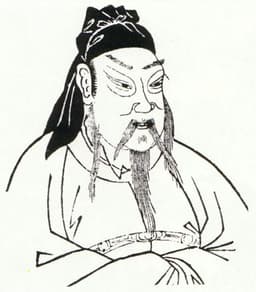
Lord Pingyuan
Politician · Ancient
53.6Total
Basic Information
Born
-70
-308
Died
5
-251
Era
Ancient
Ancient
Nationality
China
China
Occupation
Politician
Politician
Civilization
Eastern
Eastern
Score Comparison
Military (10%)
50.0
50.0
Political (20%)
68.0
45.1
Influence (20%)
54.9
56.4
Legacy (20%)
45.0
50.0
Leadership (15%)
66.0
74.0
Strategy (15%)
41.2
41.0
TOTAL
54.2
53.6
Kong Guang — Complete Timeline
10 BC
Appointed as Chancellor of HanPolitical Action◆ Major
Kong Guang was appointed as chancellor (chengxiang) of the Han dynasty under Emperor Ai. As a descendant of Confucius, his appointment symbolized the continued influence of Confucian scholarship in the imperial government.
Han DynastyGovernmentConfucianism
Impact: nationalconstructive
7 BC
Advised Against the Abdication of Emperor AiPolitical Action◆ Major
Kong Guang counseled Emperor Ai against abdicating the throne in favor of his male favorite Dong Xian. He argued that such an act would violate the principles of the Mandate of Heaven and destabilize the state.
Han DynastyPolitical AdviceSuccession
Impact: national
5 AD
Opposed the Usurpation of Wang MangPolitical Action◆ Major
Kong Guang opposed the growing power of the regent Wang Mang, who later usurped the Han throne. He attempted to rally Confucian scholars against Wang Mang's reforms but was ultimately sidelined.
Han DynastyUsurpationConfucian Resistance
Impact: national
Death in ExilePolitical Action
Kong Guang was forced into exile by Wang Mang after opposing his policies. He died shortly thereafter, marking the end of a prominent Confucian voice in the late Western Han court.
Han DynastyExileDeath
Impact: nationaltragic
Lord Pingyuan — Complete Timeline
260 BC
Executed his concubine for insulting a crippled manPolitical Action
When a crippled man complained that Lord Pingyuan's concubine had mocked him, Lord Pingyuan executed the concubine to demonstrate his commitment to justice. This act enhanced his reputation for fairness and attracted many retainers to his service.
JusticeReputationRetainers
259 BC
Raised troops to defend HandanPolitical Action◆ Major
During the siege of Handan by Qin, Lord Pingyuan, as chancellor of Zhao, organized the city's defense. He personally appealed to the nobility and commoners for resources, raising a force of 3,000 volunteers to supplement the regular army.
DefenseSiege of HandanLeadership
Impact: nationalconstructive
258 BC
Secured aid from Wei and ChuPolitical Action◆ Major
Lord Pingyuan sent envoys to Wei and Chu to request military assistance against the Qin siege. His diplomatic efforts, including a famous debate with the Chu king, resulted in joint Wei-Chu forces coming to Zhao's relief, lifting the siege.
DiplomacyAllianceSiege of Handan
Impact: regionalconstructive
250 BC
Hosted 3,000 retainersCultural
Lord Pingyuan maintained a household of 3,000 retainers, including scholars, strategists, and adventurers. This practice, common among the Four Lords, made his court a center of political and intellectual activity during the Warring States period.
PatronageRetainersFour Lords
Impact: nationalconstructive
Expert Analysis
Origins
Kong Guang, born in 65 BCE in Qufu, Shandong, was a 13th-generation descendant of Confucius. His family background as direct heirs to the Confucian tradition provided him with a classical education and a deep reverence for ritual and moral governance. He rose through the ranks of the Han bureaucracy, leveraging both his lineage and his scholarly reputation.
Lord Pingyuan, born as Zhao Sheng around 308 BCE, was a younger son of King Wuling of Zhao. He belonged to the royal family of Zhao and inherited the title of Lord Pingyuan. His upbringing in the martial and diplomatic culture of the Warring States period equipped him with skills in military command and alliance-building. He was one of the Four Lords of the Warring States, a group of influential nobles who maintained large retinues of retainers.
Rise to Power
Kong Guang's political ascent culminated in his appointment as Chancellor (chengxiang) under Emperor Ai of Han in 1 BCE. This appointment was a symbolic victory for Confucian scholars, as it demonstrated the court's reliance on Confucian ideology for governance. His key turning point came when he advised Emperor Ai against abdicating the throne to his favorite, Dong Xian, arguing that such an act would violate the principles of succession and destabilize the dynasty.
Lord Pingyuan's rise was tied to his role in the Zhao court. He became Chancellor of Zhao during a time of intense conflict with Qin. His most significant turning point was the siege of Handan in 257 BCE, when Qin forces surrounded the Zhao capital. Lord Pingyuan took command of the city's defense, rallying the nobility and commoners alike. He sent envoys to Wei and Chu, securing military aid through personal diplomacy, including a famous debate with the Wei general Jinbi.
Leadership & Governance
Kong Guang's leadership was rooted in Confucian principles. He emphasized moral rectitude, ritual propriety, and the importance of advice from learned ministers. As chancellor, he advocated for policies that strengthened the role of scholars in government. However, his governance was constrained by the rising power of Wang Mang, the regent who later usurped the throne. Kong Guang's political score of 68.0 reflects his influence within the court, but his inability to curb Wang Mang's ambitions shows a limitation in practical power.
Lord Pingyuan's leadership was more pragmatic and military-oriented. He maintained a household of 3,000 retainers, including strategists like Mao Sui, who famously argued for the Chu alliance. His decision to execute his concubine for insulting a crippled man demonstrated his commitment to justice and loyalty to his retainers, a key aspect of his leadership style. His political score of 45.1 is lower than Kong Guang's, indicating less influence in central governance, but his leadership score of 74.0 reflects his ability to command loyalty and organize defense.
Triumph & Tragedy
Kong Guang's greatest triumph was his role in preserving the Han succession by opposing Emperor Ai's abdication. His advice helped maintain stability during a volatile period. However, his greatest failure was his inability to prevent Wang Mang's usurpation. Despite his opposition, Wang Mang forced him into exile in 6 CE, where he died shortly after. This tragic end marked the silencing of a major Confucian voice.
Lord Pingyuan's triumph was the successful defense of Handan against Qin, a turning point in the Warring States period. His diplomatic efforts secured the alliances that saved Zhao. However, his tragedy lies in the eventual fall of Zhao to Qin in 222 BCE, after his death. His reliance on retainers also led to accusations of nepotism and inefficiency, as many retainers were not always loyal or capable.
Character & Destiny
Kong Guang was a principled Confucian who believed in the power of moral example. His character was shaped by his lineage and education, leading him to prioritize ritual and tradition. This made him a steadfast advisor but also inflexible in the face of political reality. His destiny was sealed by his opposition to Wang Mang, who represented the ruthless pragmatism that Confucianism opposed.
Lord Pingyuan was a charismatic patron who valued personal loyalty and martial prowess. His execution of his concubine for insulting a crippled man shows a willingness to enforce justice ruthlessly. His character attracted many retainers, but his reliance on them also made him vulnerable to their flaws. His destiny was tied to Zhao's survival, and though he saved Handan, he could not prevent the eventual Qin conquest.
Legacy
Kong Guang's legacy is as a defender of Confucian orthodoxy during the Han dynasty. His appointment as chancellor reinforced the connection between the imperial court and Confucian scholarship. His scores in influence (54.9) and legacy (45.0) reflect his impact on the Confucian tradition, though his political failure limited his long-term influence. The Han dynasty continued to use Confucian scholars, but Wang Mang's usurpation showed the limits of their power.
Lord Pingyuan's legacy is as one of the Four Lords, exemplifying the patronage system of the Warring States. His defense of Handan is remembered as a key event in Chinese history. His influence score of 56.4 and legacy score of 50.0 are slightly higher than Kong Guang's, as his actions had immediate military consequences. However, his legacy is more localized to the Zhao state and the Warring States period.
Conclusion
Kong Guang and Lord Pingyuan represent different forms of political influence: one through scholarly advice and moral authority, the other through military command and patronage. Kong Guang's total score of 54.2 edges out Lord Pingyuan's 53.6, but the gap is narrow. In terms of long-term impact on Chinese civilization, Kong Guang's role in cementing Confucian influence in Han governance arguably had greater significance, as Confucianism shaped Chinese political thought for centuries. Lord Pingyuan's achievements were crucial but more ephemeral. Therefore, Kong Guang had a slightly greater impact, despite his tragic end.
Rankings
🥇
Kong GuangLeader
Mil: 50.0Pol: 68.0Inf: 54.9
54.2
🥈
Lord Pingyuan
Mil: 50.0Pol: 45.1Inf: 56.4
53.6
+0.6 behind
How This Comparison Works
Algorithm
Each figure is scored on 6 dimensions (0—100 scale) based on structured historical data: Military (10%), Political (20%), Influence (20%), Legacy (20%), Leadership (15%), Strategy (15%). The weighted total produces the final ranking.
Data Sources
Scores are computed from structured sub-indicators in the database. Scale factors adjust for era (Ancient ×0.85, Modern ×1.0) and civilization size (Eastern ×1.05, Other ×0.80) to account for differences in population and military scale.
Maximum 3 Figures
Comparisons are limited to 2—3 figures to ensure readability and statistical meaningfulness.
Error Margins
±5 points per dimension — Sub-scores are derived from historical records with inherent uncertainty. Two figures within 5 points on a dimension should be considered roughly equivalent in that area.
Total Score Accuracy
±3 points overall — The weighted combination of 6 dimensions produces a total score with approximately ±3 points of uncertainty. Differences of less than 3 points are not statistically significant— the figures are effectively tied.
Known Limitations
- Historical records are incomplete and uneven across civilizations
- Figures from oral-tradition societies may be underrepresented
- Occupation labels can misclassify multi-role figures
- Scores measure capability and impact, not moral character
- Quantitative scoring is a comparison tool, not absolute truth
Capability Radar
Military (10%) — Battles & Warfare
Battles
22
30
Win Rate
24
30
Expansion
30
10
Political (20%) — Governance & Reform
Reform
55
20
Diplomacy
50
60
Economy
50
30
Influence (20%) — Cultural & Global Reach
Cultural
40
40
Global
20
30
Legacy (20%) — Historical Impact
Historical
40
50
Longevity
30
40
Leadership (15%) — Power & Stability
Tenure
60
50
Stability
55
40
Strategy (15%) — Tactics & Innovation
Strategy
30
40
Tactics
35
30
Reform
39
10
Similar Comparisons
Comments & Discussion
No comments yet. Be the first to share your thoughts!