Loading...
Kodandera M. Cariappa vs William Tecumseh Sherman
William Tecumseh Sherman leads by 4.6 pts · 2 figures compared
…
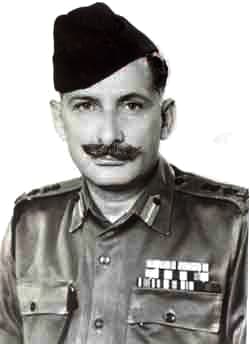
Kodandera M. Cariappa
General · Modern
57.0Total
William Tecumseh Sherman
General · Modern
61.6Total
Basic Information
Born
1899
1820
Died
1993
1891
Era
Modern
Modern
Nationality
India
United States
Occupation
General
General
Civilization
Indian
Western
Score Comparison
Military (10%)
50.0
72.0
Political (20%)
62.7
42.2
Influence (20%)
55.0
65.0
Legacy (20%)
54.0
68.0
Leadership (15%)
62.0
50.7
Strategy (15%)
60.0
72.0
TOTAL
57.0
61.6
Kodandera M. Cariappa — Complete Timeline
1919 AD
Commissioned into Indian ArmyPolitical Action◆ Major
Kodandera M. Cariappa was commissioned as a temporary second lieutenant in the British Indian Army. He served in the 2nd Battalion, 88th Carnatic Infantry, beginning a long military career.
Indian ArmyCommissionMilitary career
Impact: national
1939 AD
Service in World War IIWar◆ Major
Cariappa served in the Middle East and Burma during World War II. He commanded the 7th Indian Infantry Brigade in the Burma Campaign, earning a reputation for leadership and tactical skill.
World War IIBurmaMilitary service
Impact: regional
1947 AD
Command in Indo-Pakistani War of 1947-48War◆ Major
Cariappa commanded Indian forces in the Kashmir operations during the Indo-Pakistani War of 1947-48. He led the successful defense of Srinagar and the capture of key positions in Jammu and Kashmir.
Kashmir1947 warMilitary operations
Impact: regionalconstructive
1949 AD
Appointment as first Indian Commander-in-ChiefPolitical Action
Cariappa was appointed as the first Indian Commander-in-Chief of the Indian Army in January 1949, succeeding General Sir Roy Bucher. He oversaw the Indianization of the army's officer corps.
Indian ArmyCommander-in-ChiefIndianization
Impact: nationalconstructive
1953 AD
Retirement and diplomatic servicePolitical Action
Cariappa retired from the Indian Army in 1953. He later served as High Commissioner to Australia and New Zealand from 1953 to 1956, representing India diplomatically.
RetirementDiplomacyHigh Commissioner
Impact: national
William Tecumseh Sherman — Complete Timeline
1862 AD
Battle of ShilohWar◆ Major
Sherman commanded a division at Shiloh, where his initial failure to entrench led to a surprise Confederate attack. Despite heavy losses, he rallied his troops and contributed to the Union victory, though the battle was criticized for poor preparation.
American Civil WarWestern TheaterBloody Battle
Impact: nationaltragic
1863 AD
Battle of VicksburgWar
Sherman played a key role in Grant's Vicksburg Campaign, leading assaults and siege operations. The capture of Vicksburg gave the Union control of the Mississippi River, splitting the Confederacy in two.
American Civil WarSiegeMississippi River
Impact: national
1864 AD
March to the SeaWar
Sherman led 60,000 Union troops from Atlanta to Savannah, destroying railroads, factories, and civilian property in a 300-mile swath. The campaign aimed to break Confederate morale and economic capacity, and resulted in the capture of Savannah.
American Civil WarTotal WarScorched Earth
Impact: nationaldestructive
1865 AD
Carolinas CampaignWar◆ Major
Sherman led his army through the Carolinas, destroying infrastructure and supplies. The campaign culminated in the capture of Columbia, South Carolina, and the surrender of Confederate forces under Joseph Johnston, effectively ending the war in the East.
American Civil WarTotal WarConfederate Surrender
Impact: nationaldestructive
Expert Analysis
Origins
Kodandera M. Cariappa was born on January 28, 1899, in Shanivarsanthe, Coorg, India, into a family of modest means. His father, a revenue officer, and his mother instilled discipline. He was educated at the Presidency College, Madras, and later applied to the Indian Military Academy, graduating in 1919 as a temporary second lieutenant in the British Indian Army. He joined the 2nd Battalion, 88th Carnatic Infantry, and served in Mesopotamia and Iraq.
William Tecumseh Sherman was born on February 8, 1820, in Lancaster, Ohio, to a prominent family. His father, a lawyer and judge, died when Sherman was nine, and he was raised by Thomas Ewing, a family friend and politician. He graduated from the United States Military Academy at West Point in 1840, sixth in his class, and served in the Second Seminole War and the Mexican-American War.
Rise to Power
Cariappa's rise was gradual within the British Indian Army. He served in World War II in the Middle East and Burma, commanding the 7th Indian Infantry Brigade. His performance led to command of the 26th Indian Infantry Division in 1944. After India's independence, he was appointed Deputy Chief of the General Staff in 1947. His key turning point came in January 1949 when he succeeded General Sir Roy Bucher as the first Indian Commander-in-Chief of the Indian Army, overseeing the transition from British to Indian command.
Sherman's rise accelerated during the American Civil War. Initially a colonel of the 13th U.S. Infantry, he commanded a brigade at First Bull Run (1861). His reputation suffered after a nervous breakdown in Kentucky, but he recovered. Under Ulysses S. Grant, he commanded a division at Shiloh (April 1862), where his failure to entrench led to heavy losses but he rallied troops. He became a corps commander in Grant's Vicksburg Campaign (1863), playing a key role in the siege. In 1864, he was appointed commander of the Military Division of the Mississippi, leading the Atlanta Campaign and subsequent March to the Sea.
Leadership & Governance
Cariappa's leadership style was methodical and diplomatic. He focused on integrating the Indian Army after partition, ensuring smooth transition of command. He emphasized discipline and meritocracy, promoting officers based on ability rather than background. During the Indo-Pakistani War of 1947-48, he commanded operations in Kashmir, coordinating air and ground forces to secure Srinagar and push back Pakistani tribal militias. His governance approach was consultative, working closely with political leaders like Prime Minister Jawaharlal Nehru.
Sherman's leadership was aggressive and strategic. He believed in total war, targeting not just enemy armies but also economic infrastructure. His March to the Sea (November-December 1864) involved 60,000 troops destroying railroads, factories, and supplies across 300 miles from Atlanta to Savannah. He justified this as breaking Confederate morale and capacity. His Carolinas Campaign (1865) continued this strategy. Sherman scored 50.7 in leadership and 72.0 in strategy, reflecting his tactical innovation but controversial methods.
Triumph & Tragedy
Cariappa's greatest success was commanding the Indian Army during the 1947-48 Kashmir operations, securing the state's accession to India. He also oversaw the Indian Army's transition to a national force, integrating former British Indian soldiers and officers. His failures include the limited scope of his command; he did not lead in a major war beyond counterinsurgency. His diplomatic service as High Commissioner to Australia was unremarkable.
Sherman's greatest success was the March to the Sea, which crippled the Confederate economy and accelerated the war's end. He captured Atlanta (September 1864), boosting Lincoln's re-election. His failure at Shiloh, where he failed to entrench, resulted in 10,000 Union casualties on the first day. His harsh tactics in the Carolinas, including burning Columbia, South Carolina, drew criticism for excessive destruction. He scored 72.0 in military, reflecting his battlefield effectiveness, but his political score of 42.2 indicates his controversial legacy.
Character & Destiny
Cariappa was disciplined, reserved, and diplomatic. He avoided political entanglements, focusing on military professionalism. His character shaped his fate as a transitional figure, bridging British colonial command and independent India's army. He was respected for his integrity and fairness.
Sherman was blunt, strategic, and ruthless. He openly criticized the press and politicians, once stating, "War is hell." His personality led to conflicts with superiors, but his loyalty to Grant ensured his rise. His destiny was to be the architect of modern total war, leaving a legacy of destruction and controversy.
Legacy
Cariappa's legacy is as the first Indian Commander-in-Chief, symbolizing the Indianization of the military. The Indian Army's ethos of professionalism and apolitical stance owes partly to his leadership. He is remembered with the Cariappa Memorial in Coorg and annual celebrations. His influence on Indian military doctrine is limited but foundational.
Sherman's legacy is immense in military history. His concept of total war influenced later conflicts, including World War II. The Sherman tank is named after him. He is credited with shortening the Civil War by destroying Confederate resources. However, his tactics remain controversial, with critics citing civilian suffering. He scored 65.0 in influence and 68.0 in legacy, higher than Cariappa's 55.0 and 54.0.
Conclusion
William Tecumseh Sherman had greater impact, with a total score of 61.6 versus Cariappa's 57.0. Sherman's military innovations in total warfare reshaped conflict and accelerated the Union victory, influencing global military strategy. Cariappa's role was crucial for India's transition but limited in scope. While Cariappa's leadership in Kashmir was strategic, Sherman's campaigns were transformative. The 4.6-point gap reflects Sherman's broader historical significance.
Rankings
🥇
William Tecumseh ShermanLeader
Mil: 72.0Pol: 42.2Inf: 65.0
61.6
🥈
Kodandera M. Cariappa
Mil: 50.0Pol: 62.7Inf: 55.0
57.0
+4.6 behind
How This Comparison Works
Algorithm
Each figure is scored on 6 dimensions (0—100 scale) based on structured historical data: Military (10%), Political (20%), Influence (20%), Legacy (20%), Leadership (15%), Strategy (15%). The weighted total produces the final ranking.
Data Sources
Scores are computed from structured sub-indicators in the database. Scale factors adjust for era (Ancient ×0.85, Modern ×1.0) and civilization size (Eastern ×1.05, Other ×0.80) to account for differences in population and military scale.
Maximum 3 Figures
Comparisons are limited to 2—3 figures to ensure readability and statistical meaningfulness.
Error Margins
±5 points per dimension — Sub-scores are derived from historical records with inherent uncertainty. Two figures within 5 points on a dimension should be considered roughly equivalent in that area.
Total Score Accuracy
±3 points overall — The weighted combination of 6 dimensions produces a total score with approximately ±3 points of uncertainty. Differences of less than 3 points are not statistically significant— the figures are effectively tied.
Known Limitations
- Historical records are incomplete and uneven across civilizations
- Figures from oral-tradition societies may be underrepresented
- Occupation labels can misclassify multi-role figures
- Scores measure capability and impact, not moral character
- Quantitative scoring is a comparison tool, not absolute truth
Capability Radar
Military (10%) — Battles & Warfare
Battles
15
85
Win Rate
10
80
Expansion
10
75
Political (20%) — Governance & Reform
Reform
60
20
Diplomacy
65
40
Economy
30
25
Influence (20%) — Cultural & Global Reach
Cultural
40
75
Global
45
65
Legacy (20%) — Historical Impact
Historical
55
80
Longevity
50
70
Leadership (15%) — Power & Stability
Tenure
55
30
Stability
70
20
Strategy (15%) — Tactics & Innovation
Strategy
25
95
Tactics
20
90
Reform
70
70
Similar Comparisons
Comments & Discussion
No comments yet. Be the first to share your thoughts!