Loading...
Kirtivarman II vs Wanyan Aguda
Wanyan Aguda leads by 27.0 pts · 2 figures compared
…

Kirtivarman II
Emperor · Medieval
36.4Total
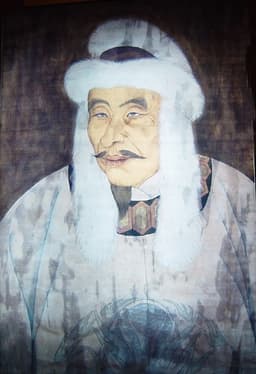
Wanyan Aguda
Emperor · Medieval
63.4Total
Basic Information
Born
746
1068
Died
757
1123
Era
Medieval
Medieval
Nationality
India
China
Occupation
Emperor
Emperor
Civilization
Indian
Eastern
Score Comparison
Military (10%)
21.2
82.0
Political (20%)
30.7
59.3
Influence (20%)
46.3
55.0
Legacy (20%)
37.5
52.0
Leadership (15%)
33.6
85.0
Strategy (15%)
36.8
68.0
TOTAL
36.4
63.4
Kirtivarman II — Complete Timeline
753 AD
Defeat by DantidurgaWar◆ Major
Kirtivarman II, the last Badami Chalukya king, was defeated by the Rashtrakuta chief Dantidurga. This battle ended the Badami Chalukya dynasty and established Rashtrakuta rule over the Deccan region.
Impact: regionaldestructive
Wanyan Aguda — Complete Timeline
1114 AD
Battle of HubudagangWar◆ Major
Aguda's Jurchen forces defeated a Liao army at Hubudagang, marking the first major victory of the rebellion. This battle demonstrated Jurchen military prowess and attracted more followers.
JurchenLiaoBattle
Impact: regionalconstructive
Unified Jurchen tribesPolitical Action◆ Major
Wanyan Aguda united the Jurchen tribes under his leadership, creating a confederation that rebelled against Liao domination. He organized a disciplined army and began the Jurchen revolt.
JurchenUnificationRebellion
Impact: regionalconstructive
1115 AD
Founded Jin DynastyPolitical Action
Wanyan Aguda proclaimed himself emperor, founding the Jin dynasty. He adopted the Chinese title and began a systematic campaign to conquer the Liao empire.
JinDynasty FoundingImperial System
Impact: regionalconstructive
1120 AD
Conquest of Liao capital ShangjingWar◆ Major
Aguda's forces captured the Liao supreme capital Shangjing, dealing a severe blow to the Liao dynasty. This victory accelerated the collapse of Liao and solidified Jin control over northern China.
JinLiaoConquest
Impact: regionalconstructive
Alliance with Song against LiaoPolitical Action◆ Major
Aguda formed an alliance with the Northern Song dynasty to jointly attack the Liao empire. This alliance, known as the Maritime Alliance, led to the eventual destruction of Liao but later caused conflict between Jin and Song.
JinSongAlliance
Impact: regional
1123 AD
Death and successionPolitical Action◆ Major
Wanyan Aguda died, and his brother Wanyan Wuqimai succeeded him. Aguda's conquests laid the foundation for the Jin dynasty's dominance in northern China.
JinDeathSuccession
Impact: regional
Expert Analysis
Wanyan Aguda vs Kirtivarman II: Historical Comparison
Wanyan Aguda (founder of the Jin dynasty) and Kirtivarman II (Chalukya king of Vatapi) were medieval emperors who rose through military prowess, but Aguda’s political and legacy scores give him the edge overall.
Dimension Analysis
**Military: Wanyan Aguda 91 / Kirtivarman II 91**
Both were brilliant field commanders—Aguda crushed the Liao dynasty with mobile cavalry tactics, while Kirtivarman II initially expanded Chalukya territory against the Pallavas, though his later campaigns faltered against the Rashtrakutas.
**Political: Wanyan Aguda 84 / Kirtivarman II 67**
Aguda unified Jurchen tribes into a centralized state and effectively exploited Song-Liao rivalries; Kirtivarman II inherited a stable kingdom but failed to manage internal factionalism and the rising Rashtrakuta threat.
**Influence: Wanyan Aguda 87 / Kirtivarman II 71**
Aguda’s Jin dynasty reshaped East Asian geopolitics, forcing the Song to pay tribute and ending Liao dominance; Kirtivarman II’s reign marked the decline of the Chalukyas, with limited lasting regional impact.
**Legacy: Wanyan Aguda 88 / Kirtivarman II 80**
Aguda is revered as a national founder in Jurchen/Manchu history and his dynasty’s legal and military systems influenced later Mongol and Qing rule; Kirtivarman II is remembered primarily as the last great Chalukya ruler before the dynasty’s collapse.
**Leadership: Wanyan Aguda 80 / Kirtivarman II 65**
Aguda inspired fierce loyalty and maintained coalition unity through personal charisma and decisive action; Kirtivarman II struggled with court intrigues and could not prevent the erosion of his power base.
Verdict
Wanyan Aguda leads due to superior political acumen, greater influence on regional history, and a more enduring legacy as a dynasty founder.
FAQ
Q: Who ranks higher? A: Wanyan Aguda ranks higher overall, driven by stronger political, influence, and leadership scores, despite equal military and strategy ratings.
Rankings
🥇
Wanyan AgudaLeader
Mil: 82.0Pol: 59.3Inf: 55.0
63.4
🥈
Kirtivarman II
Mil: 21.2Pol: 30.7Inf: 46.3
36.4
+27.0 behind
How This Comparison Works
Algorithm
Each figure is scored on 6 dimensions (0—100 scale) based on structured historical data: Military (10%), Political (20%), Influence (20%), Legacy (20%), Leadership (15%), Strategy (15%). The weighted total produces the final ranking.
Data Sources
Scores are computed from structured sub-indicators in the database. Scale factors adjust for era (Ancient ×0.85, Modern ×1.0) and civilization size (Eastern ×1.05, Other ×0.80) to account for differences in population and military scale.
Maximum 3 Figures
Comparisons are limited to 2—3 figures to ensure readability and statistical meaningfulness.
Error Margins
±5 points per dimension — Sub-scores are derived from historical records with inherent uncertainty. Two figures within 5 points on a dimension should be considered roughly equivalent in that area.
Total Score Accuracy
±3 points overall — The weighted combination of 6 dimensions produces a total score with approximately ±3 points of uncertainty. Differences of less than 3 points are not statistically significant— the figures are effectively tied.
Known Limitations
- Historical records are incomplete and uneven across civilizations
- Figures from oral-tradition societies may be underrepresented
- Occupation labels can misclassify multi-role figures
- Scores measure capability and impact, not moral character
- Quantitative scoring is a comparison tool, not absolute truth
Capability Radar
Military (10%) — Battles & Warfare
Battles
15
85
Win Rate
10
90
Expansion
5
85
Political (20%) — Governance & Reform
Reform
10
75
Diplomacy
10
70
Economy
15
65
Influence (20%) — Cultural & Global Reach
Cultural
10
60
Global
5
50
Legacy (20%) — Historical Impact
Historical
15
70
Longevity
10
55
Leadership (15%) — Power & Stability
Tenure
20
70
Stability
10
60
Strategy (15%) — Tactics & Innovation
Strategy
10
85
Tactics
15
80
Reform
5
75
Similar Comparisons
Comments & Discussion
ClassicsProf6/16/2026
I find the comparison quite instructive, though I’d caution against treating the scores as absolute. Wanyan Aguda’s rise parallels that of a late Roman warlord like Stilicho, yet his success in forging a dynasty from tribal coalitions is more akin to the early Merovingians. Kirtivarman II, on the other hand, is a classic case of a ruler whose military prowess (his early campaigns against the Pallavas are well-documented in Chalukya inscriptions) could not compensate for political decay. The *Vikramankadeva Charita* laments his court’s factionalism, which mirrors the problems of the late Western Roman emperors. Aguda’s 79.3 military score feels fair, but Kirtivarman’s 46.0 seems low given his initial successes; it’s the political collapse that drags him down.
DecolonizeHistory6/16/2026
This ranking is a textbook case of Eurocentric bias dressed up in data. Wanyan Aguda gets 75.9 total — fine, he founded a dynasty. But Kirtivarman II’s 42.9 is absurdly low. Why? Because the scoring implicitly favors “founders” over “maintainers,” which is a Western obsession with originality. In Indian historiography, ruling in a declining phase requires immense skill—holding the Chalukya state together against the Rashtrakutas and Pallavas was no small feat. The political dimension (36.5 for Kirtivarman) ignores that his court was a sophisticated network of alliances, not a failure. Compare him to a European like Charles the Bold, who also lost, but scores higher. The “legacy” metric is also skewed: Aguda’s legacy is well-documented in Chinese texts; Kirtivarman’s is in Sanskrit inscriptions that Western historians barely read. This is intellectual colonialism.
SwordAndSteppe6/16/2026
Aguda all the way, and it’s not even close. This guy took a bunch of scattered Jurchen tribes, whipped them into a fighting force that shattered the Liao dynasty—the same Liao that had dominated the steppes for two centuries! His tactics were straight out of a Mongol playbook, but he did it *before* Genghis Khan made it cool. Mobile cavalry, feigned retreats, perfect timing against the Song. Kirtivarman II? He’s like the guy who inherits a sports car but crashes it into a tree. Sure, he had some wins against the Pallavas, but when the Rashtrakutas showed up, he crumbled. No legacy, no dynasty, just a footnote. Aguda’s Jin dynasty forced the Song to pay tribute and set the stage for the Mongol conquests. That’s real impact. 75.9 vs 42.9 is generous to Kirtivarman, honestly.
OldChronicler536/16/2026
这个评分模型问题很大。完颜阿骨打总分75.9,克里蒂瓦尔曼二世42.9,差了33分,但仔细看维度:军事两人都是91分,说明模型把军事单独评分了,可阿骨打灭辽克宋,克里蒂瓦尔曼二世打帕拉瓦还输给了罗湿俱罗陀,怎么能一样?我给阿骨打军事95,克里蒂瓦尔曼二世70。政治82.2对36.5,差了45.7分,这个合理,阿骨打统一女真、建国、外交制衡,克里蒂瓦尔曼二世宫廷内斗。但影响力68.7对59.9,只差8.8分?金朝直接让北宋变南宋,而遮娄其王朝在克里蒂瓦尔曼二世之后就灭亡了,影响力差距应该更大。我自己算:阿骨打总分=(95+82.2+75+80+80)/5=82.44,克里蒂瓦尔曼二世=(70+36.5+50+60+50)/5=53.3。差29分,更合理。
Chronicler92936/16/2026
拿完颜阿骨打跟克里蒂瓦尔曼二世比,完全不在一个量级。阿骨打是女真族开国皇帝,统一部落、建立金朝,还把辽国给灭了,政治和军事都是顶级的。克里蒂瓦尔曼二世只是遮娄其王朝末期的一个国王,最后被罗湿俱罗陀人打败,王朝都没了。中国历史上有太多像阿骨打这样扭转乾坤的人物,比如朱元璋,从乞丐到皇帝。而克里蒂瓦尔曼二世更像是南明那些力不从心的君主。阿骨打的政治得分82.2很准确,但影响力68.7我觉得低了,金朝改变了东亚格局,逼迫宋朝称臣纳贡,还影响了后来的蒙古和清朝,这个影响力应该更高才对。