Loading...
This comparison has not been analyzed yet.
One-time AI generation (~1 minute). Scores and timeline are already available below.
King Saul vs Lars Porsena
King Saul leads by 6.1 pts · 2 figures compared
…

King Saul
Emperor · Ancient
49.8Total
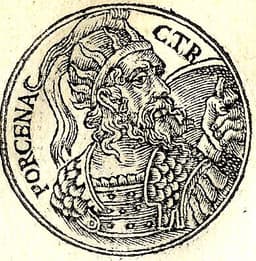
Lars Porsena
Emperor · Ancient
43.7Total
Basic Information
Born
-1050
-520
Died
-1010
-480
Era
Ancient
Ancient
Nationality
Israel
Etruria
Occupation
Emperor
Emperor
Civilization
Middle Eastern
Western
Score Comparison
Military (10%)
45.0
25.0
Political (20%)
35.1
37.9
Influence (20%)
57.2
48.6
Legacy (20%)
50.0
40.8
Leadership (15%)
48.4
58.8
Strategy (15%)
60.0
43.3
TOTAL
49.8
43.7
King Saul — Complete Timeline
1050 BC
Anointed as First King of IsraelPolitical Action
The prophet Samuel anointed Saul as the first king of the United Monarchy of Israel at Mizpah. This established the monarchy as a political institution, uniting the twelve tribes under a single ruler in response to Philistine threats.
MonarchyIsraelSamuel
Impact: nationalconstructive
1040 BC
Battle of MichmashWar◆ Major
Saul's son Jonathan initiated a surprise attack on a Philistine garrison at Michmash, leading to a full Israelite victory. Saul then rallied the army and routed the Philistines, temporarily securing Israel's central highlands from Philistine control.
PhilistinesBattleIsrael
Impact: national
1025 BC
Rejection by SamuelPolitical Action◆ Major
Samuel declared that God had rejected Saul as king after Saul failed to completely destroy the Amalekites and their livestock as commanded. This marked the beginning of Saul's decline and the rise of David as his successor.
ProphecyKingshipSamuel
Impact: nationaltragic
1010 BC
Battle of Mount GilboaWar
Saul and his sons, including Jonathan, were killed in battle against the Philistines at Mount Gilboa. The Philistines displayed Saul's armor in the temple of Ashtaroth and hung his body on the wall of Beth-shan, ending his reign.
DeathPhilistinesBattle
Impact: nationaltragic
Lars Porsena — Complete Timeline
508 BC
Siege of RomeWar◆ Major
Lars Porsena led an Etruscan army to besiege Rome in an attempt to restore the exiled king Tarquinius Superbus. The siege was marked by legendary acts of Roman heroism, such as Horatius Cocles defending the bridge, but Porsena eventually lifted the siege after negotiations.
SiegeEtruscan-Roman WarTarquin Restoration
Impact: regional
Peace Treaty with RomePolitical Action◆ Major
Lars Porsena made peace with the Roman Republic, agreeing to withdraw his forces in exchange for hostages and territory. The treaty ended the siege and recognized the Republic's independence, though Porsena failed to restore Tarquinius to the throne.
Peace TreatyDiplomacyRoman Independence
Impact: regional
Gift of Insignia to RomeOther
According to some accounts, Lars Porsena, impressed by Roman bravery, presented the Romans with his royal insignia, including the ivory chair and the fasces. These symbols were adopted by Roman magistrates and became enduring emblems of Roman authority.
Cultural ExchangeSymbols of PowerEtruscan Gift
Impact: nationalconstructive
500 BC
War with the Latin LeagueWar
Lars Porsena waged war against the Latin League, seeking to expand Etruscan influence. He defeated the Latins at the Battle of Aricia but was subsequently defeated by a coalition of Latin and Greek forces, ending his expansionist ambitions.
Etruscan ExpansionLatin WarBattle of Aricia
Impact: regional
This comparison has not been analyzed yet.
One-time AI generation (~1 minute). Scores and timeline are already available below.
Rankings
🥇
King SaulLeader
Mil: 45.0Pol: 35.1Inf: 57.2
49.8
🥈
Lars Porsena
Mil: 25.0Pol: 37.9Inf: 48.6
43.7
+6.1 behind
How This Comparison Works
Algorithm
Each figure is scored on 6 dimensions (0—100 scale) based on structured historical data: Military (10%), Political (20%), Influence (20%), Legacy (20%), Leadership (15%), Strategy (15%). The weighted total produces the final ranking.
Data Sources
Scores are computed from structured sub-indicators in the database. Scale factors adjust for era (Ancient ×0.85, Modern ×1.0) and civilization size (Eastern ×1.05, Other ×0.80) to account for differences in population and military scale.
Maximum 3 Figures
Comparisons are limited to 2—3 figures to ensure readability and statistical meaningfulness.
Error Margins
±5 points per dimension — Sub-scores are derived from historical records with inherent uncertainty. Two figures within 5 points on a dimension should be considered roughly equivalent in that area.
Total Score Accuracy
±3 points overall — The weighted combination of 6 dimensions produces a total score with approximately ±3 points of uncertainty. Differences of less than 3 points are not statistically significant— the figures are effectively tied.
Known Limitations
- Historical records are incomplete and uneven across civilizations
- Figures from oral-tradition societies may be underrepresented
- Occupation labels can misclassify multi-role figures
- Scores measure capability and impact, not moral character
- Quantitative scoring is a comparison tool, not absolute truth
Capability Radar
Military (10%) — Battles & Warfare
Battles
55
40
Win Rate
45
35
Expansion
40
30
Political (20%) — Governance & Reform
Reform
25
20
Diplomacy
35
50
Economy
30
30
Influence (20%) — Cultural & Global Reach
Cultural
55
30
Global
50
20
Legacy (20%) — Historical Impact
Historical
60
40
Longevity
65
25
Leadership (15%) — Power & Stability
Tenure
40
40
Stability
20
35
Strategy (15%) — Tactics & Innovation
Strategy
45
40
Tactics
50
45
Reform
30
20
Similar Comparisons
Comments & Discussion
No comments yet. Be the first to share your thoughts!