Loading...
Lars Porsena vs Necho II
Necho II leads by 12.3 pts · 2 figures compared
…
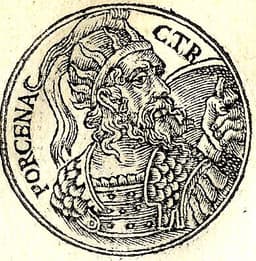
Lars Porsena
Emperor · Ancient
43.7Total

Necho II
Emperor · Ancient
56.0Total
Basic Information
Born
-520
-610
Died
-480
-595
Era
Ancient
Ancient
Nationality
Etruria
Egypt
Occupation
Emperor
Emperor
Civilization
Western
Middle Eastern
Score Comparison
Military (10%)
25.0
55.0
Political (20%)
37.9
68.0
Influence (20%)
48.6
52.5
Legacy (20%)
40.8
45.8
Leadership (15%)
58.8
65.0
Strategy (15%)
43.3
60.0
TOTAL
43.7
56.0
Lars Porsena — Complete Timeline
508 BC
Siege of RomeWar◆ Major
Lars Porsena led an Etruscan army to besiege Rome in an attempt to restore the exiled king Tarquinius Superbus. The siege was marked by legendary acts of Roman heroism, such as Horatius Cocles defending the bridge, but Porsena eventually lifted the siege after negotiations.
SiegeEtruscan-Roman WarTarquin Restoration
Impact: regional
Peace Treaty with RomePolitical Action◆ Major
Lars Porsena made peace with the Roman Republic, agreeing to withdraw his forces in exchange for hostages and territory. The treaty ended the siege and recognized the Republic's independence, though Porsena failed to restore Tarquinius to the throne.
Peace TreatyDiplomacyRoman Independence
Impact: regional
Gift of Insignia to RomeOther
According to some accounts, Lars Porsena, impressed by Roman bravery, presented the Romans with his royal insignia, including the ivory chair and the fasces. These symbols were adopted by Roman magistrates and became enduring emblems of Roman authority.
Cultural ExchangeSymbols of PowerEtruscan Gift
Impact: nationalconstructive
500 BC
War with the Latin LeagueWar
Lars Porsena waged war against the Latin League, seeking to expand Etruscan influence. He defeated the Latins at the Battle of Aricia but was subsequently defeated by a coalition of Latin and Greek forces, ending his expansionist ambitions.
Etruscan ExpansionLatin WarBattle of Aricia
Impact: regional
Necho II — Complete Timeline
609 BC
Battle of Megiddo (609 BC)War◆ Major
Necho II led an Egyptian army to Carchemish to support the Assyrians against the Babylonians. On the way, he defeated the Judean army of King Josiah at Megiddo. Josiah was killed in the battle. This victory allowed Necho to assert Egyptian control over the Levant for a short period.
BattleJudahAssyria
Impact: regional
605 BC
Defeat at the Battle of CarchemishWar◆ Major
Necho II's Egyptian forces were defeated by the Babylonian army under Nebuchadnezzar II at Carchemish. The defeat ended Egyptian influence in the Levant and allowed Babylon to dominate the region. Necho retreated to Egypt and lost control of Syria and Palestine.
BabylonDefeatLevant
Impact: regionaltragic
600 BC
Construction of the Nile-Red Sea canalInvention◆ Major
Necho II began construction of a canal connecting the Nile River to the Red Sea. The canal, which was later completed by Darius I, was approximately 85 kilometers long and allowed ships to travel between the Mediterranean and the Red Sea. This project facilitated trade and military transport.
CanalTradeEngineering
Impact: globalconstructive
Phoenician circumnavigation of AfricaInvention◆ Major
Necho II commissioned a Phoenician expedition to circumnavigate Africa. According to Herodotus, the expedition sailed from the Red Sea around the Cape of Good Hope and returned via the Pillars of Hercules (Gibraltar). This voyage, if historical, would have been the first circumnavigation of Africa.
ExplorationAfricaNavigation
Impact: globalconstructive
Expert Analysis
Origins
Lars Porsena was an Etruscan king of Clusium, active around 508 BC. He emerged from the Etruscan civilization, which dominated central Italy before Rome's rise. Details of his early life are sparse, but he likely inherited his position and commanded significant military resources. Necho II, pharaoh of Egypt's 26th Dynasty, ruled from 610 to 595 BC. He was the son of Psamtik I, who reunified Egypt after Assyrian domination. Necho received a strong state with a revived economy and military, including Greek mercenaries. His early reign focused on consolidating power and pursuing ambitious infrastructure and foreign policy projects.
Rise to Power
Porsena's rise is tied to the Tarquin monarchy's expulsion from Rome. After Lucius Tarquinius Superbus was overthrown, Porsena led an Etruscan army to restore him. The Siege of Rome (c. 508 BC) is his defining event, immortalized in Roman legends of heroism like Horatius Cocles. Porsena's power derived from his military reputation as a king of Clusium, one of the most powerful Etruscan cities. Necho II ascended the throne upon his father's death in 610 BC. He immediately pursued an expansionist policy in the Levant, aiming to reassert Egyptian influence after centuries of foreign rule. His key turning point was the Battle of Megiddo (609 BC), where he defeated and killed King Josiah of Judah, gaining control of the region. This victory allowed him to march to Carchemish to aid the fading Assyrian Empire against the Babylonians.
Leadership & Governance
Porsena's leadership was typical of Etruscan monarchs: he led armies personally and negotiated treaties. After the Siege of Rome, he chose diplomacy over destruction, withdrawing in exchange for hostages and territory. Some accounts claim he gifted his royal insignia to Rome, a gesture that may reflect a pragmatic approach to alliance-building. His governance score of 58.8 reflects a mixed record: he failed to restore the Tarquins but secured some concessions. Necho II was a more systematic ruler. He initiated massive public works, particularly the canal linking the Nile to the Red Sea (later completed by Darius I). The canal was approximately 85 kilometers long and aimed to boost trade. He also commissioned a Phoenician expedition to circumnavigate Africa, a feat that demonstrated his commitment to exploration and commerce. His political score of 68.0 indicates effective state management and strategic vision, though his military ambitions ultimately overreached.
Triumph & Tragedy
Porsena's greatest success was the initial siege, which forced Rome to negotiate. He secured the return of lands taken from the Etruscans by Rome. However, his failure to restore the Tarquins is a clear defeat. The legend of Horatius Cocles holding the bridge symbolizes Rome's resilience and Porsena's inability to conquer the city. Militarily, he scored only 25.0, reflecting his ultimate failure. Necho II's triumph was the Battle of Megiddo, a decisive victory that made Egypt the dominant power in the Levant temporarily. He also advanced the canal project, which later facilitated trade. His greatest tragedy was the Battle of Carchemish (605 BC), where Nebuchadnezzar II crushed his army, ending Egyptian influence in the Near East. The defeat cost him his Levantine holdings and weakened Egypt. Necho's military score of 55.0 reflects a mixed record: success against Judah but failure against Babylon.
Character & Destiny
Porsena's character is portrayed in Roman sources as a noble adversary, respecting bravery and choosing peace over destruction. His decision to withdraw rather than press the siege may indicate pragmatism or caution. His destiny was to be remembered as a formidable enemy who could not break Rome's spirit. Necho II was ambitious and forward-thinking, evident in the canal and circumnavigation. He was also a capable military commander, but his strategic overextension led to his downfall. His destiny was to lose Egypt's empire in the Levant, but his legacy as a builder and patron of exploration endured. Personality-wise, Necho scored 65.0 in leadership, higher than Porsena's 58.8, suggesting more effective governance.
Legacy
Porsena's legacy is largely symbolic. He appears in Roman mythology as a foil to Roman virtue. The story of his siege and the heroic defense of Rome became foundational myths. However, his direct impact on history is minimal: he did not restore the Tarquins, and Etruscan power declined soon after. His total score of 43.7 reflects low long-term influence. Necho II left a more tangible legacy. The canal he began was completed by Darius I and used for centuries. The Phoenician circumnavigation of Africa, if historical, was a remarkable achievement that demonstrated the feasibility of sailing around the continent. His defeat at Carchemish set the stage for Babylonian dominance, but his efforts to revive Egyptian power influenced later pharaohs. His influence score of 52.5 and legacy score of 45.8 are moderate, reflecting his role in the broader currents of ancient history.
Conclusion
Necho II had a greater impact than Lars Porsena. With a total score of 56.0 versus 43.7, Necho outperformed in military (55.0 vs 25.0), political (68.0 vs 37.9), leadership (65.0 vs 58.8), and strategy (60.0 vs 43.3). While Porsena's siege of Rome became legendary, it did not alter the course of history—Rome eventually conquered the Etruscans. Necho's canal and circumnavigation were pioneering efforts that advanced human knowledge and trade. His defeat at Carchemish shaped the Near East's political landscape, enabling the rise of Babylon. Porsena's influence is confined to Roman folklore, whereas Necho's actions had concrete, long-term effects. Therefore, Necho II is the more significant historical figure.
Rankings
🥇
Necho IILeader
Mil: 55.0Pol: 68.0Inf: 52.5
56.0
🥈
Lars Porsena
Mil: 25.0Pol: 37.9Inf: 48.6
43.7
+12.3 behind
How This Comparison Works
Algorithm
Each figure is scored on 6 dimensions (0—100 scale) based on structured historical data: Military (10%), Political (20%), Influence (20%), Legacy (20%), Leadership (15%), Strategy (15%). The weighted total produces the final ranking.
Data Sources
Scores are computed from structured sub-indicators in the database. Scale factors adjust for era (Ancient ×0.85, Modern ×1.0) and civilization size (Eastern ×1.05, Other ×0.80) to account for differences in population and military scale.
Maximum 3 Figures
Comparisons are limited to 2—3 figures to ensure readability and statistical meaningfulness.
Error Margins
±5 points per dimension — Sub-scores are derived from historical records with inherent uncertainty. Two figures within 5 points on a dimension should be considered roughly equivalent in that area.
Total Score Accuracy
±3 points overall — The weighted combination of 6 dimensions produces a total score with approximately ±3 points of uncertainty. Differences of less than 3 points are not statistically significant— the figures are effectively tied.
Known Limitations
- Historical records are incomplete and uneven across civilizations
- Figures from oral-tradition societies may be underrepresented
- Occupation labels can misclassify multi-role figures
- Scores measure capability and impact, not moral character
- Quantitative scoring is a comparison tool, not absolute truth
Capability Radar
Military (10%) — Battles & Warfare
Battles
40
45
Win Rate
35
40
Expansion
30
50
Political (20%) — Governance & Reform
Reform
20
60
Diplomacy
50
50
Economy
30
55
Influence (20%) — Cultural & Global Reach
Cultural
30
40
Global
20
35
Legacy (20%) — Historical Impact
Historical
40
50
Longevity
25
45
Leadership (15%) — Power & Stability
Tenure
40
55
Stability
35
45
Strategy (15%) — Tactics & Innovation
Strategy
40
55
Tactics
45
50
Reform
20
30
Similar Comparisons
Comments & Discussion
No comments yet. Be the first to share your thoughts!