Loading...
This comparison has not been analyzed yet.
One-time AI generation (~1 minute). Scores and timeline are already available below.
Khalifa bin Zayed Al Nahyan vs Talal of Jordan
Khalifa bin Zayed Al Nahyan leads by 27.9 pts · 2 figures compared
…
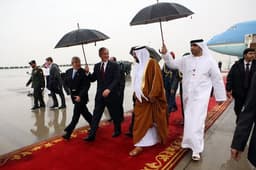
Khalifa bin Zayed Al Nahyan
Emperor · Modern
60.4Total

Talal of Jordan
Emperor · Modern
32.5Total
Basic Information
Born
1948
1909
Died
—
1972
Era
Modern
Modern
Nationality
UAE
Jordan
Occupation
Emperor
Emperor
Civilization
Middle Eastern
Middle Eastern
Score Comparison
Military (10%)
40.0
10.8
Political (20%)
75.0
25.0
Influence (20%)
58.3
45.5
Legacy (20%)
50.0
34.2
Leadership (15%)
80.7
31.2
Strategy (15%)
60.0
31.1
TOTAL
60.4
32.5
Khalifa bin Zayed Al Nahyan — Complete Timeline
2004 AD
Accession as Ruler of Abu DhabiPolitical Action◆ Major
Khalifa bin Zayed Al Nahyan became the Ruler of Abu Dhabi on November 3, 2004, following the death of his father, Zayed bin Sultan Al Nahyan. He also became the President of the United Arab Emirates.
SuccessionMonarchyAbu Dhabi
Impact: national
2006 AD
Establishment of Masdar CityReform◆ Major
Khalifa bin Zayed initiated the Masdar City project, a planned sustainable urban development in Abu Dhabi. The city aimed to be a hub for clean technology and renewable energy, including the Masdar Institute of Science and Technology.
SustainabilityRenewable EnergyInnovation
Impact: globalconstructive
2008 AD
Launch of Abu Dhabi Vision 2030Reform◆ Major
Khalifa bin Zayed launched the Abu Dhabi Economic Vision 2030, a long-term plan to diversify the emirate's economy away from oil, focusing on knowledge-based industries, tourism, and infrastructure. The plan guided major investments in renewable energy and technology.
DevelopmentVisionEconomy
Impact: nationalconstructive
2015 AD
UAE's Involvement in Yemen WarWar◆ Major
Under Khalifa bin Zayed's leadership, the UAE joined the Saudi-led military intervention in Yemen in March 2015, aiming to restore the internationally recognized government. The UAE deployed troops and conducted airstrikes, with significant impact on the conflict.
WarYemenMilitary Intervention
Impact: regionaldestructive
2020 AD
Normalization of Relations with Israel (Abraham Accords)Political Action◆ Major
Khalifa bin Zayed approved the Abraham Accords in September 2020, normalizing diplomatic relations between the UAE and Israel. The agreement, brokered by the United States, established trade, tourism, and security cooperation.
DiplomacyPeaceIsrael
Impact: globalconstructive
Talal of Jordan — Complete Timeline
1951 AD
Accession to the ThronePolitical Action◆ Major
Talal became King of Jordan on September 6, 1951, after the assassination of his father, Abdullah I. His reign was brief, lasting less than a year, during which he attempted to implement constitutional reforms and improve relations with Egypt and Saudi Arabia.
SuccessionReignConstitutional Reform
Impact: nationalconstructive
1952 AD
Promulgation of the 1952 ConstitutionReform◆ Major
Talal oversaw the adoption of a new constitution in January 1952, which transformed Jordan into a constitutional monarchy. The constitution established a parliamentary system with a prime minister and cabinet responsible to the elected parliament.
ConstitutionParliamentary SystemReform
Impact: nationalprogressive
Abdication Due to Mental IllnessPolitical Action◆ Major
Talal was forced to abdicate on August 11, 1952, after a medical commission declared him mentally unfit to rule due to schizophrenia. He was succeeded by his son Hussein, who was only 17 at the time, with a regency council appointed.
AbdicationMental HealthSuccession
Impact: nationaltragic
1972 AD
Exile and DeathPolitical Action
After his abdication, Talal lived in exile in Turkey and later in a sanatorium in Switzerland. He died on July 7, 1972, in Istanbul, Turkey, largely forgotten by the Jordanian public. His remains were returned to Jordan for burial.
ExileDeathMental Illness
Impact: nationaltragic
This comparison has not been analyzed yet.
One-time AI generation (~1 minute). Scores and timeline are already available below.
Rankings
🥇
Khalifa bin Zayed Al NahyanLeader
Mil: 40.0Pol: 75.0Inf: 58.3
60.4
🥈
Talal of Jordan
Mil: 10.8Pol: 25.0Inf: 45.5
32.5
+27.9 behind
How This Comparison Works
Algorithm
Each figure is scored on 6 dimensions (0—100 scale) based on structured historical data: Military (10%), Political (20%), Influence (20%), Legacy (20%), Leadership (15%), Strategy (15%). The weighted total produces the final ranking.
Data Sources
Scores are computed from structured sub-indicators in the database. Scale factors adjust for era (Ancient ×0.85, Modern ×1.0) and civilization size (Eastern ×1.05, Other ×0.80) to account for differences in population and military scale.
Maximum 3 Figures
Comparisons are limited to 2—3 figures to ensure readability and statistical meaningfulness.
Error Margins
±5 points per dimension — Sub-scores are derived from historical records with inherent uncertainty. Two figures within 5 points on a dimension should be considered roughly equivalent in that area.
Total Score Accuracy
±3 points overall — The weighted combination of 6 dimensions produces a total score with approximately ±3 points of uncertainty. Differences of less than 3 points are not statistically significant— the figures are effectively tied.
Known Limitations
- Historical records are incomplete and uneven across civilizations
- Figures from oral-tradition societies may be underrepresented
- Occupation labels can misclassify multi-role figures
- Scores measure capability and impact, not moral character
- Quantitative scoring is a comparison tool, not absolute truth
Capability Radar
Military (10%) — Battles & Warfare
Battles
0
4
Win Rate
0
7
Expansion
10
13
Political (20%) — Governance & Reform
Reform
75
5
Diplomacy
80
15
Economy
85
5
Influence (20%) — Cultural & Global Reach
Cultural
55
5
Global
65
5
Legacy (20%) — Historical Impact
Historical
60
10
Longevity
50
5
Leadership (15%) — Power & Stability
Tenure
85
10
Stability
85
5
Strategy (15%) — Tactics & Innovation
Strategy
0
15
Tactics
0
18
Reform
30
22
Similar Comparisons
Comments & Discussion
No comments yet. Be the first to share your thoughts!