Loading...
Kalashoka vs Qin Shi Huang
Qin Shi Huang leads by 39.7 pts · 2 figures compared
…

Kalashoka
Emperor · Ancient
45.5Total
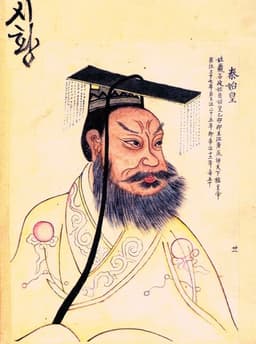
Qin Shi Huang
Emperor · Ancient
85.2Total
Basic Information
Born
-422
-259
Died
-396
-210
Era
Ancient
Ancient
Nationality
Magadha
China
Occupation
Emperor
Emperor
Civilization
Indian
Eastern
Score Comparison
Military (10%)
25.9
80.0
Political (20%)
37.9
90.0
Influence (20%)
51.8
85.0
Legacy (20%)
45.0
90.0
Leadership (15%)
62.2
78.0
Strategy (15%)
36.8
82.0
TOTAL
45.5
85.2
Kalashoka — Complete Timeline
410 BC
Convened the Second Buddhist Council at VaishaliCultural◆ Major
King Kalashoka sponsored the Second Buddhist Council at Vaishali to resolve disputes over monastic discipline. The council, attended by 700 monks, condemned ten lax practices of the Vajjian monks, leading to a schism between the Sthaviravada and Mahasanghika schools.
Buddhist CouncilSchismMonastic Discipline
Impact: regionalconstructive
Qin Shi Huang — Complete Timeline
246 BC
Construction of the Mausoleum and Terracotta ArmyOther◆ Major
Qin Shi Huang commissioned a vast mausoleum complex near Xi'an, guarded by thousands of life-sized terracotta soldiers, horses, and chariots. The project employed hundreds of thousands of workers and reflected his obsession with immortality and imperial power.
Impact: global
230 BC
Conquest of the Six Warring StatesWar
From 230 to 221 BCE, Ying Zheng led the Qin state in a series of campaigns that conquered the Han, Zhao, Wei, Chu, Yan, and Qi states. This unified China under a single ruler for the first time, ending the Warring States period.
Impact: global
221 BC
Standardization of Writing, Currency, and MeasurementsReform◆ Major
Qin Shi Huang ordered the standardization of Chinese script, currency, and weights and measures across the unified empire. This facilitated administration, trade, and cultural integration, laying a foundation for future dynasties.
Impact: globalconstructive
Proclamation of the Qin DynastyPolitical Action
After conquering the last independent state, Ying Zheng declared himself Shi Huangdi (First Emperor), founding the Qin Dynasty. He adopted a new title to signify his supreme authority and initiated centralized imperial rule.
Impact: global
214 BC
Initiation of the Great Wall ConstructionOther◆ Major
Qin Shi Huang ordered the connection and extension of existing northern fortifications to create a unified defensive wall against nomadic Xiongnu raids. This project involved massive conscripted labor and became the precursor to the later Great Wall.
Impact: regional
213 BC
Burning of Books and Burying of ScholarsPolitical Action◆ Major
On the advice of Li Si, Qin Shi Huang ordered the burning of historical records and philosophical texts not aligned with Legalist doctrine. He also had 460 Confucian scholars buried alive to suppress dissent and consolidate ideological control.
Impact: nationaldestructive
Expert Analysis
kalashoka-vs-qin-shi-huang
# The First Emperor and the Forgotten King
In the shadow of Xi’an, thousands of life-sized terracotta soldiers stand eternal guard over a tomb that has remained unopened for over two millennia. Half a world away, in the ancient city of Vaishali, another ruler once gathered monks to settle a dispute that would forever shape the destiny of Buddhism. One emperor is known to every schoolchild; the other is all but forgotten. Why did Qin Shi Huang, who reigned a century and a half after Kalashoka, leave such an indelible mark on history, while the Magadhan king slipped into near-oblivion? The answer lies not merely in what they did, but in the worlds they inhabited and the ambitions that drove them.
Origins
Qin Shi Huang was born Ying Zheng in 259 BC, during the chaotic Warring States period, when seven Chinese states fought for supremacy. His father was king of Qin, a harsh, militaristic state in the western frontier. The boy grew up amid plots and betrayals—his father died when he was young, and his mother’s lover attempted to seize power. This crucible forged a ruler who trusted no one and saw control as the only path to survival.
Kalashoka’s origins are murkier. He ruled Magadha, the most powerful kingdom in ancient India, from 422 to 396 BC. The region had produced the great Mauryan empire a century earlier, but Kalashoka’s era was one of fragmentation. He inherited a throne already shaped by Buddhist influence—his father had been a patron of the faith—and the young king likely saw himself as a guardian of tradition rather than a revolutionary.
The difference in their eras is crucial. Qin Shi Huang faced a world of warring states where unification was the ultimate prize; Kalashoka presided over a relatively stable kingdom where religious harmony was the primary concern. One was a builder of empires, the other a preserver of faiths.
Rise to Power
Ying Zheng became king of Qin at age thirteen, but real power came only after he eliminated his political rivals. In 238 BC, he crushed a rebellion by his mother’s lover, Lao Ai, and soon exiled his own chancellor, Lü Buwei. By 230 BC, he was ready to conquer. Over the next nine years, his armies swept through the six rival states—Han, Zhao, Wei, Chu, Yan, and Qi—using superior tactics, iron weapons, and a ruthlessness that shocked even hardened warriors.
Kalashoka’s rise was far less dramatic. He inherited the throne of Magadha, likely through normal succession, and his reign appears to have been peaceful. His defining moment came in 410 BC, when he convened the Second Buddhist Council at Vaishali. The council addressed a dispute over monastic discipline—whether monks could accept gold and silver. Kalashoka’s sponsorship of this event shows a ruler concerned with spiritual authority, not territorial expansion.
The contrast in their paths is stark: one rose through conquest, the other through consensus. Qin Shi Huang’s power was won by the sword; Kalashoka’s was exercised through patronage.
Leadership & Governance
Qin Shi Huang’s rule was a revolution. In 221 BC, after conquering the last independent state, he proclaimed himself *Shi Huangdi*—the First Emperor. He immediately set about standardizing everything: writing script, currency, weights, and measurements. He connected northern fortifications into what would become the Great Wall, and he imposed a single legal code across his vast domain. His methods were brutal—in 213 BC, he ordered the burning of historical records and philosophical texts not aligned with Legalist doctrine, and had scholars buried alive for dissent. Yet his vision was breathtaking: a unified China where one emperor, one law, and one script would endure for eternity.
Kalashoka governed with a lighter hand. He supported the Buddhist Sangha, convened the council, and likely maintained the existing administrative structures of Magadha. His reign saw no grand building projects, no military campaigns recorded in history. The Second Buddhist Council was his legacy—a moment when he used his authority to preserve religious unity. But unlike Qin Shi Huang, he did not seek to transform his kingdom; he sought to sustain it.
The difference in their governance reflects their goals. Qin Shi Huang wanted to create a new world; Kalashoka wanted to protect the old one.
Triumph & Tragedy
Qin Shi Huang’s greatest triumph was unification itself. By 221 BC, he had ended centuries of war and created a single Chinese state that would, despite dynastic changes, remain a fundamental political reality for two millennia. His standardization of writing allowed Chinese civilization to cohere across vast distances. His mausoleum, guarded by the Terracotta Army, remains one of the most astonishing archaeological discoveries in human history.
His tragedy was that his empire barely outlived him. He died in 210 BC, and within four years, the Qin Dynasty collapsed in rebellion. His harsh Legalist policies, his persecution of scholars, and his obsession with immortality all proved unsustainable. He sought to rule forever, yet his dynasty lasted only fifteen years.
Kalashoka’s triumph was the Second Buddhist Council, which helped preserve the integrity of the early Buddhist monastic community. His tragedy is that we know so little about him—his reign is a footnote, his achievements overshadowed by the later Mauryan emperor Ashoka. Where Qin Shi Huang’s name echoes through millennia, Kalashoka’s survives only in obscure Buddhist chronicles.
Character & Destiny
Qin Shi Huang was paranoid, ruthless, and megalomaniacal. He believed himself divine, sought immortality through alchemy, and built a tomb complex that mirrored the cosmos. His personality drove his decisions: his need for control led to standardization, but also to book-burning; his fear of death led to the Terracotta Army, but also to his neglect of succession. His character was both his strength and his undoing.
Kalashoka appears to have been a pious, moderate ruler. He supported Buddhism without persecuting other faiths, convened councils without imposing doctrine. His personality seems to have been that of a caretaker, not a conqueror. This made him a good king for his time, but it also made him forgettable.
One man’s ambition reshaped the world; the other’s humility let him fade into it.
Legacy
Qin Shi Huang is remembered as the father of China. His political model—centralized, bureaucratic, autocratic—influenced every subsequent Chinese dynasty. The Great Wall, the standard script, the very idea of a unified China all trace back to him. He is simultaneously revered as a unifier and condemned as a tyrant.
Kalashoka is remembered only by Buddhist historians and specialists. The Second Buddhist Council is a minor event in the vast tapestry of Buddhist history. His name appears in the *Mahavamsa* and *Dipavamsa*, but few outside academic circles know it. His legacy is not his own, but that of the faith he protected.
Conclusion
Standing before the Terracotta Army, one feels the weight of Qin Shi Huang’s ambition—a ruler who tried to conquer death itself. Wandering the quiet plains of Vaishali, there is no monument to Kalashoka, only the memory of a council that kept a great tradition alive. Their fates were not determined by their virtue or their wisdom, but by the scale of their vision and the violence of their times. Qin Shi Huang built an empire of stone and blood that still stands in spirit; Kalashoka built a bridge of faith that carried Buddhism into the future. Both succeeded, but only one is remembered—because history, like the First Emperor, prefers the grand gesture to the quiet hand.
Rankings
🥇
Qin Shi HuangLeader
Mil: 80.0Pol: 90.0Inf: 85.0
85.2
🥈
Kalashoka
Mil: 25.9Pol: 37.9Inf: 51.8
45.5
+39.7 behind
How This Comparison Works
Algorithm
Each figure is scored on 6 dimensions (0—100 scale) based on structured historical data: Military (10%), Political (20%), Influence (20%), Legacy (20%), Leadership (15%), Strategy (15%). The weighted total produces the final ranking.
Data Sources
Scores are computed from structured sub-indicators in the database. Scale factors adjust for era (Ancient ×0.85, Modern ×1.0) and civilization size (Eastern ×1.05, Other ×0.80) to account for differences in population and military scale.
Maximum 3 Figures
Comparisons are limited to 2—3 figures to ensure readability and statistical meaningfulness.
Error Margins
±5 points per dimension — Sub-scores are derived from historical records with inherent uncertainty. Two figures within 5 points on a dimension should be considered roughly equivalent in that area.
Total Score Accuracy
±3 points overall — The weighted combination of 6 dimensions produces a total score with approximately ±3 points of uncertainty. Differences of less than 3 points are not statistically significant— the figures are effectively tied.
Known Limitations
- Historical records are incomplete and uneven across civilizations
- Figures from oral-tradition societies may be underrepresented
- Occupation labels can misclassify multi-role figures
- Scores measure capability and impact, not moral character
- Quantitative scoring is a comparison tool, not absolute truth
Capability Radar
Military (10%) — Battles & Warfare
Battles
10
85
Win Rate
10
90
Expansion
10
90
Political (20%) — Governance & Reform
Reform
30
95
Diplomacy
40
75
Economy
30
90
Influence (20%) — Cultural & Global Reach
Cultural
40
95
Global
30
85
Legacy (20%) — Historical Impact
Historical
50
95
Longevity
40
95
Leadership (15%) — Power & Stability
Tenure
40
70
Stability
40
65
Strategy (15%) — Tactics & Innovation
Strategy
10
85
Tactics
10
80
Reform
10
95
Similar Comparisons
Comments & Discussion
FIRST EMPEROR'S SHADOW6/17/2026
Look, Kalashoka might have settled a Buddhist council, but Qin Shi Huang united seven warring states into one empire - that's real power. The Terracotta Army alone is a logistical miracle involving over 700,000 workers and craftsmen. Kalashoka's legacy is preserved only in dusty Pali texts, while Qin's legalist reforms abolished feudalism and standardized writing, currency, and axle widths across China. One man shaped the modern world, the other shaped a footnote.|en|
数据侦探6/17/2026
说秦始皇有“永久影响”?别逗了。他焚书坑儒,销毁了无数历史文献和百家典籍,结果后世史家只能靠残篇断简拼凑秦史。马王堆出土的帛书古地图和《五星占》说明,同时代印度克什米尔的天文数学远超中国。蒙古骑兵横扫欧亚时,谁能继承秦的“统一”遗产?别把暴政当功绩,真正的遗产是文化连续性,不是兵马俑。|zh
SANSKRIT SCHOLAR6/17/2026
It's ironic - the name "Kalashoka" literally means "the dark-hued beauty" in Sanskrit, yet history painted him shadowy. He presided over the Second Buddhist Council at Vaishali, which defined the split between Sthaviravada and Mahasanghika traditions - an early fissure that gave rise to Mahayana Buddhism. Meanwhile, Qin Shi Huang chased immortality pills made of mercury and jade, a fool's errand that actually killed him. Compare real spiritual legacy to chemical embarrassment.|en
盛世迷途6/17/2026
别把秦始皇说得太伟大。他确实统一了文字和度量衡,但这种暴力整合是以消灭地方文化为代价的。看看长沙马王堆汉墓出土的《老子》帛书和帛画,战国时期楚文化多么多彩!而秦法严苛到“诽谤者族,偶语者弃市”,百姓连交头接耳都要被处死。相比之下,Kalashoka时代的印度虽然有佛教分裂,但阿育王石柱刻着“依法治国”的理念,这比秦始皇的广场恐惧症强多了。|zh
REVISIONIST CYNIC6/17/2026
Oh please, both were authoritarian patriarchs who manipulated religion for power. Qin burned books to control thought; Kalashoka convened a council to freeze doctrine. The difference? Qin's terracotta soldiers are tourist photos; Kalashoka is a Google search test. But here's a fact: Qin Shi Huang's mausoleum is topped with a bronze chariot modeled on real two-thousand-year-old technology, yet Kalashoka's capital Vaishali hosted the first known republics in world history. Who's truly innovative?|