Loading...
Juan Manuel Santos vs Mohammad Mosaddegh
Mohammad Mosaddegh leads by 9.8 pts · 2 figures compared
…
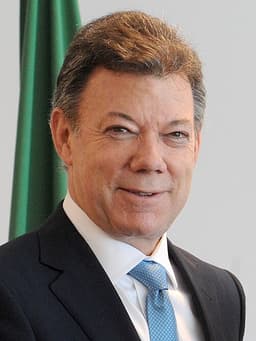
Juan Manuel Santos
Politician · Modern
58.3Total

Mohammad Mosaddegh
Politician · Modern
68.1Total
Basic Information
Born
1951
1882
Died
—
1967
Era
Modern
Modern
Nationality
Colombia
Iran
Occupation
Politician
Politician
Civilization
Western
Middle Eastern
Score Comparison
Military (10%)
49.8
43.3
Political (20%)
62.7
78.0
Influence (20%)
56.7
82.0
Legacy (20%)
55.0
72.0
Leadership (15%)
78.0
64.0
Strategy (15%)
43.2
39.6
TOTAL
58.3
68.1
Juan Manuel Santos — Complete Timeline
2010 AD
Elected President of ColombiaPolitical Action◆ Major
Juan Manuel Santos won the Colombian presidential election as the candidate of the National Unity Party. He was the former Defense Minister under Uribe and initially continued the hardline security policy.
ElectionPresidencyColombia
Impact: national
2012 AD
Launched Formal Peace Talks with FARCPolitical Action◆ Major
Santos announced the start of formal peace negotiations with the FARC in Havana, Cuba. The talks were held in secret for six months before being made public, with Norway and Cuba as guarantors.
Peace ProcessFARCColombian Conflict
Impact: nationalconstructive
2016 AD
Signed Final Peace Agreement with FARCPolitical Action
Santos signed a historic peace agreement with FARC commander Rodrigo Londo
Peace AgreementFARCColombian Conflict
Impact: nationalconstructive
Awarded Nobel Peace PrizeCultural◆ Major
Santos was awarded the Nobel Peace Prize for his efforts to end the Colombian civil war. The Nobel Committee recognized his leadership in the peace process despite the narrow rejection of the initial peace deal in a referendum.
Nobel PrizePeaceRecognition
Impact: globalconstructive
Peace Referendum RejectedPolitical Action◆ Major
The initial peace agreement with the FARC was narrowly rejected by Colombian voters in a referendum by 50.2% to 49.8%. The result was a major setback for Santos, who had campaigned heavily for approval.
ReferendumPeace ProcessSetback
Impact: nationaltragic
Mohammad Mosaddegh — Complete Timeline
1951 AD
Nationalization of the Anglo-Iranian Oil CompanyPolitical Action
Mosaddegh's government nationalized the Anglo-Iranian Oil Company, taking control of Iran's oil industry from British ownership. The move was popular in Iran but led to a British-led boycott and severe economic pressure.
OilNationalismDecolonization
Impact: globalconstructive
Elected Prime Minister of IranPolitical Action◆ Major
Mosaddegh was elected Prime Minister by the Majlis (parliament) after leading the campaign for oil nationalization. He became a symbol of Iranian nationalism and anti-imperialism, but his policies created conflict with the Shah and Western powers.
DemocracyNationalismElection
Impact: nationalconstructive
1953 AD
1953 Iranian coup d'étatPolitical Action
The CIA and MI6 orchestrated a coup (Operation Ajax) that overthrew Mosaddegh's government. He was arrested after days of street fighting, and the Shah returned to power. The coup ended Iranian democracy and led to 25 years of autocratic rule.
CoupCIACold War
Impact: globaldestructive
1967 AD
House arrest and deathOther◆ Major
After the coup, Mosaddegh was tried for treason and sentenced to three years in prison, then placed under house arrest in his village of Ahmadabad until his death. He remained a symbol of resistance against foreign intervention.
House ArrestPolitical PrisonerSymbol
Impact: nationaltragic
Expert Analysis
Origins
Juan Manuel Santos was born on August 10, 1951, in Bogotá, Colombia, into a wealthy political family. His uncle Eduardo Santos was president of Colombia from 1938 to 1942. He studied economics at the University of Kansas and later earned a master's from the London School of Economics and a degree from Harvard's Kennedy School. His early career included journalism and serving as a delegate to the International Coffee Organization.
Mohammad Mosaddegh was born on June 16, 1882, in Tehran, Iran, into a prominent aristocratic family. His father was a finance minister under the Qajar dynasty. He studied law and political science in Paris and earned a doctorate from the University of Neuchâtel in Switzerland. Returning to Iran, he entered politics and became a vocal critic of foreign influence, particularly British control over Iran's oil.
Rise to Power
Santos entered politics in the 1990s, serving as Minister of Foreign Trade under President César Gaviria. He later became Minister of Finance under President Andrés Pastrana. In 2006, President Álvaro Uribe appointed him Minister of Defense, where he oversaw successful military operations against the FARC. In 2010, Santos won the presidency as the candidate of the National Unity Party, succeeding Uribe.
Mosaddegh was first elected to the Majlis (parliament) in 1923 but was forced into retirement by Reza Shah. He returned after Reza Shah's abdication in 1941. In 1951, he led the campaign to nationalize the Anglo-Iranian Oil Company. The Majlis elected him Prime Minister on April 28, 1951, with overwhelming support. His nationalization bill was signed into law on May 1, 1951.
Leadership & Governance
Santos governed as a pragmatic centrist. His signature achievement was the peace process with the FARC, which involved secret talks in Havana starting in 2012. He faced fierce opposition from former President Uribe, who accused him of being soft on terrorism. Santos pushed the peace agreement through despite a narrow referendum defeat (50.2% to 49.8% against) by renegotiating and having Congress approve it. His leadership score of 78.0 reflects this persistence.
Mosaddegh was a charismatic democrat but struggled with governance. He nationalized the oil industry on May 1, 1951, but failed to run it effectively. British sanctions crippled Iran's economy. Mosaddegh's political score of 78.0 is high, but his strategy score of 39.6 reflects his inability to manage the crisis. He dissolved the Majlis in 1953 to rule by decree, which alienated supporters and paved the way for the coup.
Triumph & Tragedy
Santos's triumph was the 2016 peace agreement with the FARC, ending a 52-year war that killed 260,000 people. He was awarded the Nobel Peace Prize in 2016. However, the peace deal faced a narrow referendum defeat, and subsequent implementation has been slow. Violence persists in some regions. His military score of 49.8 is low, reflecting his focus on negotiation over force.
Mosaddegh's triumph was the nationalization of Iran's oil, a bold act of sovereignty that inspired anti-colonial movements. However, his tragedy was the 1953 coup orchestrated by the CIA and MI6 (Operation Ajax), which overthrew him. He was arrested, tried for treason, and spent the rest of his life under house arrest. The coup restored the Shah's autocracy and led to decades of dictatorship.
Character & Destiny
Santos was methodical and patient, willing to compromise. He faced down Uribe's opposition and the referendum defeat to achieve peace. His character scored 78.0 in leadership but 43.2 in strategy, indicating a focus on long-term goals over tactical brilliance. His destiny was to be a peacemaker, but his legacy is mixed due to ongoing violence.
Mosaddegh was principled but rigid. He refused to compromise with the British or the Shah, leading to his isolation. His charisma and nationalism made him a hero, but his lack of political maneuvering cost him power. His strategy score of 39.6 reflects this. His destiny was to be a martyr for Iranian nationalism, overthrown by foreign powers.
Legacy
Santos's legacy is the peace process, which earned him a Nobel Prize. However, Colombia still faces violence from other armed groups. His political score of 62.7 and influence of 56.7 reflect moderate impact. The peace deal is a model for conflict resolution but has not fully transformed Colombia.
Mosaddegh's legacy is immense. He is a symbol of resistance to imperialism in Iran and the Middle East. His influence score of 82.0 and legacy of 72.0 are high. The 1953 coup is a cautionary tale of foreign intervention. Iran's 1979 revolution was partly inspired by his memory. His oil nationalization set a precedent for resource sovereignty.
Conclusion
Mohammad Mosaddegh had greater impact. While Santos's peace deal ended a long conflict, its implementation is uncertain. Mosaddegh's actions reshaped Iran's history and global oil politics. His total score of 68.1 exceeds Santos's 58.3. Mosaddegh's influence and legacy scores (82.0 and 72.0) dwarf Santos's (56.7 and 55.0). Mosaddegh's defiance of colonial powers inspired generations, while Santos's peace is still contested. Mosaddegh's impact on world history is more profound.
Rankings
🥇
Mohammad MosaddeghLeader
Mil: 43.3Pol: 78.0Inf: 82.0
68.1
🥈
Juan Manuel Santos
Mil: 49.8Pol: 62.7Inf: 56.7
58.3
+9.8 behind
How This Comparison Works
Algorithm
Each figure is scored on 6 dimensions (0—100 scale) based on structured historical data: Military (10%), Political (20%), Influence (20%), Legacy (20%), Leadership (15%), Strategy (15%). The weighted total produces the final ranking.
Data Sources
Scores are computed from structured sub-indicators in the database. Scale factors adjust for era (Ancient ×0.85, Modern ×1.0) and civilization size (Eastern ×1.05, Other ×0.80) to account for differences in population and military scale.
Maximum 3 Figures
Comparisons are limited to 2—3 figures to ensure readability and statistical meaningfulness.
Error Margins
±5 points per dimension — Sub-scores are derived from historical records with inherent uncertainty. Two figures within 5 points on a dimension should be considered roughly equivalent in that area.
Total Score Accuracy
±3 points overall — The weighted combination of 6 dimensions produces a total score with approximately ±3 points of uncertainty. Differences of less than 3 points are not statistically significant— the figures are effectively tied.
Known Limitations
- Historical records are incomplete and uneven across civilizations
- Figures from oral-tradition societies may be underrepresented
- Occupation labels can misclassify multi-role figures
- Scores measure capability and impact, not moral character
- Quantitative scoring is a comparison tool, not absolute truth
Capability Radar
Military (10%) — Battles & Warfare
Battles
28
19
Win Rate
33
25
Expansion
34
30
Political (20%) — Governance & Reform
Reform
85
85
Diplomacy
90
70
Economy
60
75
Influence (20%) — Cultural & Global Reach
Cultural
55
60
Global
70
70
Legacy (20%) — Historical Impact
Historical
75
75
Longevity
65
65
Leadership (15%) — Power & Stability
Tenure
70
55
Stability
75
20
Strategy (15%) — Tactics & Innovation
Strategy
40
33
Tactics
40
35
Reform
46
36
Similar Comparisons
Comments & Discussion
No comments yet. Be the first to share your thoughts!