Loading...
Joseph Stalin vs Napoleon Bonaparte
Napoleon Bonaparte leads by 2.1 pts · 2 figures compared
…
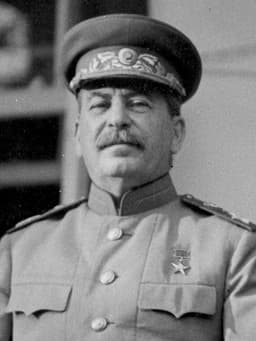
Joseph Stalin
Politician · Modern
68.8Total

Napoleon Bonaparte
General · Modern
70.9Total
Basic Information
Born
1878
1769
Died
1953
1821
Era
Modern
Modern
Nationality
Russia
France
Occupation
Politician
General
Civilization
Western
Western
Score Comparison
Military (10%)
75.0
94.0
Political (20%)
70.0
72.0
Influence (20%)
72.0
40.0
Legacy (20%)
55.0
80.0
Leadership (15%)
80.0
78.0
Strategy (15%)
70.0
90.0
TOTAL
68.8
70.9
Joseph Stalin — Complete Timeline
1928 AD
Launched the First Five-Year PlanReform
Stalin initiated a series of centralized economic plans aimed at rapid industrialization and collectivization of agriculture. The First Five-Year Plan set ambitious targets for heavy industry, leading to significant growth but also severe shortages and human cost.
Impact: global
1929 AD
Implemented forced collectivization of agricultureReform
Stalin ordered the consolidation of individual peasant farms into collective farms (kolkhozy). This was met with resistance, leading to the liquidation of kulaks (wealthy peasants) as a class. The policy caused a catastrophic famine, particularly in Ukraine (Holodomor), resulting in millions of deaths.
Impact: nationaldestructive
1937 AD
Conducted the Great Purge (Great Terror)Political Action
Stalin orchestrated a campaign of political repression against alleged enemies of the state. Millions were arrested, executed, or sent to the Gulag labor camps. The purges targeted the Communist Party, military leadership, intellectuals, and ordinary citizens, consolidating Stalin's absolute power.
Impact: nationaldestructive
1945 AD
Led the Soviet Union to victory in World War IIWar
Stalin served as Supreme Commander of the Soviet armed forces. The Soviet Union bore the brunt of the war against Nazi Germany, suffering immense casualties. The Red Army's victory at Stalingrad and the capture of Berlin were key turning points. The war ended with Soviet domination of Eastern Europe.
Impact: global
Established the Eastern Bloc and the Iron CurtainPolitical Action◆ Major
After WWII, Stalin imposed communist governments in Eastern European countries occupied by the Red Army, creating a buffer zone against the West. This division of Europe into Soviet and Western spheres of influence marked the beginning of the Cold War.
Impact: globaldestructive
Napoleon Bonaparte — Complete Timeline
1799 AD
Coup of 18 BrumaireOther◆ Major
Napoleon Bonaparte, with support from his brother Lucien and key political figures, overthrew the Directory in a bloodless coup. He established the Consulate with himself as First Consul, effectively becoming the ruler of France. This event ended the French Revolution's most unstable period.
French RevolutionCoupRise to Power
Impact: regional
1804 AD
Promulgation of the Napoleonic CodeOther◆ Major
Napoleon enacted the Civil Code of the French, known as the Napoleonic Code, a comprehensive set of laws that replaced the fragmented feudal legal systems. The code established legal equality, protected property rights, and secularized law. It became the basis for legal systems in many European and world countries.
Legal ReformNapoleonic CodeCivil Law
Impact: globalconstructive
1805 AD
Battle of AusterlitzWar◆ Major
Napoleon's Grande Arm
Napoleonic WarsBattleDecisive Victory
Impact: global
1812 AD
Invasion of RussiaWar◆ Major
Napoleon led the Grande Arm
Napoleonic WarsInvasionDisaster
Impact: globaldestructive
1815 AD
Battle of WaterlooWar◆ Major
Napoleon's French army was defeated by the combined forces of the Duke of Wellington's Anglo-Allied army and Gebhard Leberecht von Bl
Napoleonic WarsBattleFinal Defeat
Impact: globaldestructive
Expert Analysis
Napoleon Bonaparte vs Joseph Stalin
# The Corsican and the Cossack
In the winter of 1812, Napoleon Bonaparte watched his Grand Army burn Moscow to the ground, convinced that Tsar Alexander I would soon sue for peace. One hundred and thirty years later, another dictator stood in Red Square as Nazi troops reached the outskirts of Moscow, refusing evacuation orders while his generals begged him to leave. Both men faced existential threats from invading armies—one from the east, the other from the west—yet their responses could not have been more different. Napoleon, the military genius who reshaped Europe, died a prisoner on a remote Atlantic island. Stalin, the paranoid architect of terror, died in his bed, master of half a continent. What drove these two men down such divergent paths?
Origins
Napoleon Bonaparte was born in 1769 on Corsica, an island that had just been sold to France by Genoa. His family were minor Italian nobility, speaking Corsican as their first language. Young Napoleon was mocked at French military school for his accent and small stature—a boy who carried a chip on his shoulder the size of an empire. He devoured military history and Enlightenment philosophy, dreaming of glory and rational order.
Stalin was born in 1878 in Gori, Georgia, a backwater of the Russian Empire. His father was a violent, alcoholic shoemaker; his mother a devout washerwoman. Young Ioseb Dzhugashvili was beaten at home and bullied at seminary. Where Napoleon found escape in military textbooks, Stalin found refuge in revolutionary pamphlets. One grew up believing he could conquer the world; the other grew up believing the world needed to be destroyed and rebuilt.
Rise to Power
Napoleon’s ascent was a matter of breathtaking speed and brilliant calculation. At twenty-four, he cleared the streets of Paris of royalist rebels with a "whiff of grapeshot." At twenty-six, he led a ragged army across the Alps into Italy and won six victories in twelve days. By thirty, he was First Consul of France. By thirty-five, Emperor. Each step was a gamble, but each gamble paid off—Austerlitz in 1805, Jena in 1806, Friedland in 1807. He did not wait for history; he seized it.
Stalin rose differently. He was not a battlefield commander but a bureaucratic predator. After Lenin’s death in 1924, Stalin positioned himself as the quiet, unremarkable administrator while Trotsky, Zinoviev, and Kamenev tore each other apart. He collected dossiers, cultivated loyalists, and waited. By 1928, when he launched the First Five-Year Plan, he had already outmaneuvered every rival. He did not seize power in a coup; he absorbed it slowly, like a glacier swallowing a valley.
Leadership & Governance
Napoleon ruled through a blend of personal magnetism and rational reform. The Napoleonic Code standardized French law, abolished feudal privileges, and established meritocracy. He built roads, founded banks, and reformed education. When he entered a room, men felt the force of his presence. His military strategy was a masterpiece of rapid movement and decisive engagement—he sought to destroy enemy armies in a single battle, not grind them down over years.
Stalin ruled through fear. The Great Purge of 1937-1938 saw millions arrested, executed, or sent to the Gulag. He did not inspire loyalty; he enforced it. His Five-Year Plans transformed a peasant economy into an industrial superpower, but at a staggering human cost—famine in Ukraine, forced labor in Siberia, and a bureaucracy that rewarded denunciation over competence. Where Napoleon’s soldiers would die for him, Stalin’s subordinates trembled before him.
Triumph & Tragedy
Napoleon’s greatest moment was Austerlitz in 1805, where he crushed the combined armies of Austria and Russia so decisively that the Holy Roman Empire dissolved. His greatest failure was the invasion of Russia in 1812. He marched 600,000 men into the vastness of the steppe; fewer than 50,000 returned. He could not understand a war without decisive battles, an enemy that refused to surrender.
Stalin’s greatest triumph was the Soviet victory in World War II. After the catastrophic early defeats of 1941—when entire armies were encircled and destroyed—he rallied the nation, moved factories east of the Urals, and sent wave after wave of soldiers into the German guns. The victory at Stalingrad in 1943 was his Austerlitz. His greatest tragedy was the human cost of that victory—27 million Soviet dead, and a paranoid system that had purged many of its best generals just before the war.
Character & Destiny
Napoleon was a man of boundless ambition and restless energy. "Impossible is a word to be found only in the dictionary of fools," he said. He believed that will could conquer circumstance. Yet his very brilliance became his undoing—he could not stop, could not consolidate, could not accept limits. He invaded Spain, then Russia, then fought all of Europe at once. His destiny was to push too far.
Stalin was a man of immense patience and deep suspicion. He trusted no one, forgave nothing, and remembered every slight. "Death solves all problems," he reportedly said, "no man, no problem." His paranoia kept him alive—he outlived every rival—but it also created a system of terror that consumed its own children. His destiny was to survive, but at the cost of becoming the very tyranny he had fought against.
Legacy
Napoleon left a divided legacy. To the French, he is a national hero who modernized the state. To Europeans, he is both a liberator who spread revolutionary ideals and a conqueror who drowned the continent in blood. His legal code survives in much of the world. His name remains synonymous with ambition, genius, and tragic overreach.
Stalin left a darker shadow. To some Russians, he is the leader who defeated Hitler and built a superpower. To millions of others, he is a mass murderer whose purges and famines killed more of his own people than any foreign enemy. His legacy is a warning: that the desire for absolute security can produce absolute terror.
Conclusion
Napoleon and Stalin were both products of their times, but they represent two poles of modern tyranny. Napoleon was the conqueror who believed in glory; Stalin was the survivor who believed in nothing. One died quoting Shakespeare on a rock in the South Atlantic; the other died surrounded by sycophants in a dacha outside Moscow. Their lives remind us that power reveals character—and that the greatest empires, whether built on glory or fear, are always built on human bones.
Rankings
🥇
Napoleon BonaparteLeader
Mil: 94.0Pol: 72.0Inf: 40.0
70.9
🥈
Joseph Stalin
Mil: 75.0Pol: 70.0Inf: 72.0
68.8
+2.1 behind
How This Comparison Works
Algorithm
Each figure is scored on 6 dimensions (0—100 scale) based on structured historical data: Military (10%), Political (20%), Influence (20%), Legacy (20%), Leadership (15%), Strategy (15%). The weighted total produces the final ranking.
Data Sources
Scores are computed from structured sub-indicators in the database. Scale factors adjust for era (Ancient ×0.85, Modern ×1.0) and civilization size (Eastern ×1.05, Other ×0.80) to account for differences in population and military scale.
Maximum 3 Figures
Comparisons are limited to 2—3 figures to ensure readability and statistical meaningfulness.
Error Margins
±5 points per dimension — Sub-scores are derived from historical records with inherent uncertainty. Two figures within 5 points on a dimension should be considered roughly equivalent in that area.
Total Score Accuracy
±3 points overall — The weighted combination of 6 dimensions produces a total score with approximately ±3 points of uncertainty. Differences of less than 3 points are not statistically significant— the figures are effectively tied.
Known Limitations
- Historical records are incomplete and uneven across civilizations
- Figures from oral-tradition societies may be underrepresented
- Occupation labels can misclassify multi-role figures
- Scores measure capability and impact, not moral character
- Quantitative scoring is a comparison tool, not absolute truth
Capability Radar
Military (10%) — Battles & Warfare
Battles
85
95
Win Rate
80
90
Expansion
85
95
Political (20%) — Governance & Reform
Reform
90
95
Diplomacy
70
80
Economy
85
85
Influence (20%) — Cultural & Global Reach
Cultural
70
85
Global
95
90
Legacy (20%) — Historical Impact
Historical
95
95
Longevity
80
90
Leadership (15%) — Power & Stability
Tenure
95
85
Stability
60
70
Strategy (15%) — Tactics & Innovation
Strategy
85
95
Tactics
60
98
Reform
90
92
Similar Comparisons
Comments & Discussion
CORSICAN CAVALIER6/16/2026
Calling Napoleon a "military genius" is a myth. He was a lucky gambler who got crushed the moment he faced a Russian winter and a coalition that actually coordinated. Austerlitz was brilliant, sure, but Borodino was a pyrrhic draw that bled his army dry. Stalin, for all his paranoid brutality, learned from the Winter War with Finland and rebuilt the Red Army in time. The Georgian bootmaker beat the Corsican glamour boy. Period.|
斯大林格勒的斯大林6/16/2026
别拿拿破仑跟斯大林比军事,这根本不在一个量级。拿破仑1812年入侵俄罗斯时连个像样的补给线都不组织,大雪一来就溃败。斯大林在1941年德军打到莫斯科时,虽然慌乱但硬是稳住局势,把工厂迁到乌拉尔后方。拿破仑输在战略傲慢,斯大林赢在制度狠劲。记住一点:拿破仑的帝国毁于一次远征,斯大林撑过了整场战争。|