Loading...
This comparison has not been analyzed yet.
One-time AI generation (~1 minute). Scores and timeline are already available below.
Joseph Muscat vs Kausea Natano
Joseph Muscat leads by 3.6 pts · 2 figures compared
…
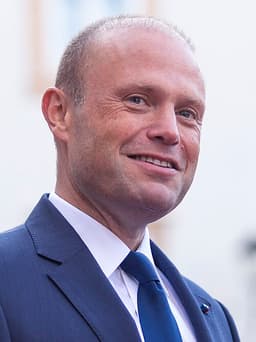
Joseph Muscat
Politician · Modern
50.5Total

Kausea Natano
Politician · Modern
46.9Total
Basic Information
Born
1974
1957
Died
—
—
Era
Modern
Modern
Nationality
Malta
Tuvalu
Occupation
Politician
Politician
Civilization
Western
Other
Score Comparison
Military (10%)
46.3
50.0
Political (20%)
61.3
37.9
Influence (20%)
52.5
51.8
Legacy (20%)
40.0
38.3
Leadership (15%)
62.2
62.2
Strategy (15%)
42.1
43.8
TOTAL
50.5
46.9
Joseph Muscat — Complete Timeline
2013 AD
Elected Prime Minister of MaltaPolitical Action◆ Major
Muscat became Prime Minister of Malta in March 2013, leading the Labour Party to a landslide victory. His campaign focused on economic growth, anti-corruption, and social liberalization.
ElectionPolitical Change
Impact: national
2014 AD
Introduced the Individual Investor Programme (IIP)Political Action◆ Major
Muscat's government launched the Individual Investor Programme, selling Maltese citizenship for a
Citizenship by InvestmentEconomic Policy
Impact: nationalconstructive
2017 AD
Re-elected Prime MinisterPolitical Action◆ Major
Muscat won a second term in the 2017 snap election, called after a scandal involving his wife's Panama company. His Labour Party increased its majority, despite the controversy.
ElectionRe-election
Impact: national
Murder of Daphne Caruana GaliziaOther
Investigative journalist Daphne Caruana Galizia was assassinated by a car bomb on October 16, 2017. She had been investigating corruption involving Muscat's associates, leading to a major political crisis and allegations of a cover-up.
AssassinationJournalismCorruption
Impact: nationaltragic
2020 AD
Resigned as Prime MinisterPolitical Action◆ Major
Muscat resigned as Prime Minister in January 2020, following months of protests over the Caruana Galizia murder investigation. His resignation came after the arrest of businessman Yorgen Fenech, who was implicated in the murder.
ResignationPolitical Crisis
Impact: nationaltragic
Kausea Natano — Complete Timeline
2019 AD
Elected Prime Minister of TuvaluPolitical Action◆ Major
Natano was elected Prime Minister after the 2019 general election, succeeding Enele Sopoaga. He formed a government committed to continuing Tuvalu's climate activism and strengthening ties with international partners.
Prime MinisterTuvaluGovernment Formation
Impact: nationalconstructive
2021 AD
Advocated for Tuvalu's constitution to recognize statehood in perpetuityPolitical Action◆ Major
Natano supported constitutional amendments to declare Tuvalu's statehood permanent regardless of sea-level rise. The amendment aimed to ensure Tuvalu's continued recognition as a sovereign state even if its physical territory becomes uninhabitable.
Constitutional AmendmentClimate ChangeSovereignty
Impact: nationalconstructive
2023 AD
Signed the Tuvalu-Australia Falepili Union treatyPolitical Action◆ Major
Natano signed a bilateral treaty with Australia establishing the Falepili Union, which provided Tuvalu with climate resilience funding and a pathway for Tuvaluans to migrate to Australia. The treaty also included security cooperation provisions.
TreatyAustraliaClimate Migration
Impact: regionalconstructive
2024 AD
Lost re-election as Prime MinisterPolitical Action◆ Major
Natano was defeated in the 2024 Tuvaluan general election, losing his parliamentary seat. Feleti Teo succeeded him as Prime Minister, ending Natano's term.
Election DefeatPolitical Transition
Impact: national
This comparison has not been analyzed yet.
One-time AI generation (~1 minute). Scores and timeline are already available below.
Rankings
🥇
Joseph MuscatLeader
Mil: 46.3Pol: 61.3Inf: 52.5
50.5
🥈
Kausea Natano
Mil: 50.0Pol: 37.9Inf: 51.8
46.9
+3.6 behind
How This Comparison Works
Algorithm
Each figure is scored on 6 dimensions (0—100 scale) based on structured historical data: Military (10%), Political (20%), Influence (20%), Legacy (20%), Leadership (15%), Strategy (15%). The weighted total produces the final ranking.
Data Sources
Scores are computed from structured sub-indicators in the database. Scale factors adjust for era (Ancient ×0.85, Modern ×1.0) and civilization size (Eastern ×1.05, Other ×0.80) to account for differences in population and military scale.
Maximum 3 Figures
Comparisons are limited to 2—3 figures to ensure readability and statistical meaningfulness.
Error Margins
±5 points per dimension — Sub-scores are derived from historical records with inherent uncertainty. Two figures within 5 points on a dimension should be considered roughly equivalent in that area.
Total Score Accuracy
±3 points overall — The weighted combination of 6 dimensions produces a total score with approximately ±3 points of uncertainty. Differences of less than 3 points are not statistically significant— the figures are effectively tied.
Known Limitations
- Historical records are incomplete and uneven across civilizations
- Figures from oral-tradition societies may be underrepresented
- Occupation labels can misclassify multi-role figures
- Scores measure capability and impact, not moral character
- Quantitative scoring is a comparison tool, not absolute truth
Capability Radar
Military (10%) — Battles & Warfare
Battles
32
24
Win Rate
35
27
Expansion
36
27
Political (20%) — Governance & Reform
Reform
35
25
Diplomacy
45
40
Economy
50
20
Influence (20%) — Cultural & Global Reach
Cultural
20
15
Global
25
35
Legacy (20%) — Historical Impact
Historical
25
20
Longevity
15
10
Leadership (15%) — Power & Stability
Tenure
40
30
Stability
20
30
Strategy (15%) — Tactics & Innovation
Strategy
37
28
Tactics
38
36
Reform
46
33
Similar Comparisons
Comments & Discussion
No comments yet. Be the first to share your thoughts!