Loading...
Alexander De Croo vs Joseph Muscat
Joseph Muscat leads by 2.2 pts · 2 figures compared
…
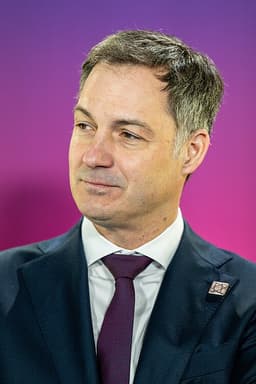
Alexander De Croo
Politician · Modern
48.3Total
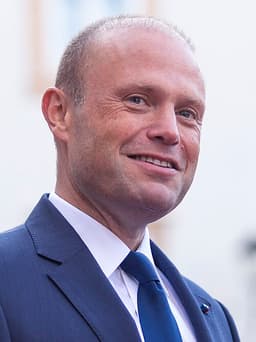
Joseph Muscat
Politician · Modern
50.5Total
Basic Information
Born
1975
1974
Died
—
—
Era
Modern
Modern
Nationality
Belgium
Malta
Occupation
Politician
Politician
Civilization
Western
Western
Score Comparison
Military (10%)
14.0
46.3
Political (20%)
68.0
61.3
Influence (20%)
51.0
52.5
Legacy (20%)
37.5
40.0
Leadership (15%)
74.0
62.2
Strategy (15%)
34.7
42.1
TOTAL
48.3
50.5
Alexander De Croo — Complete Timeline
2012 AD
Appointed Deputy Prime Minister of BelgiumPolitical Action
Alexander De Croo became Deputy Prime Minister and Minister of Pensions in the Di Rupo government. He later served as Minister of Development Cooperation and Minister of Finance, gaining experience in coalition governance.
Belgian PoliticsCoalitionGovernment
Impact: nationalconstructive
2020 AD
Became Prime Minister of BelgiumPolitical Action◆ Major
De Croo became Prime Minister of Belgium, leading a seven-party coalition government. His appointment ended a 16-month political deadlock after the 2019 elections, with a focus on COVID-19 recovery and economic reforms.
Belgian PoliticsPrime MinisterCoalition
Impact: nationalconstructive
Led Belgium's COVID-19 ResponsePolitical Action◆ Major
De Croo's government managed the COVID-19 pandemic, including lockdowns, vaccination rollout, and economic support. Belgium faced high infection rates and criticism over hospital capacity, but the vaccination campaign eventually reached high coverage.
COVID-19Belgian PoliticsPublic Health
Impact: national
2021 AD
Hosted NATO Summit in BrusselsPolitical Action
De Croo hosted the NATO summit in Brussels, where leaders discussed defense spending, Afghanistan withdrawal, and relations with Russia. The summit reaffirmed NATO's collective defense commitments.
NATOSummitDefense
Impact: globalconstructive
2022 AD
Navigated Energy Crisis and InflationPolitical Action◆ Major
De Croo's government responded to the energy crisis caused by the Russia-Ukraine war, implementing price caps and subsidies for households. Belgium also faced high inflation, leading to social unrest and strikes.
Energy CrisisInflationBelgian Politics
Impact: national
Joseph Muscat — Complete Timeline
2013 AD
Elected Prime Minister of MaltaPolitical Action◆ Major
Muscat became Prime Minister of Malta in March 2013, leading the Labour Party to a landslide victory. His campaign focused on economic growth, anti-corruption, and social liberalization.
ElectionPolitical Change
Impact: national
2014 AD
Introduced the Individual Investor Programme (IIP)Political Action◆ Major
Muscat's government launched the Individual Investor Programme, selling Maltese citizenship for a
Citizenship by InvestmentEconomic Policy
Impact: nationalconstructive
2017 AD
Re-elected Prime MinisterPolitical Action◆ Major
Muscat won a second term in the 2017 snap election, called after a scandal involving his wife's Panama company. His Labour Party increased its majority, despite the controversy.
ElectionRe-election
Impact: national
Murder of Daphne Caruana GaliziaOther
Investigative journalist Daphne Caruana Galizia was assassinated by a car bomb on October 16, 2017. She had been investigating corruption involving Muscat's associates, leading to a major political crisis and allegations of a cover-up.
AssassinationJournalismCorruption
Impact: nationaltragic
2020 AD
Resigned as Prime MinisterPolitical Action◆ Major
Muscat resigned as Prime Minister in January 2020, following months of protests over the Caruana Galizia murder investigation. His resignation came after the arrest of businessman Yorgen Fenech, who was implicated in the murder.
ResignationPolitical Crisis
Impact: nationaltragic
Expert Analysis
Origins
Alexander De Croo was born on November 3, 1975, in Vilvoorde, Belgium, into a prominent political family. His father, Herman De Croo, served as the President of the Belgian Chamber of Representatives. Alexander studied business engineering at the Vrije Universiteit Brussel and later earned an MBA from the Kellogg School of Management in the United States. He initially worked in the private sector as a consultant at Boston Consulting Group before entering politics in 2006.
Joseph Muscat was born on January 22, 1974, in Pietà, Malta, into a working-class family. He studied commerce at the University of Malta and later earned a PhD in management research from the University of Bristol. Muscat was active in the Labour Party from a young age, serving as a member of the European Parliament from 2004 to 2008. He became the leader of the Labour Party in 2008, positioning himself as a reformist.
Rise to Power
De Croo's rise was gradual and coalition-based. He entered federal politics in 2006 as a candidate for the Open Flemish Liberals and Democrats (Open VLD). In 2012, he became Deputy Prime Minister and Minister of Pensions in the Di Rupo government. He later served as Minister of Development Cooperation and then as Minister of Finance. In October 2020, after 16 months of political deadlock following the 2019 elections, De Croo became Prime Minister, leading a seven-party coalition that included Flemish and French-speaking liberals, socialists, greens, and Christian democrats.
Muscat's rise was swift and populist. He won the Labour Party leadership in 2008 and became Leader of the Opposition. In the 2013 general election, Muscat led Labour to a landslide victory, winning 55% of the vote and 39 of 69 seats. His campaign focused on economic growth, anti-corruption, and a break from the previous Nationalist government. He became Prime Minister on March 11, 2013.
Leadership & Governance
De Croo's leadership style is consensual and technocratic. He managed a fractious coalition during crises like COVID-19 and the energy crisis. His government implemented lockdowns, a vaccination rollout that achieved 75% full vaccination by September 2021, and economic support measures worth €2.5 billion. On energy, De Croo's government introduced price caps and subsidies worth €1.2 billion to protect households. However, Belgium's infection rates were high, with 1.2 million cases by early 2021.
Muscat's governance was more decisive but controversial. He pursued economic liberalization, cutting corporate taxes from 35% to 25% and attracting foreign investment. His signature policy was the Individual Investor Programme (IIP), which sold Maltese citizenship for €650,000. By 2020, the scheme had raised over €800 million, but it drew EU criticism for facilitating tax avoidance. Muscat also expanded Malta's gaming industry, contributing to GDP growth averaging 6% per year from 2013 to 2019.
Triumph & Tragedy
De Croo's greatest success was steering Belgium through the COVID-19 pandemic without a government collapse. His coalition held together despite ideological differences. He also successfully hosted the NATO summit in Brussels in June 2021, where leaders discussed Afghanistan and Russia. However, his government faced criticism for slow vaccine procurement and high death rates (over 25,000 by 2022). The energy crisis response was also seen as reactive rather than proactive.
Muscat's economic achievements were notable: Malta's unemployment fell to 3.5% and GDP per capita surpassed the EU average. However, his legacy is dominated by the murder of investigative journalist Daphne Caruana Galizia on October 16, 2017. She had been investigating corruption linked to Muscat's associates. The murder sparked international outrage and protests. Muscat resisted calls to resign until December 2019, when he announced he would step down in January 2020. Three men were convicted for the murder, but questions remain about who ordered it.
Character & Destiny
De Croo is described as pragmatic and diplomatic, with a low-key demeanor. His ability to build consensus among seven parties reflects his patience. He scored 74.0 in leadership, indicating steady management. However, his strategic score of 34.7 suggests a lack of bold vision. His destiny was to manage crises rather than transform Belgium.
Muscat was charismatic and ambitious, with a populist touch. He scored 62.2 in leadership and 42.1 in strategy. His downfall came from his tolerance of corruption. The Panama Papers scandal in 2016 revealed that his wife owned a shell company, leading to a snap election that he won. But the Caruana Galizia murder exposed the dark side of his governance. His resignation in 2020 was forced by public pressure, marking a tragic end to a promising career.
Legacy
De Croo's legacy is modest: he will be remembered as a crisis manager who kept Belgium together. His scores reflect this: political 68.0, influence 51.0, legacy 37.5. Belgium remains a stable but fragmented state. His key achievement is the coalition model, but no major reforms.
Muscat's legacy is deeply tarnished. While his economic policies modernized Malta, the IIP and corruption scandals damaged the country's reputation. His score legacy of 40.0 reflects the mixed assessment. The murder of Daphne Caruana Galizia has become a symbol of impunity, and the EU has criticized Malta's rule of law. Muscat's influence score of 52.5 is higher than De Croo's, showing his greater impact, but mostly negative.
Conclusion
Joseph Muscat had greater impact than Alexander De Croo, as reflected in his higher total score of 50.5 versus 48.3. Muscat transformed Malta's economy and put the country on the map, but his legacy is irrevocably damaged by the Caruana Galizia murder. De Croo was a competent manager but left little lasting change. In the balance of impact, Muscat's actions—both positive and negative—shaped his nation more profoundly. Therefore, Muscat is the more consequential figure, though his legacy is cautionary.
Rankings
🥇
Joseph MuscatLeader
Mil: 46.3Pol: 61.3Inf: 52.5
50.5
🥈
Alexander De Croo
Mil: 14.0Pol: 68.0Inf: 51.0
48.3
+2.2 behind
How This Comparison Works
Algorithm
Each figure is scored on 6 dimensions (0—100 scale) based on structured historical data: Military (10%), Political (20%), Influence (20%), Legacy (20%), Leadership (15%), Strategy (15%). The weighted total produces the final ranking.
Data Sources
Scores are computed from structured sub-indicators in the database. Scale factors adjust for era (Ancient ×0.85, Modern ×1.0) and civilization size (Eastern ×1.05, Other ×0.80) to account for differences in population and military scale.
Maximum 3 Figures
Comparisons are limited to 2—3 figures to ensure readability and statistical meaningfulness.
Error Margins
±5 points per dimension — Sub-scores are derived from historical records with inherent uncertainty. Two figures within 5 points on a dimension should be considered roughly equivalent in that area.
Total Score Accuracy
±3 points overall — The weighted combination of 6 dimensions produces a total score with approximately ±3 points of uncertainty. Differences of less than 3 points are not statistically significant— the figures are effectively tied.
Known Limitations
- Historical records are incomplete and uneven across civilizations
- Figures from oral-tradition societies may be underrepresented
- Occupation labels can misclassify multi-role figures
- Scores measure capability and impact, not moral character
- Quantitative scoring is a comparison tool, not absolute truth
Capability Radar
Military (10%) — Battles & Warfare
Battles
20
32
Win Rate
24
35
Expansion
27
36
Political (20%) — Governance & Reform
Reform
45
35
Diplomacy
55
45
Economy
50
50
Influence (20%) — Cultural & Global Reach
Cultural
20
20
Global
25
25
Legacy (20%) — Historical Impact
Historical
20
25
Longevity
15
15
Leadership (15%) — Power & Stability
Tenure
40
40
Stability
45
20
Strategy (15%) — Tactics & Innovation
Strategy
34
37
Tactics
36
38
Reform
35
46
Similar Comparisons
Comments & Discussion
No comments yet. Be the first to share your thoughts!