Loading...
Joseph Kabila vs Mohamed Nasheed
Mohamed Nasheed leads by 9.9 pts · 2 figures compared
…
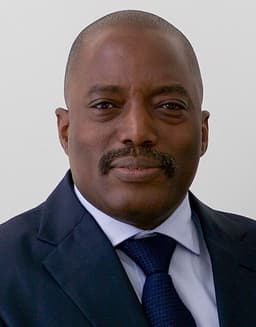
Joseph Kabila
Politician · Modern
47.2Total

Mohamed Nasheed
Politician · Modern
57.1Total
Basic Information
Born
1971
1967
Died
—
—
Era
Modern
Modern
Nationality
Congo
Maldives
Occupation
Politician
Politician
Civilization
Other
Indian
Score Comparison
Military (10%)
20.0
45.1
Political (20%)
40.8
72.0
Influence (20%)
49.4
57.2
Legacy (20%)
40.8
46.7
Leadership (15%)
74.0
65.7
Strategy (15%)
54.6
60.0
TOTAL
47.2
57.1
Joseph Kabila — Complete Timeline
2001 AD
Became President of the Democratic Republic of the CongoPolitical Action◆ Major
Joseph Kabila became President of the DRC at age 29 after his father Laurent Kabila's assassination. He inherited a country embroiled in the Second Congo War and faced the challenge of ending the conflict.
PresidencySuccessionDRC
Impact: national
2002 AD
Signed Sun City AgreementPolitical Action
Kabila's government signed the Sun City Agreement, a peace deal that ended the Second Congo War. The agreement established a transitional government and paved the way for democratic elections.
Peace AgreementSecond Congo WarTransition
Impact: regionalconstructive
2006 AD
Won First Democratic Elections in DRCPolitical Action◆ Major
Joseph Kabila won the first democratic presidential elections in the DRC since independence, defeating Jean-Pierre Bemba in a runoff. The elections were largely peaceful but marred by allegations of irregularities.
ElectionsDemocracyDRC
Impact: nationalconstructive
2016 AD
Refused to Step Down After 2016 ElectionsPolitical Action◆ Major
Kabila's refusal to step down after his constitutional term limit expired in 2016 sparked political crisis and protests. He remained in power until 2019, citing delays in organizing elections.
Constitutional CrisisTerm LimitsPolitical Instability
Impact: nationaldestructive
2019 AD
Peacefully Transferred Power to Félix TshisekediPolitical Action
Joseph Kabila peacefully transferred power to opposition leader F
Power TransferDemocracyDRC
Impact: nationalconstructive
Mohamed Nasheed — Complete Timeline
2008 AD
Elected first democratically elected President of MaldivesPolitical Action
Mohamed Nasheed won the Maldives' first multi-party presidential election, defeating long-serving President Maumoon Abdul Gayoom. His victory marked a historic transition to democracy after 30 years of authoritarian rule, with Nasheed promising reforms and transparency.
DemocracyElectionTransition
Impact: nationalconstructive
2009 AD
Held the world's first underwater cabinet meetingPolitical Action◆ Major
Nasheed and his cabinet held a meeting underwater off the coast of the Maldives to highlight the threat of climate change and rising sea levels. The event drew global media attention and underscored the existential risk facing low-lying island nations.
Climate changeActivismMaldives
Impact: globalconstructive
2012 AD
Resigned under pressure amid a political crisisPolitical Action◆ Major
After weeks of protests and a police mutiny, Nasheed resigned as president, claiming he was forced out in a coup. He was succeeded by Vice President Mohammed Waheed Hassan. The event sparked international concern and led to a period of political instability.
ResignationPolitical crisisCoup allegations
Impact: nationaltragic
2015 AD
Arrested and sentenced to 13 years in prisonPolitical Action◆ Major
Nasheed was arrested under anti-terrorism laws for ordering the arrest of a judge during his presidency. He was sentenced to 13 years in prison, a move widely condemned internationally as politically motivated. He was later granted asylum in the UK.
ImprisonmentPolitical persecutionHuman rights
Impact: nationaltragic
Expert Analysis
Origins
Joseph Kabila was born on June 4, 1971, in Hewa Bora, Congo, the son of Laurent-Désiré Kabila, a rebel leader. He grew up in Tanzania and Uganda, receiving military training and education. After his father's assassination in 2001, Joseph inherited the presidency at age 29. Mohamed Nasheed was born on May 17, 1967, in Malé, Maldives. He attended school in Maldives and later studied at Liverpool John Moores University in the UK, earning a degree in marine biology. Nasheed became a journalist and political activist, opposing the authoritarian rule of Maumoon Abdul Gayoom.
Rise to Power
Joseph Kabila became president on January 26, 2001, immediately after his father's assassination. He inherited a country embroiled in the Second Congo War (1998-2003). Kabila consolidated power by negotiating peace deals, notably the Sun City Agreement of 2002, which ended the war and established a transitional government. He won the first democratic elections in DRC in 2006, defeating Jean-Pierre Bemba with 58.1% of the vote. Mohamed Nasheed rose to prominence as a pro-democracy activist, enduring imprisonment under Gayoom. He co-founded the Maldivian Democratic Party (MDP) in 2003. In 2008, Nasheed won the first multi-party presidential election, defeating Gayoom with 54.2% of the vote. His victory marked a turning point for democracy in Maldives.
Leadership & Governance
Kabila's leadership style was pragmatic and authoritarian. He focused on ending the war and stabilizing Congo through power-sharing arrangements. However, his governance was marked by corruption and human rights abuses. He scored 74.0 in leadership but only 40.8 in political effectiveness. In contrast, Nasheed promoted democratic reforms, transparency, and environmental activism. He held the world's first underwater cabinet meeting in 2009 to highlight climate change. Nasheed's leadership scored 65.7, but his governance faced challenges from a deeply entrenched elite. Kabila's refusal to step down after his term expired in 2016 led to a political crisis, while Nasheed's resignation under duress in 2012 showed vulnerability.
Triumph & Tragedy
Kabila's greatest triumph was ending the Second Congo War and overseeing the first democratic elections in 2006. He peacefully transferred power to Félix Tshisekedi in 2019, a rare feat in African politics. However, his failure to implement reforms and his power grab after 2016 tarnished his legacy. Nasheed's triumph was establishing democracy in Maldives and elevating climate change as a global issue. His tragedy came in 2012 when he resigned during a police mutiny, claiming a coup. He was later arrested in 2015 and sentenced to 13 years under anti-terrorism laws, raising concerns about judicial independence.
Character & Destiny
Kabila was cautious and calculating, often avoiding confrontation. His character allowed him to survive in a volatile environment but prevented bold reforms. Nasheed was charismatic and idealistic, willing to take risks for democracy and the environment. His character inspired many but also made him enemies. Historians note that Kabila's destiny was shaped by his father's legacy, while Nasheed's fate was tied to his confrontation with the old guard. Kabila scored 54.6 in strategy, reflecting his ability to navigate power transitions, while Nasheed scored 60.0, showing stronger strategic thinking but less durability.
Legacy
Kabila's legacy is mixed: he ended a major war and enabled democratic elections, but his authoritarian tendencies and corruption undermined progress. He scored 40.8 in legacy. Nasheed's legacy as a democracy pioneer and climate activist is more positive, scoring 46.7. His efforts led to the Maldives becoming a vocal advocate for climate action. However, his failure to consolidate democratic institutions left the country vulnerable. Kabila's influence (49.4) was limited to Congo, while Nasheed's influence (57.2) extended globally on climate issues.
Conclusion
Mohamed Nasheed had greater impact overall, scoring 57.1 compared to Kabila's 47.2. Nasheed's role in establishing democracy in Maldives and his global climate advocacy created a more enduring legacy. While Kabila achieved peace and a democratic transition, his legacy is marred by corruption and authoritarianism. Nasheed's higher scores in political (72.0 vs 40.8) and strategy (60.0 vs 54.6) reflect his more innovative and principled leadership. The 9.9-point gap underscores Nasheed's broader influence, despite Kabila's larger stage.
Rankings
🥇
Mohamed NasheedLeader
Mil: 45.1Pol: 72.0Inf: 57.2
57.1
🥈
Joseph Kabila
Mil: 20.0Pol: 40.8Inf: 49.4
47.2
+9.9 behind
How This Comparison Works
Algorithm
Each figure is scored on 6 dimensions (0—100 scale) based on structured historical data: Military (10%), Political (20%), Influence (20%), Legacy (20%), Leadership (15%), Strategy (15%). The weighted total produces the final ranking.
Data Sources
Scores are computed from structured sub-indicators in the database. Scale factors adjust for era (Ancient ×0.85, Modern ×1.0) and civilization size (Eastern ×1.05, Other ×0.80) to account for differences in population and military scale.
Maximum 3 Figures
Comparisons are limited to 2—3 figures to ensure readability and statistical meaningfulness.
Error Margins
±5 points per dimension — Sub-scores are derived from historical records with inherent uncertainty. Two figures within 5 points on a dimension should be considered roughly equivalent in that area.
Total Score Accuracy
±3 points overall — The weighted combination of 6 dimensions produces a total score with approximately ±3 points of uncertainty. Differences of less than 3 points are not statistically significant— the figures are effectively tied.
Known Limitations
- Historical records are incomplete and uneven across civilizations
- Figures from oral-tradition societies may be underrepresented
- Occupation labels can misclassify multi-role figures
- Scores measure capability and impact, not moral character
- Quantitative scoring is a comparison tool, not absolute truth
Capability Radar
Military (10%) — Battles & Warfare
Battles
15
44
Win Rate
20
47
Expansion
10
47
Political (20%) — Governance & Reform
Reform
30
70
Diplomacy
40
65
Economy
25
55
Influence (20%) — Cultural & Global Reach
Cultural
15
40
Global
20
45
Legacy (20%) — Historical Impact
Historical
25
50
Longevity
20
30
Leadership (15%) — Power & Stability
Tenure
65
35
Stability
20
30
Strategy (15%) — Tactics & Innovation
Strategy
15
50
Tactics
10
55
Reform
25
59
Similar Comparisons
Comments & Discussion
No comments yet. Be the first to share your thoughts!