Loading...
Joseph Kabila vs Margaret of Parma
Margaret of Parma leads by 8.6 pts · 2 figures compared
…
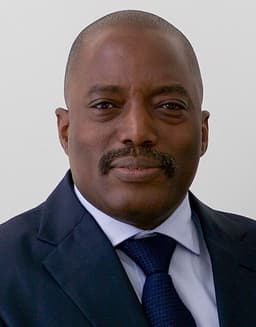
Joseph Kabila
Politician · Modern
47.2Total

Margaret of Parma
Politician · Modern
55.8Total
Basic Information
Born
1971
1522
Died
—
1586
Era
Modern
Modern
Nationality
Congo
Netherlands
Occupation
Politician
Politician
Civilization
Other
Western
Score Comparison
Military (10%)
20.0
39.9
Political (20%)
40.8
68.0
Influence (20%)
49.4
54.9
Legacy (20%)
40.8
45.8
Leadership (15%)
74.0
74.0
Strategy (15%)
54.6
53.8
TOTAL
47.2
55.8
Joseph Kabila — Complete Timeline
2001 AD
Became President of the Democratic Republic of the CongoPolitical Action◆ Major
Joseph Kabila became President of the DRC at age 29 after his father Laurent Kabila's assassination. He inherited a country embroiled in the Second Congo War and faced the challenge of ending the conflict.
PresidencySuccessionDRC
Impact: national
2002 AD
Signed Sun City AgreementPolitical Action
Kabila's government signed the Sun City Agreement, a peace deal that ended the Second Congo War. The agreement established a transitional government and paved the way for democratic elections.
Peace AgreementSecond Congo WarTransition
Impact: regionalconstructive
2006 AD
Won First Democratic Elections in DRCPolitical Action◆ Major
Joseph Kabila won the first democratic presidential elections in the DRC since independence, defeating Jean-Pierre Bemba in a runoff. The elections were largely peaceful but marred by allegations of irregularities.
ElectionsDemocracyDRC
Impact: nationalconstructive
2016 AD
Refused to Step Down After 2016 ElectionsPolitical Action◆ Major
Kabila's refusal to step down after his constitutional term limit expired in 2016 sparked political crisis and protests. He remained in power until 2019, citing delays in organizing elections.
Constitutional CrisisTerm LimitsPolitical Instability
Impact: nationaldestructive
2019 AD
Peacefully Transferred Power to Félix TshisekediPolitical Action
Joseph Kabila peacefully transferred power to opposition leader F
Power TransferDemocracyDRC
Impact: nationalconstructive
Margaret of Parma — Complete Timeline
1559 AD
Appointed Governor of the NetherlandsPolitical Action◆ Major
Margaret of Parma was appointed Governor of the Netherlands by her half-brother King Philip II of Spain. She governed during the early stages of the Dutch Revolt, implementing policies that sought to suppress Protestantism and maintain Spanish control.
Dutch RevoltSpanish NetherlandsGovernorship
Impact: regional
1566 AD
Issued the Edict of 1566Political Action◆ Major
Margaret issued an edict moderating the anti-heresy laws in the Netherlands, allowing limited Protestant worship in an attempt to quell unrest. This concession failed to satisfy Calvinist radicals and contributed to the outbreak of the Iconoclastic Fury later that year.
Religious PolicyDutch RevoltCompromise
Impact: regional
Iconoclastic Fury (Beeldenstorm)Other◆ Major
Calvinist mobs destroyed Catholic church art and statues across the Netherlands. Margaret's government was unable to prevent the widespread destruction, which deepened the religious divide and prompted Philip II to send the Duke of Alba with an army to restore order.
IconoclasmDutch RevoltReligious Violence
Impact: regionaldestructive
1567 AD
Resigned as GovernorPolitical Action◆ Major
Margaret resigned as Governor of the Netherlands after the arrival of the Duke of Alba, who was sent by Philip II to suppress the revolt. She opposed Alba's harsh policies and left the Netherlands, returning to Italy.
Dutch RevoltResignationAlba
Impact: regional
Expert Analysis
Origins
**Joseph Kabila** was born on June 4, 1971, in Hewa Bora, Congo, the son of Laurent-Désiré Kabila, a rebel leader who later became president. He grew up in Tanzania and Uganda, receiving military training and education in guerrilla warfare. His early life was shaped by his father's revolutionary activities, and he was groomed for leadership within the rebel group AFDL. He spoke Swahili, English, and French but lacked formal higher education.
**Margaret of Parma** was born on July 5, 1522, in Oudenaarde, Flanders, the illegitimate daughter of Holy Roman Emperor Charles V. She was raised by her aunt and later married into the Farnese family. She received a humanist education and was trained in governance, serving as regent of the Netherlands from 1559 to 1567. Her background as a Habsburg illegitimate daughter gave her both privileges and constraints, as she was loyal to her half-brother King Philip II of Spain.
Rise to Power
Joseph Kabila became president at age 29 on January 17, 2001, after his father Laurent Kabila was assassinated by a bodyguard. He inherited a country in the midst of the Second Congo War (1998–2003), involving multiple African nations. His rise was not through election but through dynastic succession within a rebel government. He quickly consolidated power by negotiating with rebel groups and international actors, leading to the Sun City Agreement in 2002, which established a transitional government and ended the war.
Margaret of Parma was appointed Governor of the Netherlands in 1559 by Philip II, replacing the unpopular Duke of Savoy. She was chosen for her loyalty and administrative experience, having previously governed in Italy. Her rise was due to her Habsburg lineage and her ability to manage the complex politics of the Netherlands, which was a wealthy but restive territory. She faced immediate challenges from the nobility, such as William of Orange, who opposed Spanish centralization.
Leadership & Governance
Joseph Kabila's leadership style was authoritarian but pragmatic. He presided over a transitional government from 2003 to 2006, then won the first democratic elections in the DRC in 2006, defeating Jean-Pierre Bemba with 58% of the vote. He promoted economic liberalization and attracted foreign investment, but his rule was marked by corruption, human rights abuses, and weak state institutions. He amended the constitution in 2011 to reduce presidential powers but later refused to step down after his term expired in 2016, sparking a political crisis. His governance score of 74.0 reflects his ability to maintain power but not to build lasting democratic institutions.
Margaret of Parma governed the Netherlands during a period of rising religious and political tension. She attempted moderate reforms, such as the Edict of 1566, which relaxed anti-heresy laws to appease Calvinists. However, her authority was undermined by the Iconoclastic Fury (Beeldenstorm) in August 1566, when Calvinist mobs destroyed Catholic churches. She failed to prevent the violence, leading Philip II to send the Duke of Alba with an army to suppress the revolt. Her leadership score of 74.0 indicates effective management within constraints but inability to control radical elements.
Triumph & Tragedy
Joseph Kabila's greatest triumph was ending the Second Congo War and overseeing the first democratic elections in 2006, which were relatively free and fair. He also peacefully transferred power to Félix Tshisekedi in 2019 after the disputed 2018 elections, a rare event in African politics. His tragedies include the ongoing conflict in eastern DRC, with millions dead from war and disease; his refusal to step down in 2016 led to violent protests and a democratic backslide. His military score of 20.0 reflects his lack of direct military involvement, though he maintained control through security forces.
Margaret of Parma's triumph was her initial success in stabilizing the Netherlands after the turmoil of the 1550s, using a combination of diplomacy and moderate policies. Her tragedy was the failure to prevent the Iconoclastic Fury, which escalated the Dutch Revolt. She resigned in 1567 after Alba's arrival, her authority completely undermined. Her military score of 39.9 reflects her reliance on Spanish troops but inability to command them effectively.
Character & Destiny
Joseph Kabila was reserved and secretive, often described as a technocrat rather than a charismatic leader. He made calculated decisions, such as negotiating peace deals while maintaining a tight grip on power. His character led him to prioritize stability over democracy, which ultimately damaged his legacy. He scored 54.6 in strategy, showing moderate skill in navigating complex political landscapes.
Margaret of Parma was pragmatic and loyal, but her dependence on Philip II limited her autonomy. She tried to balance the interests of the Spanish crown and the Dutch nobility, but her moderate stance pleased neither side. Her character led to her downfall when she could not control the radical Calvinists. She scored 53.8 in strategy, indicating a similar level of strategic capability to Kabila.
Legacy
Joseph Kabila's legacy is mixed: he ended a major war and oversaw a democratic transition, but he also presided over corruption and authoritarianism. The DRC remains unstable, and his political dynasty continues to influence the country. His total score of 47.2 reflects limited long-term impact.
Margaret of Parma's legacy is as a transitional figure in the Dutch Revolt. Her moderate policies were overshadowed by the harsh repression of Alba, but her attempts at compromise are noted by historians. She scored 45.8 in legacy, slightly lower than Kabila's 40.8, but her overall impact on the Netherlands' path to independence is significant.
Conclusion
Margaret of Parma had a greater overall impact than Joseph Kabila, with a total score of 55.8 compared to Kabila's 47.2. While Kabila ended a war and held elections, his failures in governance and human rights undermine his legacy. Margaret's role in the early Dutch Revolt, though ultimately unsuccessful, set the stage for the Eighty Years' War and the eventual independence of the Netherlands. Her political score of 68.0 far exceeds Kabila's 40.8, reflecting her more nuanced governance in a complex political environment. Therefore, Margaret of Parma is the more significant historical figure.
Rankings
🥇
Margaret of ParmaLeader
Mil: 39.9Pol: 68.0Inf: 54.9
55.8
🥈
Joseph Kabila
Mil: 20.0Pol: 40.8Inf: 49.4
47.2
+8.6 behind
How This Comparison Works
Algorithm
Each figure is scored on 6 dimensions (0—100 scale) based on structured historical data: Military (10%), Political (20%), Influence (20%), Legacy (20%), Leadership (15%), Strategy (15%). The weighted total produces the final ranking.
Data Sources
Scores are computed from structured sub-indicators in the database. Scale factors adjust for era (Ancient ×0.85, Modern ×1.0) and civilization size (Eastern ×1.05, Other ×0.80) to account for differences in population and military scale.
Maximum 3 Figures
Comparisons are limited to 2—3 figures to ensure readability and statistical meaningfulness.
Error Margins
±5 points per dimension — Sub-scores are derived from historical records with inherent uncertainty. Two figures within 5 points on a dimension should be considered roughly equivalent in that area.
Total Score Accuracy
±3 points overall — The weighted combination of 6 dimensions produces a total score with approximately ±3 points of uncertainty. Differences of less than 3 points are not statistically significant— the figures are effectively tied.
Known Limitations
- Historical records are incomplete and uneven across civilizations
- Figures from oral-tradition societies may be underrepresented
- Occupation labels can misclassify multi-role figures
- Scores measure capability and impact, not moral character
- Quantitative scoring is a comparison tool, not absolute truth
Capability Radar
Military (10%) — Battles & Warfare
Battles
15
10
Win Rate
20
10
Expansion
10
5
Political (20%) — Governance & Reform
Reform
30
40
Diplomacy
40
55
Economy
25
45
Influence (20%) — Cultural & Global Reach
Cultural
15
30
Global
20
30
Legacy (20%) — Historical Impact
Historical
25
45
Longevity
20
30
Leadership (15%) — Power & Stability
Tenure
65
60
Stability
20
30
Strategy (15%) — Tactics & Innovation
Strategy
15
15
Tactics
10
10
Reform
25
10
Similar Comparisons
Comments & Discussion
No comments yet. Be the first to share your thoughts!