Loading...
This comparison has not been analyzed yet.
One-time AI generation (~1 minute). Scores and timeline are already available below.
Jose Mujica vs Odvar Nordli
Odvar Nordli leads by 0.4 pts · 2 figures compared
…
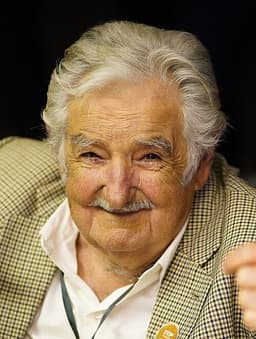
Jose Mujica
Politician · Modern
52.3Total
Odvar Nordli
Politician · Modern
52.7Total
Basic Information
Born
1935
1927
Died
—
—
Era
Modern
Modern
Nationality
Uruguay
Norway
Occupation
Politician
Politician
Civilization
Western
Western
Score Comparison
Military (10%)
41.6
49.6
Political (20%)
45.0
53.8
Influence (20%)
58.0
53.3
Legacy (20%)
45.0
45.0
Leadership (15%)
68.0
72.0
Strategy (15%)
54.8
43.3
TOTAL
52.3
52.7
Jose Mujica — Complete Timeline
1960 AD
Joined the Tupamaro guerrilla movementPolitical Action◆ Major
Mujica joined the Movimiento de Liberaci
GuerrillaUruguayTupamaros
Impact: nationaldestructive
1972 AD
Imprisonment during the dictatorshipPolitical Action◆ Major
Mujica was captured by Uruguayan security forces and imprisoned for 14 years, including 7 years in solitary confinement. He was held in military barracks and subjected to harsh conditions, emerging as a symbol of resistance.
ImprisonmentDictatorshipHuman Rights
Impact: nationaltragic
2009 AD
Elected President of UruguayPolitical Action
Mujica won the 2009 presidential election as the candidate of the Broad Front coalition, defeating former President Luis Alberto Lacalle. He took office in 2010, becoming known as the 'world's poorest president' for donating most of his salary.
ElectionPresidencyUruguay
Impact: nationalconstructive
2013 AD
Legalized same-sex marriage in UruguayReform◆ Major
Mujica signed the Equal Marriage Law, making Uruguay the 12th country in the world to legalize same-sex marriage. The law granted same-sex couples the same rights as heterosexual couples, including adoption and inheritance.
LGBT RightsMarriage EqualitySocial Reform
Impact: nationalprogressive
Legalized cannabis regulationReform◆ Major
Mujica's government passed a law legalizing the production, sale, and consumption of cannabis under state regulation. Uruguay became the first country in the world to fully legalize cannabis for recreational use, aiming to combat drug trafficking.
Drug PolicyCannabisInnovation
Impact: globalprogressive
Odvar Nordli — Complete Timeline
1976 AD
Became Prime Minister of NorwayPolitical Action
On January 15, 1976, Nordli became Prime Minister, succeeding Trygve Bratteli. He led the Labour Party government during a period of rapid oil wealth accumulation and economic expansion.
Labour PartyOil BoomSuccession
Impact: national
Managed the Oil BoomPolitical Action◆ Major
Nordli's government oversaw the early management of Norway's oil revenues, including the establishment of the Government Pension Fund Global (oil fund) in 1990. His policies aimed to avoid Dutch disease and invest oil wealth for future generations.
OilSovereign Wealth FundEconomic Policy
Impact: nationalconstructive
1977 AD
Expanded the Welfare StateReform◆ Major
Nordli's government introduced several welfare expansions, including improved sick leave benefits and increased pensions. These reforms were funded by oil revenues and solidified Norway's social democratic model.
Welfare StateSocial ReformOil Revenue
Impact: nationalconstructive
1981 AD
Resigned as Prime MinisterPolitical Action◆ Major
Nordli resigned as Prime Minister in February 1981, citing health reasons. His resignation came after a period of economic challenges, including inflation and labor disputes, and he was succeeded by Gro Harlem Brundtland.
ResignationHealthSuccession
Impact: national
This comparison has not been analyzed yet.
One-time AI generation (~1 minute). Scores and timeline are already available below.
Rankings
🥇
Odvar NordliLeader
Mil: 49.6Pol: 53.8Inf: 53.3
52.7
🥈
Jose Mujica
Mil: 41.6Pol: 45.0Inf: 58.0
52.3
+0.4 behind
How This Comparison Works
Algorithm
Each figure is scored on 6 dimensions (0—100 scale) based on structured historical data: Military (10%), Political (20%), Influence (20%), Legacy (20%), Leadership (15%), Strategy (15%). The weighted total produces the final ranking.
Data Sources
Scores are computed from structured sub-indicators in the database. Scale factors adjust for era (Ancient ×0.85, Modern ×1.0) and civilization size (Eastern ×1.05, Other ×0.80) to account for differences in population and military scale.
Maximum 3 Figures
Comparisons are limited to 2—3 figures to ensure readability and statistical meaningfulness.
Error Margins
±5 points per dimension — Sub-scores are derived from historical records with inherent uncertainty. Two figures within 5 points on a dimension should be considered roughly equivalent in that area.
Total Score Accuracy
±3 points overall — The weighted combination of 6 dimensions produces a total score with approximately ±3 points of uncertainty. Differences of less than 3 points are not statistically significant— the figures are effectively tied.
Known Limitations
- Historical records are incomplete and uneven across civilizations
- Figures from oral-tradition societies may be underrepresented
- Occupation labels can misclassify multi-role figures
- Scores measure capability and impact, not moral character
- Quantitative scoring is a comparison tool, not absolute truth
Capability Radar
Military (10%) — Battles & Warfare
Battles
15
27
Win Rate
10
32
Expansion
5
37
Political (20%) — Governance & Reform
Reform
60
55
Diplomacy
65
55
Economy
55
65
Influence (20%) — Cultural & Global Reach
Cultural
45
30
Global
45
30
Legacy (20%) — Historical Impact
Historical
40
40
Longevity
30
30
Leadership (15%) — Power & Stability
Tenure
55
60
Stability
50
60
Strategy (15%) — Tactics & Innovation
Strategy
15
36
Tactics
20
42
Reform
5
47
Similar Comparisons
Comments & Discussion
No comments yet. Be the first to share your thoughts!