Loading...
This comparison has not been analyzed yet.
One-time AI generation (~1 minute). Scores and timeline are already available below.
Jorge Batlle vs Yousaf Raza Gillani
Jorge Batlle leads by 2.2 pts · 2 figures compared
…
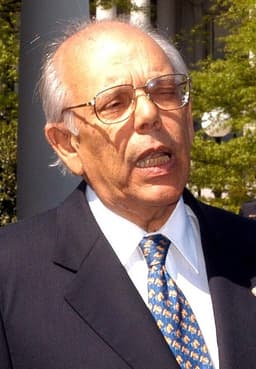
Jorge Batlle
Politician · Modern
51.7Total

Yousaf Raza Gillani
Politician · Modern
49.5Total
Basic Information
Born
1927
1952
Died
—
—
Era
Modern
Modern
Nationality
Uruguay
Pakistan
Occupation
Politician
Politician
Civilization
Western
Indian
Score Comparison
Military (10%)
50.0
46.3
Political (20%)
68.0
45.1
Influence (20%)
49.4
50.2
Legacy (20%)
40.8
40.0
Leadership (15%)
64.0
64.0
Strategy (15%)
43.2
60.0
TOTAL
51.7
49.5
Jorge Batlle — Complete Timeline
1999 AD
Elected President of UruguayPolitical Action◆ Major
Jorge Batlle was elected president of Uruguay in the 1999 general election as the Colorado Party candidate, defeating the Broad Front candidate Tabar
ElectionColorado PartyPresidential Victory
Impact: nationalconstructive
2002 AD
Faced Banking CrisisOther◆ Major
Uruguay experienced a severe banking crisis in 2002, triggered by the Argentine economic crisis. Depositors withdrew billions of dollars, leading to a bank run. Batlle's government imposed a freeze on bank deposits and negotiated a $3 billion loan from the IMF.
Banking CrisisEconomic CrisisIMF
Impact: nationaldestructive
2003 AD
Signed the Free Trade Agreement with MexicoPolitical Action
Batlle signed a free trade agreement with Mexico in November 2003, aiming to boost bilateral trade and investment. The agreement was part of Uruguay's strategy to diversify its trade relations beyond Mercosur.
Free TradeMexicoTrade Diversification
Impact: regionalconstructive
2005 AD
Ended Presidential Term with Low ApprovalPolitical Action
Batlle completed his presidential term in March 2005, handing power to Tabar
End of TermLow ApprovalEconomic Crisis
Impact: nationaldestructive
Yousaf Raza Gillani — Complete Timeline
2008 AD
Elected Prime Minister of PakistanPolitical Action◆ Major
Yousaf Raza Gillani was elected as the 18th Prime Minister of Pakistan on March 25, 2008, after the Pakistan Peoples Party (PPP) won the general elections. He led a coalition government and was the first Prime Minister from the PPP since Benazir Bhutto's assassination.
Prime MinisterPPP2008 Elections
Impact: national
2010 AD
Repeal of the 17th AmendmentReform◆ Major
Under Gillani's premiership, the 18th Amendment to the Constitution was passed on April 8, 2010, which repealed the 17th Amendment and restored the parliamentary system. The amendment devolved powers to provinces and removed the president's power to dissolve parliament.
Constitutional AmendmentParliamentary SystemDevolution
Impact: nationalconstructive
2012 AD
Disqualification by Supreme CourtPolitical Action◆ Major
On June 19, 2012, the Supreme Court of Pakistan disqualified Yousaf Raza Gillani from holding public office for contempt of court. The court ruled that he had failed to write to Swiss authorities to reopen corruption cases against President Asif Ali Zardari.
DisqualificationSupreme CourtContempt
Impact: nationaltragic
This comparison has not been analyzed yet.
One-time AI generation (~1 minute). Scores and timeline are already available below.
Rankings
🥇
Jorge BatlleLeader
Mil: 50.0Pol: 68.0Inf: 49.4
51.7
🥈
Yousaf Raza Gillani
Mil: 46.3Pol: 45.1Inf: 50.2
49.5
+2.2 behind
How This Comparison Works
Algorithm
Each figure is scored on 6 dimensions (0—100 scale) based on structured historical data: Military (10%), Political (20%), Influence (20%), Legacy (20%), Leadership (15%), Strategy (15%). The weighted total produces the final ranking.
Data Sources
Scores are computed from structured sub-indicators in the database. Scale factors adjust for era (Ancient ×0.85, Modern ×1.0) and civilization size (Eastern ×1.05, Other ×0.80) to account for differences in population and military scale.
Maximum 3 Figures
Comparisons are limited to 2—3 figures to ensure readability and statistical meaningfulness.
Error Margins
±5 points per dimension — Sub-scores are derived from historical records with inherent uncertainty. Two figures within 5 points on a dimension should be considered roughly equivalent in that area.
Total Score Accuracy
±3 points overall — The weighted combination of 6 dimensions produces a total score with approximately ±3 points of uncertainty. Differences of less than 3 points are not statistically significant— the figures are effectively tied.
Known Limitations
- Historical records are incomplete and uneven across civilizations
- Figures from oral-tradition societies may be underrepresented
- Occupation labels can misclassify multi-role figures
- Scores measure capability and impact, not moral character
- Quantitative scoring is a comparison tool, not absolute truth
Capability Radar
Military (10%) — Battles & Warfare
Battles
29
43
Win Rate
29
48
Expansion
37
47
Political (20%) — Governance & Reform
Reform
45
30
Diplomacy
50
45
Economy
45
35
Influence (20%) — Cultural & Global Reach
Cultural
20
20
Global
15
20
Legacy (20%) — Historical Impact
Historical
25
25
Longevity
20
15
Leadership (15%) — Power & Stability
Tenure
40
55
Stability
35
20
Strategy (15%) — Tactics & Innovation
Strategy
40
53
Tactics
42
57
Reform
42
57
Similar Comparisons
Comments & Discussion
No comments yet. Be the first to share your thoughts!