Loading...
John Major vs Milo Djukanovic
John Major leads by 4.2 pts · 2 figures compared
…
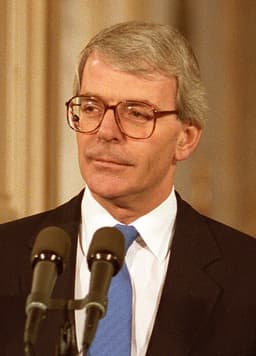
John Major
Politician · Modern
58.0Total

Milo Djukanovic
Politician · Modern
53.8Total
Basic Information
Born
1943
1962
Died
—
—
Era
Modern
Modern
Nationality
United Kingdom
Montenegro
Occupation
Politician
Politician
Civilization
Western
Western
Score Comparison
Military (10%)
50.0
50.0
Political (20%)
72.0
60.0
Influence (20%)
58.0
52.5
Legacy (20%)
50.0
45.0
Leadership (15%)
72.0
66.0
Strategy (15%)
43.7
55.5
TOTAL
58.0
53.8
John Major — Complete Timeline
1991 AD
Negotiated the Maastricht TreatyPolitical Action
Major negotiated the Maastricht Treaty, which created the European Union and established the euro currency. He secured opt-outs for the UK from the single currency and social chapter, a major achievement in European integration.
European UnionTreatyUK Opt-Outs
Impact: globalconstructive
1992 AD
Black WednesdayOther
The UK was forced to withdraw the pound sterling from the European Exchange Rate Mechanism after a speculative attack. The government spent billions trying to defend the currency, a major economic and political failure for Major's government.
Economic CrisisERMCurrency Crisis
Impact: nationaldestructive
Won the 1992 General ElectionPolitical Action◆ Major
Major led the Conservative Party to an unexpected victory in the 1992 general election, winning a majority of 21 seats. This was the Conservatives' fourth consecutive election win, despite predictions of a hung parliament.
General ElectionConservative VictoryPolitical Surprise
Impact: national
1993 AD
Signed the Downing Street DeclarationPolitical Action◆ Major
Major and Irish Taoiseach Albert Reynolds signed the Downing Street Declaration, a joint peace initiative for Northern Ireland. The declaration affirmed the principle of consent and opened the way for peace negotiations.
Northern IrelandPeace ProcessAnglo-Irish Relations
Impact: regionalconstructive
1997 AD
Resigned as Prime MinisterPolitical Action◆ Major
Major resigned as prime minister after the Conservative Party suffered a landslide defeat in the 1997 general election to Tony Blair's Labour Party. The defeat ended 18 years of Conservative government.
General ElectionConservative DefeatPolitical Transition
Impact: nationaltragic
Milo Djukanovic — Complete Timeline
1991 AD
Elected Prime Minister of MontenegroPolitical Action◆ Major
Djukanovic became Prime Minister of Montenegro at age 29, the youngest in Europe. He initially supported Slobodan Milosevic but later shifted to a pro-Western stance.
Montenegro PoliticsPost-Communist Transition
Impact: regional
1998 AD
Elected President of MontenegroPolitical Action◆ Major
Djukanovic was elected President of Montenegro, serving until 2002. He pursued a policy of distancing from Serbia and moving toward EU integration.
PresidencyMontenegro Politics
Impact: regional
2006 AD
Led Montenegro to IndependencePolitical Action◆ Major
Djukanovic, as Prime Minister, led the campaign for Montenegro's independence from Serbia. The referendum resulted in a narrow victory for independence, ending the State Union of Serbia and Montenegro.
IndependenceReferendum
Impact: regionalconstructive
2020 AD
Defeated in Parliamentary ElectionsPolitical Action◆ Major
Djukanovic's Democratic Party of Socialists lost the parliamentary elections to a coalition of opposition parties, ending his party's 30-year rule. He remained president but with reduced power.
ElectionPolitical Change
Impact: regional
Expert Analysis
Origins
John Major was born on 29 March 1943 in London, the son of a former music hall performer and a circus acrobat. His family faced financial struggles, and Major left school at 16 to work various jobs, eventually entering banking. He joined the Conservative Party and was elected to Parliament in 1979, rising through the ranks due to his moderate stance.
Milo Djukanovic was born on 15 February 1962 in Nikšić, Montenegro, then part of Yugoslavia. He studied economics at the University of Montenegro and joined the League of Communists of Yugoslavia. His political career began in the 1980s within the communist framework, and he was elected to the Montenegrin parliament in 1989.
Rise to Power
Major became Prime Minister in November 1990 after Margaret Thatcher's resignation, having served as Chancellor of the Exchequer and Foreign Secretary. His unexpected victory in the 1992 general election secured a majority, solidifying his position.
Djukanovic became Prime Minister of Montenegro in 1991 at age 29, initially supporting Slobodan Milosevic. However, by the late 1990s, he shifted to a pro-Western stance, distancing Montenegro from Serbia. He led his party to electoral victories and became President in 1998.
Leadership & Governance
Major's leadership focused on managing the Conservative Party's internal divisions over Europe. He negotiated the Maastricht Treaty in 1992, which created the European Union, but secured opt-outs for the UK from the single currency and social chapter. His government faced crises like Black Wednesday in 1992, when the pound was forced out of the ERM, damaging economic credibility. He also pursued the Downing Street Declaration in 1993, a peace initiative for Northern Ireland.
Djukanovic governed Montenegro with a pragmatic, often authoritarian style. He oversaw the country's transition from communism to a market economy, but his rule was marred by corruption allegations and links to organized crime. He led Montenegro to independence via a referendum in 2006, becoming its first independent leader. His governance score is 66.0, compared to Major's 72.0.
Triumph & Tragedy
Major's triumphs include the Maastricht Treaty and the unexpected 1992 election win. His tragedy was Black Wednesday, which cost billions and damaged Conservative economic reputation. He also failed to prevent Labour's landslide win in 1997.
Djukanovic's triumph was leading Montenegro to independence in 2006, a historic achievement. His tragedy was the end of his party's 30-year rule in 2020 after electoral defeat, amid corruption scandals. He also failed to fully integrate Montenegro into the EU.
Character & Destiny
Major was a cautious, pragmatic leader, often seen as a conciliator but lacking charisma. His character led to a focus on consensus, but also indecision. He scored 72.0 in leadership.
Djukanovic was a shrewd, adaptable politician, able to shift alliances. His long rule suggests resilience, but his association with corruption tarnished his legacy. His leadership score is 66.0.
Legacy
Major's legacy is tied to the Maastricht Treaty and the UK's European debate. His Northern Ireland peace efforts laid groundwork for the Good Friday Agreement. He is remembered as a caretaker PM, with a total score of 58.0.
Djukanovic's legacy is Montenegro's independence and its pro-Western orientation. However, his rule left a mixed record of economic reform and democratic backsliding. His total score is 53.8.
Conclusion
John Major had a greater impact on European integration and UK politics, despite his domestic challenges. His Maastricht Treaty shaped the EU, while Djukanovic's independence movement was regionally significant but limited in global influence. Major's higher total score of 58.0 vs 53.8 reflects his broader impact.
Rankings
🥇
John MajorLeader
Mil: 50.0Pol: 72.0Inf: 58.0
58.0
🥈
Milo Djukanovic
Mil: 50.0Pol: 60.0Inf: 52.5
53.8
+4.2 behind
How This Comparison Works
Algorithm
Each figure is scored on 6 dimensions (0—100 scale) based on structured historical data: Military (10%), Political (20%), Influence (20%), Legacy (20%), Leadership (15%), Strategy (15%). The weighted total produces the final ranking.
Data Sources
Scores are computed from structured sub-indicators in the database. Scale factors adjust for era (Ancient ×0.85, Modern ×1.0) and civilization size (Eastern ×1.05, Other ×0.80) to account for differences in population and military scale.
Maximum 3 Figures
Comparisons are limited to 2—3 figures to ensure readability and statistical meaningfulness.
Error Margins
±5 points per dimension — Sub-scores are derived from historical records with inherent uncertainty. Two figures within 5 points on a dimension should be considered roughly equivalent in that area.
Total Score Accuracy
±3 points overall — The weighted combination of 6 dimensions produces a total score with approximately ±3 points of uncertainty. Differences of less than 3 points are not statistically significant— the figures are effectively tied.
Known Limitations
- Historical records are incomplete and uneven across civilizations
- Figures from oral-tradition societies may be underrepresented
- Occupation labels can misclassify multi-role figures
- Scores measure capability and impact, not moral character
- Quantitative scoring is a comparison tool, not absolute truth
Capability Radar
Military (10%) — Battles & Warfare
Battles
27
31
Win Rate
29
31
Expansion
36
33
Political (20%) — Governance & Reform
Reform
55
60
Diplomacy
70
70
Economy
50
65
Influence (20%) — Cultural & Global Reach
Cultural
30
20
Global
50
25
Legacy (20%) — Historical Impact
Historical
55
40
Longevity
40
30
Leadership (15%) — Power & Stability
Tenure
65
85
Stability
45
30
Strategy (15%) — Tactics & Innovation
Strategy
39
39
Tactics
43
42
Reform
44
42
Similar Comparisons
Comments & Discussion
No comments yet. Be the first to share your thoughts!