Loading...
John Howard vs Sharad Pawar
Sharad Pawar leads by 1.4 pts · 2 figures compared
…
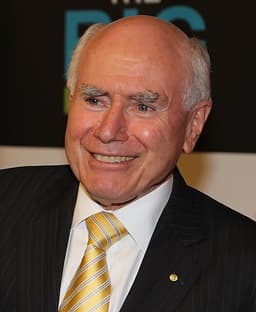
John Howard
Politician · Modern
56.6Total
Sharad Pawar
Politician · Modern
58.0Total
Basic Information
Born
1939
1940
Died
—
—
Era
Modern
Modern
Nationality
Australia
India
Occupation
Politician
Politician
Civilization
Western
Indian
Score Comparison
Military (10%)
50.0
40.9
Political (20%)
59.3
65.0
Influence (20%)
57.2
55.7
Legacy (20%)
50.0
49.2
Leadership (15%)
78.0
79.8
Strategy (15%)
41.8
60.0
TOTAL
56.6
58.0
John Howard — Complete Timeline
1996 AD
Implemented Gun Control After Port ArthurReform◆ Major
Following the Port Arthur massacre, Howard's government introduced strict gun control laws, including a ban on automatic and semi-automatic weapons and a mandatory buyback scheme. The reforms significantly reduced gun violence in Australia.
Gun ControlPort ArthurPublic Safety
Impact: nationalprogressive
Elected Prime Minister of AustraliaPolitical Action◆ Major
Howard led the Liberal-National coalition to a landslide victory in the 1996 federal election, defeating Paul Keating's Labor government. His campaign focused on economic reform, family values, and a more conservative social agenda.
ElectionLiberal PartyCoalition
Impact: national
2000 AD
Introduced the Goods and Services Tax (GST)Reform◆ Major
Howard's government introduced a 10% Goods and Services Tax, replacing the previous wholesale sales tax. The GST was a major tax reform that broadened the tax base and provided revenue for state governments, though it was politically controversial.
Tax ReformGSTEconomic Policy
Impact: nationalconstructive
2003 AD
Led Australia into the Iraq WarWar◆ Major
Howard committed Australian troops to the US-led invasion of Iraq, citing weapons of mass destruction. The decision was highly controversial and led to large public protests, but Howard argued it was necessary for global security.
Iraq WarForeign PolicyUS Alliance
Impact: globaldestructive
2007 AD
Defeated in 2007 ElectionPolitical Action◆ Major
Howard lost the 2007 federal election to Kevin Rudd's Labor Party, ending his 11-year tenure as prime minister. He also lost his own seat of Bennelong, becoming only the second sitting prime minister to lose his seat.
ElectionDefeatLabor Party
Impact: nationaltragic
Sharad Pawar — Complete Timeline
1978 AD
First Term as Chief Minister of MaharashtraPolitical Action◆ Major
Pawar became Chief Minister of Maharashtra for the first time in July 1978, leading a Progressive Democratic Front government. At 37, he was the youngest Chief Minister of the state, marking the beginning of his long political career.
Chief MinisterYoungest CMMaharashtra
Impact: regionalconstructive
1988 AD
Second Term as Chief Minister of MaharashtraPolitical Action◆ Major
Pawar became Chief Minister for a second time in June 1988, leading the Indian National Congress government. He served until 1991, focusing on cooperative sector development and agricultural reforms.
Chief MinisterCongress GovernmentMaharashtra
Impact: regionalconstructive
1993 AD
Third Term as Chief Minister of MaharashtraPolitical Action◆ Major
Pawar became Chief Minister for a third time in March 1993, serving until 1995. His tenure included the aftermath of the 1993 Mumbai bombings and the implementation of economic liberalization policies in the state.
Chief MinisterMumbai BombingsMaharashtra
Impact: regional
1999 AD
Founded the Nationalist Congress Party (NCP)Political Action◆ Major
Pawar founded the Nationalist Congress Party in June 1999 after being expelled from the Indian National Congress for challenging Sonia Gandhi's leadership. The NCP became a major political force in Maharashtra and a key coalition partner.
Political PartySplit from CongressMaharashtra
Impact: nationalconstructive
Fourth Term as Chief Minister of MaharashtraPolitical Action◆ Major
Pawar became Chief Minister for a fourth time in October 1999, leading a Congress-NCP coalition government. He served until 2003, focusing on water management and the development of the Mumbai-Pune Expressway.
Chief MinisterCoalition GovernmentMaharashtra
Impact: regionalconstructive
2004 AD
Served as Union Minister of AgriculturePolitical Action◆ Major
Pawar served as Union Minister of Agriculture and Food Processing Industries from 2004 to 2014 under Prime Minister Manmohan Singh. He implemented the National Food Security Act and oversaw agricultural reforms during a period of high food inflation.
Union MinisterAgriculture PolicyIndia
Impact: nationalconstructive
2024 AD
NCP Split and Loss of Party SymbolPolitical Action◆ Major
Pawar's nephew Ajit Pawar led a rebellion in July 2023, joining the BJP-Shiv Sena government. In 2024, the Election Commission recognized Ajit Pawar's faction as the real NCP, awarding it the party symbol. Sharad Pawar's faction was reduced to a minority.
Party SplitElection CommissionNCP
Impact: regionaldestructive
Expert Analysis
Origins
John Howard was born on 26 July 1939 in Sydney, Australia, into a middle-class family. His father ran a garage and his mother was a homemaker. Howard attended Canterbury Boys' High School and later studied law at the University of Sydney, graduating in 1961. He worked as a solicitor and became involved in the Liberal Party, serving as president of the New South Wales Young Liberals.
Sharad Pawar was born on 12 December 1940 in Baramati, Maharashtra, India, into a Maratha agricultural family. He was educated at Brihan Maharashtra College of Commerce in Pune, but left before completing his degree to enter politics. Pawar's early political mentor was his uncle, who was a local Congress leader. He joined the Indian National Congress and was elected to the Maharashtra Legislative Assembly in 1967 at age 27.
Rise to Power
Howard's rise began when he was elected to the Australian House of Representatives in 1974 for the seat of Bennelong. He served as Minister for Business and Consumer Affairs under Malcolm Fraser and later as Treasurer. In 1985, he became Leader of the Opposition, but lost the 1987 election. He was re-elected as Liberal leader in 1995 and led the coalition to a landslide victory in the 1996 federal election, defeating Paul Keating's Labor government.
Pawar's rise was rapid. He became a minister in Maharashtra in 1972 at age 31, handling portfolios like Home and Cooperation. In 1978, he broke away from Congress to form the Progressive Democratic Front and became Chief Minister for the first time at 37. He later returned to Congress and served as Chief Minister twice more (1988-1991 and 1993-1995). In 1999, after being expelled from Congress for challenging Sonia Gandhi's leadership, he founded the Nationalist Congress Party (NCP) and became Chief Minister for a fourth time (1999-2003).
Leadership & Governance
Howard governed with a pragmatic conservative approach. His signature reform was the introduction of a 10% Goods and Services Tax (GST) in 2000, which replaced the wholesale sales tax and broadened the tax base. He also implemented strict gun control laws after the 1996 Port Arthur massacre, banning automatic and semi-automatic weapons, which reduced firearm deaths. Howard's foreign policy was closely aligned with the United States, committing troops to the Iraq War in 2003, a decision that proved controversial. He also led Australia during the 1999 East Timor intervention.
Pawar's governance focused on cooperative development, water management, and agricultural policy. As Chief Minister, he promoted sugar cooperatives and irrigation projects. He handled the aftermath of the 1993 Mumbai bombings, though his tenure also saw communal riots. Pawar served as Union Minister of Agriculture (2004-2014) in the UPA government, where he oversaw the implementation of the National Food Security Act. His leadership style was pragmatic, often building coalitions across party lines, but he faced criticism for his role in the 2008 Maharashtra political crisis.
Triumph & Tragedy
Howard's greatest triumph was his electoral success: winning four consecutive elections (1996, 1998, 2001, 2004). His gun control laws significantly reduced mass shootings and are considered a model globally. The GST reform was a major fiscal achievement. However, his decision to join the Iraq War damaged his reputation, and his government's handling of the 2005 Cronulla riots and the 2007 APEC summit protests drew criticism. His defeat in 2007, losing his own seat, was a personal tragedy.
Pawar's triumphs include serving four terms as Chief Minister, a rare feat, and founding the NCP, which became a major regional party. His tenure as Agriculture Minister saw record food grain production and the passage of the Food Security Act. However, his legacy is marred by allegations of corruption, including involvement in the 1992 securities scam and the 2008 Maharashtra political crisis. He was never convicted, but the controversies weakened his moral authority. His failure to secure a national role after 2014 was a setback.
Character & Destiny
Howard was known for his stubbornness and strategic focus. He was a master of wedge politics, using issues like asylum seekers and tax reform to divide the opposition. His character was shaped by a belief in small government and individual responsibility. This led to his success in implementing reforms but also to his downfall when public opinion turned against his Iraq policy and workplace relations reforms (WorkChoices).
Pawar was a pragmatic survivor, adept at building alliances and shifting allegiances. He was known as a "Maratha strongman" who maintained power through patronage and coalition politics. His character was flexible, allowing him to work with different parties, but this also led to perceptions of opportunism. His destiny was to be a regional kingmaker rather than a national leader; he never became Prime Minister despite his ambitions.
Legacy
Howard's legacy in Australia is significant: he reshaped the tax system, implemented gun control, and maintained economic growth. His social conservatism and foreign policy alignment with the US influenced Australian politics for a decade. However, his legacy is contested due to the Iraq War and his handling of asylum seekers. He scored 50.0 in military, 59.3 in political, 57.2 in influence, 50.0 in legacy, 78.0 in leadership, and 41.8 in strategy, for a total of 56.6.
Pawar's legacy is primarily regional: he transformed Maharashtra's cooperative sector and influenced national agriculture policy. The NCP remains a force in Maharashtra politics. However, his legacy is less transformative at the national level. He scored 40.9 in military, 65.0 in political, 55.7 in influence, 49.2 in legacy, 79.8 in leadership, and 60.0 in strategy, for a total of 58.0. His higher political and leadership scores reflect his longevity and adaptability.
Conclusion
While Sharad Pawar has a slightly higher total score (58.0 vs 56.6), John Howard had a greater impact on his nation's trajectory. Howard's reforms (GST, gun control) were structural and enduring, and his foreign policy decisions shaped Australia's role in the world. Pawar's influence, though significant, was more localized and coalition-dependent. Howard's leadership score (78.0) is comparable to Pawar's (79.8), but Howard's strategy score (41.8) is lower, reflecting his inability to adapt to changing public opinion. Ultimately, Howard's legacy is more transformative for Australia, while Pawar's is more tactical within India's complex political landscape. Therefore, John Howard had a greater impact.
Rankings
🥇
Sharad PawarLeader
Mil: 40.9Pol: 65.0Inf: 55.7
58.0
🥈
John Howard
Mil: 50.0Pol: 59.3Inf: 57.2
56.6
+1.4 behind
How This Comparison Works
Algorithm
Each figure is scored on 6 dimensions (0—100 scale) based on structured historical data: Military (10%), Political (20%), Influence (20%), Legacy (20%), Leadership (15%), Strategy (15%). The weighted total produces the final ranking.
Data Sources
Scores are computed from structured sub-indicators in the database. Scale factors adjust for era (Ancient ×0.85, Modern ×1.0) and civilization size (Eastern ×1.05, Other ×0.80) to account for differences in population and military scale.
Maximum 3 Figures
Comparisons are limited to 2—3 figures to ensure readability and statistical meaningfulness.
Error Margins
±5 points per dimension — Sub-scores are derived from historical records with inherent uncertainty. Two figures within 5 points on a dimension should be considered roughly equivalent in that area.
Total Score Accuracy
±3 points overall — The weighted combination of 6 dimensions produces a total score with approximately ±3 points of uncertainty. Differences of less than 3 points are not statistically significant— the figures are effectively tied.
Known Limitations
- Historical records are incomplete and uneven across civilizations
- Figures from oral-tradition societies may be underrepresented
- Occupation labels can misclassify multi-role figures
- Scores measure capability and impact, not moral character
- Quantitative scoring is a comparison tool, not absolute truth
Capability Radar
Military (10%) — Battles & Warfare
Battles
26
43
Win Rate
29
45
Expansion
37
52
Political (20%) — Governance & Reform
Reform
65
60
Diplomacy
70
80
Economy
75
65
Influence (20%) — Cultural & Global Reach
Cultural
40
40
Global
45
35
Legacy (20%) — Historical Impact
Historical
55
50
Longevity
50
45
Leadership (15%) — Power & Stability
Tenure
70
75
Stability
75
55
Strategy (15%) — Tactics & Innovation
Strategy
37
51
Tactics
40
58
Reform
44
61
Similar Comparisons
Comments & Discussion
No comments yet. Be the first to share your thoughts!