Loading...
This comparison has not been analyzed yet.
One-time AI generation (~1 minute). Scores and timeline are already available below.
John Howard vs Jose Luis Bustamante y Rivero
John Howard leads by 11.4 pts · 2 figures compared
…
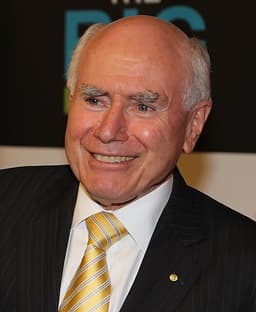
John Howard
Politician · Modern
56.6Total

Jose Luis Bustamante y Rivero
Politician · Modern
45.2Total
Basic Information
Born
1939
1894
Died
—
1989
Era
Modern
Modern
Nationality
Australia
Peru
Occupation
Politician
Politician
Civilization
Western
Western
Score Comparison
Military (10%)
50.0
49.0
Political (20%)
59.3
40.8
Influence (20%)
57.2
47.9
Legacy (20%)
50.0
36.7
Leadership (15%)
78.0
58.8
Strategy (15%)
41.8
41.6
TOTAL
56.6
45.2
John Howard — Complete Timeline
1996 AD
Implemented Gun Control After Port ArthurReform◆ Major
Following the Port Arthur massacre, Howard's government introduced strict gun control laws, including a ban on automatic and semi-automatic weapons and a mandatory buyback scheme. The reforms significantly reduced gun violence in Australia.
Gun ControlPort ArthurPublic Safety
Impact: nationalprogressive
Elected Prime Minister of AustraliaPolitical Action◆ Major
Howard led the Liberal-National coalition to a landslide victory in the 1996 federal election, defeating Paul Keating's Labor government. His campaign focused on economic reform, family values, and a more conservative social agenda.
ElectionLiberal PartyCoalition
Impact: national
2000 AD
Introduced the Goods and Services Tax (GST)Reform◆ Major
Howard's government introduced a 10% Goods and Services Tax, replacing the previous wholesale sales tax. The GST was a major tax reform that broadened the tax base and provided revenue for state governments, though it was politically controversial.
Tax ReformGSTEconomic Policy
Impact: nationalconstructive
2003 AD
Led Australia into the Iraq WarWar◆ Major
Howard committed Australian troops to the US-led invasion of Iraq, citing weapons of mass destruction. The decision was highly controversial and led to large public protests, but Howard argued it was necessary for global security.
Iraq WarForeign PolicyUS Alliance
Impact: globaldestructive
2007 AD
Defeated in 2007 ElectionPolitical Action◆ Major
Howard lost the 2007 federal election to Kevin Rudd's Labor Party, ending his 11-year tenure as prime minister. He also lost his own seat of Bennelong, becoming only the second sitting prime minister to lose his seat.
ElectionDefeatLabor Party
Impact: nationaltragic
Jose Luis Bustamante y Rivero — Complete Timeline
1945 AD
Elected President of PeruPolitical Action◆ Major
Bustamante y Rivero won the 1945 presidential election as the candidate of the National Democratic Front, a coalition that included the reformist APRA party. His victory marked a return to civilian rule after years of military government.
ElectionCivilian Rule
Impact: nationalconstructive
1948 AD
Overthrown by Manuel OdriaPolitical Action
General Manuel Odria led a military coup that overthrew President Bustamante y Rivero. The coup was triggered by Bustamante's inability to control inflation and his conflict with the APRA party, which led to a naval mutiny and political crisis.
CoupOverthrowMilitary
Impact: nationaldestructive
Exiled to ArgentinaPolitical Action
After being overthrown, Bustamante y Rivero was exiled to Argentina. He lived there for several years, writing and reflecting on his presidency and the state of Peruvian democracy.
ExilePersonal
Impact: nationaltragic
1967 AD
Served as President of the International Court of JusticePolitical Action◆ Major
Bustamante y Rivero was elected President of the International Court of Justice (ICJ) in The Hague. He served in this role until 1970, presiding over several important international disputes and contributing to the development of international law.
International LawICJDiplomacy
Impact: globalconstructive
This comparison has not been analyzed yet.
One-time AI generation (~1 minute). Scores and timeline are already available below.
Rankings
🥇
John HowardLeader
Mil: 50.0Pol: 59.3Inf: 57.2
56.6
🥈
Jose Luis Bustamante y Rivero
Mil: 49.0Pol: 40.8Inf: 47.9
45.2
+11.4 behind
How This Comparison Works
Algorithm
Each figure is scored on 6 dimensions (0—100 scale) based on structured historical data: Military (10%), Political (20%), Influence (20%), Legacy (20%), Leadership (15%), Strategy (15%). The weighted total produces the final ranking.
Data Sources
Scores are computed from structured sub-indicators in the database. Scale factors adjust for era (Ancient ×0.85, Modern ×1.0) and civilization size (Eastern ×1.05, Other ×0.80) to account for differences in population and military scale.
Maximum 3 Figures
Comparisons are limited to 2—3 figures to ensure readability and statistical meaningfulness.
Error Margins
±5 points per dimension — Sub-scores are derived from historical records with inherent uncertainty. Two figures within 5 points on a dimension should be considered roughly equivalent in that area.
Total Score Accuracy
±3 points overall — The weighted combination of 6 dimensions produces a total score with approximately ±3 points of uncertainty. Differences of less than 3 points are not statistically significant— the figures are effectively tied.
Known Limitations
- Historical records are incomplete and uneven across civilizations
- Figures from oral-tradition societies may be underrepresented
- Occupation labels can misclassify multi-role figures
- Scores measure capability and impact, not moral character
- Quantitative scoring is a comparison tool, not absolute truth
Capability Radar
Military (10%) — Battles & Warfare
Battles
26
31
Win Rate
29
33
Expansion
37
34
Political (20%) — Governance & Reform
Reform
65
40
Diplomacy
70
30
Economy
75
25
Influence (20%) — Cultural & Global Reach
Cultural
40
15
Global
45
10
Legacy (20%) — Historical Impact
Historical
55
20
Longevity
50
10
Leadership (15%) — Power & Stability
Tenure
70
35
Stability
75
20
Strategy (15%) — Tactics & Innovation
Strategy
37
36
Tactics
40
43
Reform
44
41
Similar Comparisons
Comments & Discussion
No comments yet. Be the first to share your thoughts!