Loading...
This comparison has not been analyzed yet.
One-time AI generation (~1 minute). Scores and timeline are already available below.
John Frederick I of Saxony vs Kot aMbweeky aMileng
John Frederick I of Saxony leads by 0.8 pts · 2 figures compared
…
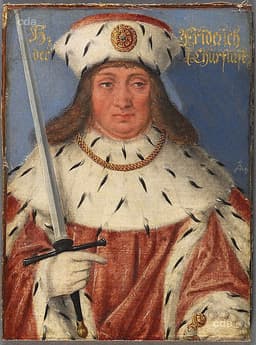
John Frederick I of Saxony
Emperor · Modern
46.5Total

Kot aMbweeky aMileng
Emperor · Modern
45.7Total
Basic Information
Born
1503
1890
Died
1554
1917
Era
Modern
Modern
Nationality
Saxony
Kuba Kingdom
Occupation
Emperor
Emperor
Civilization
Western
Other
Score Comparison
Military (10%)
50.0
50.0
Political (20%)
39.4
32.2
Influence (20%)
51.8
50.2
Legacy (20%)
43.3
40.0
Leadership (15%)
62.2
55.3
Strategy (15%)
25.0
50.0
TOTAL
46.5
45.7
John Frederick I of Saxony — Complete Timeline
1532 AD
Became Elector of SaxonyPolitical Action◆ Major
John Frederick I succeeded his father John the Constant as Elector of Saxony, becoming the head of the Ernestine line. He inherited a leading role in the Schmalkaldic League and the defense of Lutheranism in the Holy Roman Empire.
ElectorateSuccession
Impact: regional
1542 AD
Led the Schmalkaldic LeaguePolitical Action◆ Major
John Frederick I became the military leader of the Schmalkaldic League, the Protestant alliance against Emperor Charles V. He commanded the league's forces in several campaigns, including the conquest of the Duchy of Brunswick-Wolfenb
Schmalkaldic LeagueLeadership
Impact: regional
1547 AD
Defeated at the Battle of MühlbergWar◆ Major
John Frederick I was decisively defeated and captured by Imperial forces under Charles V at the Battle of M
Schmalkaldic WarDefeat
Impact: regionaltragic
Lost the Electorate to Maurice of SaxonyPolitical Action◆ Major
After his capture at M
Capitulation of WittenbergLoss of Power
Impact: regionaldestructive
Imprisoned by Charles VPolitical Action◆ Major
John Frederick I was imprisoned by Emperor Charles V after the Battle of M
ImprisonmentReligious Conviction
Impact: regionaltragic
1552 AD
Released under the Treaty of PassauPolitical Action◆ Major
John Frederick I was released from Imperial imprisonment as part of the Treaty of Passau, which granted religious toleration to Lutherans. He returned to his reduced territories but never regained the electoral title, dying in 1554.
Treaty of PassauRelease
Impact: regionalconstructive
Kot aMbweeky aMileng — Complete Timeline
1910 AD
Fought Belgian Colonial ForcesWar◆ Major
Kot aMbweeky aMileng led Kuba military resistance against Belgian colonial expansion into the Kasai region. His forces engaged in guerrilla warfare against Belgian troops and their African auxiliaries, defending Kuba sovereignty.
Colonial ResistanceWarGuerrilla
Impact: regionaltragic
1917 AD
Signed Treaty with Belgian AuthoritiesPolitical Action
Kot aMbweeky aMileng signed a treaty with Belgian colonial authorities, formally accepting Belgian suzerainty over the Kuba Kingdom. This ended armed resistance and incorporated Kuba into the Belgian Congo as a protectorate.
Colonial TreatySubmissionEnd of Independence
Impact: regionaltragic
This comparison has not been analyzed yet.
One-time AI generation (~1 minute). Scores and timeline are already available below.
Rankings
🥇
John Frederick I of SaxonyLeader
Mil: 50.0Pol: 39.4Inf: 51.8
46.5
🥈
Kot aMbweeky aMileng
Mil: 50.0Pol: 32.2Inf: 50.2
45.7
+0.8 behind
How This Comparison Works
Algorithm
Each figure is scored on 6 dimensions (0—100 scale) based on structured historical data: Military (10%), Political (20%), Influence (20%), Legacy (20%), Leadership (15%), Strategy (15%). The weighted total produces the final ranking.
Data Sources
Scores are computed from structured sub-indicators in the database. Scale factors adjust for era (Ancient ×0.85, Modern ×1.0) and civilization size (Eastern ×1.05, Other ×0.80) to account for differences in population and military scale.
Maximum 3 Figures
Comparisons are limited to 2—3 figures to ensure readability and statistical meaningfulness.
Error Margins
±5 points per dimension — Sub-scores are derived from historical records with inherent uncertainty. Two figures within 5 points on a dimension should be considered roughly equivalent in that area.
Total Score Accuracy
±3 points overall — The weighted combination of 6 dimensions produces a total score with approximately ±3 points of uncertainty. Differences of less than 3 points are not statistically significant— the figures are effectively tied.
Known Limitations
- Historical records are incomplete and uneven across civilizations
- Figures from oral-tradition societies may be underrepresented
- Occupation labels can misclassify multi-role figures
- Scores measure capability and impact, not moral character
- Quantitative scoring is a comparison tool, not absolute truth
Capability Radar
Military (10%) — Battles & Warfare
Battles
25
25
Win Rate
20
20
Expansion
10
10
Political (20%) — Governance & Reform
Reform
30
20
Diplomacy
30
15
Economy
30
15
Influence (20%) — Cultural & Global Reach
Cultural
30
25
Global
20
15
Legacy (20%) — Historical Impact
Historical
40
30
Longevity
30
20
Leadership (15%) — Power & Stability
Tenure
40
30
Stability
20
20
Strategy (15%) — Tactics & Innovation
Strategy
20
25
Tactics
20
30
Reform
10
15
Similar Comparisons
Comments & Discussion
No comments yet. Be the first to share your thoughts!