Loading...
Joao Goulart vs Sixto Duran Ballen
Sixto Duran Ballen leads by 4.5 pts · 2 figures compared
…
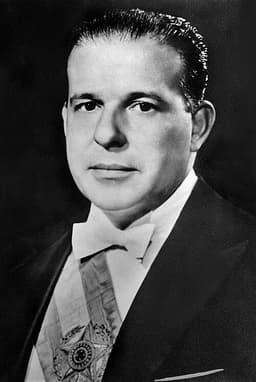
Joao Goulart
Politician · Modern
46.8Total

Sixto Duran Ballen
Politician · Modern
51.3Total
Basic Information
Born
1918
1921
Died
1976
—
Era
Modern
Modern
Nationality
Brazil
Ecuador
Occupation
Politician
Politician
Civilization
Western
Western
Score Comparison
Military (10%)
49.8
49.1
Political (20%)
42.3
68.0
Influence (20%)
50.2
49.4
Legacy (20%)
40.8
40.0
Leadership (15%)
51.9
64.0
Strategy (15%)
49.2
42.8
TOTAL
46.8
51.3
Joao Goulart — Complete Timeline
1960 AD
Elected Vice President of BrazilPolitical Action◆ Major
João Goulart was elected vice president of Brazil in 1960 on the ticket of the Brazilian Labor Party (PTB), alongside President Jânio Quadros. He assumed office on January 31, 1961.
Vice PresidencyElectionBrazil
Impact: nationalconstructive
1961 AD
Assumed the Presidency After Quadros' ResignationPolitical Action
After Quadros resigned in August 1961, Goulart assumed the presidency on September 7, 1961, following a political crisis and a compromise that established a parliamentary system. He was the first president from the PTB.
PresidencyPolitical CrisisBrazil
Impact: nationalconstructive
1962 AD
Nationalized the American-owned ITT and CSN CompaniesPolitical Action
Goulart nationalized the International Telephone and Telegraph (ITT) company and the Companhia Sider
NationalizationEconomic PolicyBrazil
Impact: national
1963 AD
Proposed the Basic ReformsReform◆ Major
Goulart proposed a series of 'Basic Reforms' (Reformas de Base) in 1963, including land reform, tax reform, educational reform, and the nationalization of foreign-owned utilities. These proposals faced strong opposition from conservative sectors and the military.
ReformLand ReformBrazil
Impact: nationalprogressive
1964 AD
Overthrown in the 1964 Military CoupPolitical Action
Goulart was overthrown by a military coup on April 1, 1964, which established a military dictatorship that lasted until 1985. He fled to Uruguay and later to Argentina, where he lived in exile until his death.
CoupExileMilitary Dictatorship
Impact: nationaltragic
Sixto Duran Ballen — Complete Timeline
1992 AD
Implemented Economic ReformsReform◆ Major
Duran Ballen implemented a series of neoliberal economic reforms, including trade liberalization, privatization of state-owned enterprises, and deregulation. These reforms aimed to modernize the economy but faced opposition from labor unions.
Economic ReformNeoliberalismPrivatization
Impact: national
Elected President of EcuadorPolitical Action◆ Major
Sixto Duran Ballen was elected President of Ecuador as the candidate of the Republican Unity Party. He campaigned on a platform of economic modernization and anti-corruption.
ElectionPresidencyEcuador
Impact: national
1995 AD
Cenepa War with PeruWar◆ Major
During Duran Ballen's presidency, a brief armed conflict erupted with Peru over a disputed border area in the Cenepa region. The conflict resulted in casualties on both sides before a ceasefire was negotiated.
WarPeruBorder Conflict
Impact: regionaldestructive
1996 AD
Completed Presidential TermPolitical Action◆ Major
Duran Ballen completed his full four-year presidential term and peacefully transferred power to his elected successor, Abdal Bucaram. This was a rare instance of democratic continuity in Ecuador.
PresidencyDemocracyPeaceful Transition
Impact: nationalconstructive
Expert Analysis
Origins
João Goulart was born on March 1, 1919, in São Borja, Rio Grande do Sul, Brazil, into a wealthy cattle-ranching family. He studied law at the Federal University of Rio Grande do Sul but never practiced, instead managing his family's estates. His political career began under the mentorship of Getúlio Vargas, who appointed him Minister of Labor in 1953. Goulart's close ties to Vargas and his progressive leanings shaped his worldview.
Sixto Duran Ballen was born on July 14, 1921, in Boston, Massachusetts, USA, to Ecuadorian parents. He studied at the University of Illinois and later at Harvard University, earning a degree in civil engineering. Upon returning to Ecuador, he entered the private sector, becoming a successful businessman in construction and real estate. His political career began later in life, serving as Minister of Public Works under President Camilo Ponce Enríquez in the 1960s.
Rise to Power
Goulart was elected Vice President in 1960 on the ticket of Jânio Quadros, a populist conservative. When Quadros unexpectedly resigned in August 1961, Goulart's accession was blocked by military ministers who opposed his leftist views. A compromise established a parliamentary system, reducing his powers, but a referendum in 1963 restored full presidential authority. This crisis marked the start of his embattled presidency.
Duran Ballen rose to prominence as a technocrat and businessman. He was elected President in 1992 as the candidate of the Republican Unity Party, campaigning on a platform of economic modernization and anti-corruption. His victory was seen as a mandate for neoliberal reforms after years of economic stagnation and political instability. He assumed office on August 10, 1992.
Leadership & Governance
Goulart's leadership was characterized by his 'Basic Reforms' (Reformas de Base), which aimed at land redistribution, nationalization of foreign-owned utilities, and expansion of social welfare. He scored 51.9 in Leadership and 49.2 in Strategy. However, his governance was plagued by political polarization and economic crisis, with inflation soaring and foreign debt mounting. He lacked the political skill to build a broad coalition, relying on labor unions and leftist allies, which alienated the military and conservative elites.
Duran Ballen implemented neoliberal reforms, including trade liberalization, privatization of state enterprises, and deregulation. His leadership score of 64.0 reflects his ability to push through a coherent economic agenda despite opposition. He also faced the Cenepa War with Peru in 1995, a brief conflict over a border dispute. His governance was marked by stability, completing his term and transferring power peacefully, a rarity in Ecuadorian history.
Triumph & Tragedy
Goulart's greatest success was the implementation of initial reforms, such as doubling the minimum wage and extending labor rights. He nationalized the American-owned ITT and Companhia Siderúrgica Nacional in 1962, increasing state control. However, his tragedy was the 1964 military coup that overthrew him, leading to a 21-year dictatorship. His inability to manage the economy and political opposition led to his downfall. He died in exile in Argentina in 1976.
Duran Ballen's triumph was overseeing a rare peaceful transfer of power after completing his term. His economic reforms stabilized the economy and attracted foreign investment, though they also increased inequality. The Cenepa War ended with a ceasefire and eventual peace agreement, but it exposed military weaknesses. His legacy is mixed: modernizing but also deepening social divides.
Character & Destiny
Goulart was seen as a well-intentioned but indecisive leader, often swayed by advisors. His character, shaped by his privileged background and Vargas's legacy, made him reluctant to use force against opponents. This contrast with his radical rhetoric created a credibility gap. His destiny was to be a martyr for the left, but his poor political judgment sealed his fate.
Duran Ballen was a pragmatic technocrat, focused on results rather than ideology. His business background gave him a managerial style, but he lacked charisma. He was determined to complete his term and avoid the coups that had plagued Ecuador. His character ensured stability but limited his transformative impact.
Legacy
Goulart's legacy is defined by the military regime that followed him and the subsequent redemocratization. His reforms were largely undone, but he remains a symbol of progressive struggle in Brazil. His influence score of 50.2 reflects his impact on Brazilian political thought. The 1964 coup is still a point of contention.
Duran Ballen's legacy is more institutional: he demonstrated that Ecuador could have peaceful transitions. His neoliberal reforms set the stage for future economic policies, but also contributed to social unrest. His legacy score of 40.0 is modest, as his achievements were overshadowed by later crises.
Conclusion
Sixto Duran Ballen, with a total score of 51.3 against Goulart's 46.8, had a more effective impact by completing his term and implementing lasting reforms, albeit with mixed results. Goulart's presidency ended in disaster, setting back Brazilian democracy by two decades. While Goulart's ideals remain influential, Duran Ballen's practical governance achieved concrete, if imperfect, results. The greater impact belongs to Duran Ballen.
Rankings
🥇
Sixto Duran BallenLeader
Mil: 49.1Pol: 68.0Inf: 49.4
51.3
🥈
Joao Goulart
Mil: 49.8Pol: 42.3Inf: 50.2
46.8
+4.5 behind
How This Comparison Works
Algorithm
Each figure is scored on 6 dimensions (0—100 scale) based on structured historical data: Military (10%), Political (20%), Influence (20%), Legacy (20%), Leadership (15%), Strategy (15%). The weighted total produces the final ranking.
Data Sources
Scores are computed from structured sub-indicators in the database. Scale factors adjust for era (Ancient ×0.85, Modern ×1.0) and civilization size (Eastern ×1.05, Other ×0.80) to account for differences in population and military scale.
Maximum 3 Figures
Comparisons are limited to 2—3 figures to ensure readability and statistical meaningfulness.
Error Margins
±5 points per dimension — Sub-scores are derived from historical records with inherent uncertainty. Two figures within 5 points on a dimension should be considered roughly equivalent in that area.
Total Score Accuracy
±3 points overall — The weighted combination of 6 dimensions produces a total score with approximately ±3 points of uncertainty. Differences of less than 3 points are not statistically significant— the figures are effectively tied.
Known Limitations
- Historical records are incomplete and uneven across civilizations
- Figures from oral-tradition societies may be underrepresented
- Occupation labels can misclassify multi-role figures
- Scores measure capability and impact, not moral character
- Quantitative scoring is a comparison tool, not absolute truth
Capability Radar
Military (10%) — Battles & Warfare
Battles
31
31
Win Rate
30
31
Expansion
34
35
Political (20%) — Governance & Reform
Reform
40
55
Diplomacy
35
45
Economy
25
60
Influence (20%) — Cultural & Global Reach
Cultural
20
20
Global
20
15
Legacy (20%) — Historical Impact
Historical
30
25
Longevity
15
15
Leadership (15%) — Power & Stability
Tenure
30
40
Stability
15
35
Strategy (15%) — Tactics & Innovation
Strategy
37
37
Tactics
40
41
Reform
44
45
Similar Comparisons
Comments & Discussion
No comments yet. Be the first to share your thoughts!