Loading...
Joao Goulart vs Lord Castlereagh
Lord Castlereagh leads by 8.2 pts · 2 figures compared
…
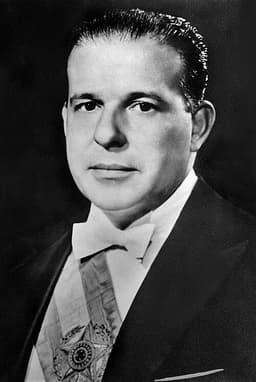
Joao Goulart
Politician · Modern
46.8Total

Lord Castlereagh
Politician · Modern
55.0Total
Basic Information
Born
1918
1769
Died
1976
1822
Era
Modern
Modern
Nationality
Brazil
Ireland
Occupation
Politician
Politician
Civilization
Western
Western
Score Comparison
Military (10%)
49.8
50.0
Political (20%)
42.3
72.0
Influence (20%)
50.2
55.0
Legacy (20%)
40.8
40.0
Leadership (15%)
51.9
75.0
Strategy (15%)
49.2
42.4
TOTAL
46.8
55.0
Joao Goulart — Complete Timeline
1960 AD
Elected Vice President of BrazilPolitical Action◆ Major
João Goulart was elected vice president of Brazil in 1960 on the ticket of the Brazilian Labor Party (PTB), alongside President Jânio Quadros. He assumed office on January 31, 1961.
Vice PresidencyElectionBrazil
Impact: nationalconstructive
1961 AD
Assumed the Presidency After Quadros' ResignationPolitical Action
After Quadros resigned in August 1961, Goulart assumed the presidency on September 7, 1961, following a political crisis and a compromise that established a parliamentary system. He was the first president from the PTB.
PresidencyPolitical CrisisBrazil
Impact: nationalconstructive
1962 AD
Nationalized the American-owned ITT and CSN CompaniesPolitical Action
Goulart nationalized the International Telephone and Telegraph (ITT) company and the Companhia Sider
NationalizationEconomic PolicyBrazil
Impact: national
1963 AD
Proposed the Basic ReformsReform◆ Major
Goulart proposed a series of 'Basic Reforms' (Reformas de Base) in 1963, including land reform, tax reform, educational reform, and the nationalization of foreign-owned utilities. These proposals faced strong opposition from conservative sectors and the military.
ReformLand ReformBrazil
Impact: nationalprogressive
1964 AD
Overthrown in the 1964 Military CoupPolitical Action
Goulart was overthrown by a military coup on April 1, 1964, which established a military dictatorship that lasted until 1985. He fled to Uruguay and later to Argentina, where he lived in exile until his death.
CoupExileMilitary Dictatorship
Impact: nationaltragic
Lord Castlereagh — Complete Timeline
1814 AD
Treaty of Paris (1814)Political Action◆ Major
Castlereagh was the chief British negotiator for the Treaty of Paris, which ended the war with France and exiled Napoleon to Elba. The treaty restored the Bourbon monarchy and set lenient terms for France, aiming to stabilize Europe.
TreatyNapoleonic WarsPeace
Impact: globalconstructive
1815 AD
Congress of ViennaPolitical Action
Castlereagh represented Britain at the Congress of Vienna, which redrew the map of Europe after the Napoleonic Wars. He advocated for a balance of power and the containment of France, securing British interests and establishing a framework for European diplomacy that lasted decades.
DiplomacyPost-NapoleonicBalance of Power
Impact: globalconstructive
Quadruple AlliancePolitical Action◆ Major
Castlereagh helped form the Quadruple Alliance between Britain, Austria, Prussia, and Russia after Napoleon's final defeat. This alliance aimed to maintain the Vienna settlement and prevent future French aggression through periodic congresses.
AllianceDiplomacySecurity
Impact: globalconstructive
1822 AD
Suicide by Letter OpenerOther◆ Major
Castlereagh died by suicide at his country estate, North Cray Place, using a letter opener. He had been suffering from paranoia and overwork, exacerbated by political attacks. His death shocked the British political establishment.
SuicideMental HealthPolitical Figure
Impact: nationaltragic
Expert Analysis
Origins
João Goulart was born on March 1, 1919, in São Borja, Rio Grande do Sul, Brazil, into a wealthy ranching family. He studied law at the University of Porto Alegre but never practiced, instead managing his family's estates. His political career began under the mentorship of Getúlio Vargas, Brazil's populist president, who appointed him labor minister in 1953. Goulart's close ties to Vargas and his advocacy for labor rights defined his early political identity.
Lord Castlereagh, born Robert Stewart on June 18, 1769, in Dublin, Ireland, was the son of an Ulster landowner. He studied at Cambridge and entered the Irish Parliament in 1790. Castlereagh's early career was marked by his role in securing the Act of Union in 1800, which merged Ireland with Great Britain. He later served as Chief Secretary for Ireland and Secretary for War, gaining experience in diplomacy and military administration.
Rise to Power
Goulart rose to prominence as a protégé of Getúlio Vargas. He was elected to the Chamber of Deputies in 1955 and became Vice President under Jânio Quadros in 1960. When Quadros resigned in August 1961, Goulart assumed the presidency on September 7, 1961, after a political crisis that saw military opposition to his leftist leanings. A compromise established a parliamentary system, limiting his powers temporarily. Goulart's rise was marked by his reliance on labor unions and popular support, but also by deep suspicion from conservative elites and the military.
Castlereagh's rise was through diplomatic and administrative roles. He became Foreign Secretary in 1812, at a critical juncture in the Napoleonic Wars. His key turning point was the Congress of Vienna (1814-1815), where he represented Britain and advocated for a balance of power in Europe. Castlereagh's diplomacy helped forge the Quadruple Alliance and secured a stable post-war order. His rise was characterized by pragmatism and a focus on European stability, rather than domestic popularity.
Leadership & Governance
Goulart's leadership style was populist and reformist. He proposed the 'Basic Reforms' in 1963, including land redistribution, tax reform, educational expansion, and nationalization of key industries. For example, he nationalized the American-owned International Telephone and Telegraph (ITT) and Companhia Siderúrgica Nacional (CSN) in 1962. However, his governance was chaotic, marked by economic instability, inflation, and political polarization. He struggled to implement reforms due to congressional opposition and military hostility. His political score of 42.3 reflects his inability to consolidate power and govern effectively.
Castlereagh's leadership was diplomatic and strategic. As Foreign Secretary, he orchestrated Britain's role in the post-Napoleonic settlement. He advocated for a balance of power, not revenge against France, and helped create the Concert of Europe, a system of regular conferences to manage international affairs. His governance score of 75.0 reflects his effectiveness in shaping European diplomacy. However, his domestic political skills were weaker; he was unpopular in Britain for his repressive policies at home, such as the Six Acts after the Peterloo Massacre.
Triumph & Tragedy
Goulart's greatest triumph was his attempt to address Brazil's deep social inequalities through the Basic Reforms, which mobilized popular support. He also successfully assumed the presidency despite a coup attempt in 1961. However, his greatest failure was his inability to manage the political crisis, leading to the 1964 military coup that overthrew him on April 1, 1964. He fled to Uruguay, where he died in exile in 1976. The coup established a 21-year military dictatorship, undoing many of his policies. His legacy score of 40.8 reflects the tragic outcome of his presidency.
Castlereagh's triumph was the Congress of Vienna, where he secured a stable European order that prevented major wars for decades. He also negotiated the Treaty of Paris (1814) and the Quadruple Alliance. However, his tragedy was his personal downfall: suffering from paranoia and overwork, he died by suicide on August 12, 1822, using a letter opener. His mental health deteriorated due to the pressures of office and political attacks. His legacy score of 40.0 is similar to Goulart's, as his contributions were overshadowed by his controversial domestic record and tragic end.
Character & Destiny
Goulart was a charismatic but indecisive leader. His empathy for the poor and workers drove his reform agenda, but his lack of political ruthlessness and failure to build strong alliances led to his downfall. He often vacillated under pressure, as seen during the 1964 crisis when he hesitated to mobilize popular resistance. His character shaped a destiny of exile and failure.
Castlereagh was cold, aloof, and pragmatic. He was known for his stamina and diplomatic skill, but also for his inflexibility and harsh domestic policies. His paranoia in his final years, possibly exacerbated by overwork, led to his suicide. Historian John Bew notes that Castlereagh's character—reserved and duty-bound—made him effective abroad but hated at home.
Legacy
Goulart's legacy is mixed. He is remembered as a martyr of democracy and a symbol of progressive reform in Brazil. His Basic Reforms influenced later land and labor movements. However, his overthrow is a cautionary tale of how social change can provoke authoritarian backlash. The military dictatorship that followed suppressed his memory, but he is now seen as a key figure in Brazil's democratic history.
Castlereagh's legacy as a diplomat is significant. He helped establish the Concert of Europe, a precursor to modern international organizations. His emphasis on balance of power and diplomatic congresses influenced European politics for decades. However, his domestic repression and suicide tarnished his reputation. He is often criticized as a reactionary, but recent scholarship has rehabilitated his diplomatic achievements.
Conclusion
Lord Castlereagh had a greater impact than João Goulart. While Goulart's reforms were important for Brazil, his failure to implement them and the subsequent dictatorship limited his influence. Castlereagh, with a total score of 55.0 against Goulart's 46.8, shaped the international order for a generation. His diplomatic framework at Vienna prevented major European wars until the Crimean War. Goulart's domestic failure contrasts with Castlereagh's enduring international legacy.
Rankings
🥇
Lord CastlereaghLeader
Mil: 50.0Pol: 72.0Inf: 55.0
55.0
🥈
Joao Goulart
Mil: 49.8Pol: 42.3Inf: 50.2
46.8
+8.2 behind
How This Comparison Works
Algorithm
Each figure is scored on 6 dimensions (0—100 scale) based on structured historical data: Military (10%), Political (20%), Influence (20%), Legacy (20%), Leadership (15%), Strategy (15%). The weighted total produces the final ranking.
Data Sources
Scores are computed from structured sub-indicators in the database. Scale factors adjust for era (Ancient ×0.85, Modern ×1.0) and civilization size (Eastern ×1.05, Other ×0.80) to account for differences in population and military scale.
Maximum 3 Figures
Comparisons are limited to 2—3 figures to ensure readability and statistical meaningfulness.
Error Margins
±5 points per dimension — Sub-scores are derived from historical records with inherent uncertainty. Two figures within 5 points on a dimension should be considered roughly equivalent in that area.
Total Score Accuracy
±3 points overall — The weighted combination of 6 dimensions produces a total score with approximately ±3 points of uncertainty. Differences of less than 3 points are not statistically significant— the figures are effectively tied.
Known Limitations
- Historical records are incomplete and uneven across civilizations
- Figures from oral-tradition societies may be underrepresented
- Occupation labels can misclassify multi-role figures
- Scores measure capability and impact, not moral character
- Quantitative scoring is a comparison tool, not absolute truth
Capability Radar
Military (10%) — Battles & Warfare
Battles
31
28
Win Rate
30
30
Expansion
34
35
Political (20%) — Governance & Reform
Reform
40
70
Diplomacy
35
95
Economy
25
60
Influence (20%) — Cultural & Global Reach
Cultural
20
30
Global
20
75
Legacy (20%) — Historical Impact
Historical
30
75
Longevity
15
70
Leadership (15%) — Power & Stability
Tenure
30
85
Stability
15
80
Strategy (15%) — Tactics & Innovation
Strategy
37
37
Tactics
40
40
Reform
44
45
Similar Comparisons
Comments & Discussion
No comments yet. Be the first to share your thoughts!