Loading...
This comparison has not been analyzed yet.
One-time AI generation (~1 minute). Scores and timeline are already available below.
Jean-Luc Dehaene vs Valdas Adamkus
Jean-Luc Dehaene leads by 8.6 pts · 2 figures compared
…

Jean-Luc Dehaene
Politician · Modern
59.3Total
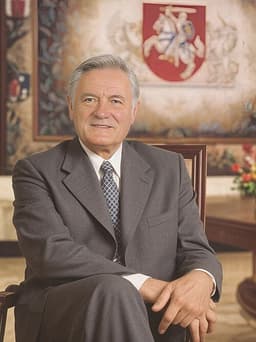
Valdas Adamkus
Politician · Modern
50.7Total
Basic Information
Born
1940
1926
Died
—
—
Era
Modern
Modern
Nationality
Belgium
Lithuania
Occupation
Politician
Politician
Civilization
Western
Western
Score Comparison
Military (10%)
49.1
49.1
Political (20%)
72.0
45.0
Influence (20%)
58.0
54.1
Legacy (20%)
56.0
45.0
Leadership (15%)
72.0
66.0
Strategy (15%)
43.0
43.4
TOTAL
59.3
50.7
Jean-Luc Dehaene — Complete Timeline
1991 AD
Maastricht Treaty negotiationsPolitical Action◆ Major
As Prime Minister, Jean-Luc Dehaene played a key role in the negotiations of the Maastricht Treaty, which established the European Union. He chaired the European Council during the Belgian presidency and helped secure agreement on the treaty's provisions.
European UnionMaastricht TreatyIntegration
Impact: globalconstructive
1992 AD
Prime Minister of Belgium (first term)Political Action◆ Major
Jean-Luc Dehaene became Prime Minister of Belgium, leading a coalition government. His tenure focused on economic reforms, including the reduction of public debt, and further state reforms to manage linguistic tensions.
Prime MinisterBelgian Politics
Impact: national
1993 AD
State reform of 1993Reform
Under Prime Minister Jean-Luc Dehaene, Belgium enacted a third state reform that transformed the country into a full federal state. The reform transferred significant powers to the regions and communities, including education and foreign trade.
State ReformFederalizationBelgium
Impact: nationalconstructive
1996 AD
Dutroux affair and political falloutOther◆ Major
The arrest of serial killer Marc Dutroux and revelations of police and judicial failures led to massive public protests. Prime Minister Jean-Luc Dehaene's government faced severe criticism for its handling of the case, leading to resignations and reforms.
Criminal JusticePublic ProtestScandal
Impact: nationaltragic
Valdas Adamkus — Complete Timeline
1998 AD
Election as President of LithuaniaPolitical Action
Valdas Adamkus was elected President of Lithuania in January 1998, winning the runoff election with 50.4% of the vote. He was a former US Environmental Protection Agency official and ran as an independent, focusing on European integration and economic reform.
Lithuanian PoliticsElectionEuropean Integration
Impact: nationalprogressive
2004 AD
Re-election as President of LithuaniaPolitical Action◆ Major
Adamkus was re-elected for a second term in June 2004, winning 52.6% of the vote in the runoff. His second term oversaw Lithuania's accession to the European Union and NATO, and he continued to push for economic and judicial reforms.
Lithuanian PoliticsRe-electionEU AccessionNATO
Impact: nationalconstructive
Lithuania's accession to the European UnionPolitical Action
Under Adamkus's presidency, Lithuania joined the European Union on May 1, 2004, along with nine other countries. This was a major milestone in Lithuania's post-Soviet integration into Western institutions, and Adamkus played a key role in the negotiations.
Lithuanian PoliticsEU AccessionEuropean Integration
Impact: nationalconstructive
This comparison has not been analyzed yet.
One-time AI generation (~1 minute). Scores and timeline are already available below.
Rankings
🥇
Jean-Luc DehaeneLeader
Mil: 49.1Pol: 72.0Inf: 58.0
59.3
🥈
Valdas Adamkus
Mil: 49.1Pol: 45.0Inf: 54.1
50.7
+8.6 behind
How This Comparison Works
Algorithm
Each figure is scored on 6 dimensions (0—100 scale) based on structured historical data: Military (10%), Political (20%), Influence (20%), Legacy (20%), Leadership (15%), Strategy (15%). The weighted total produces the final ranking.
Data Sources
Scores are computed from structured sub-indicators in the database. Scale factors adjust for era (Ancient ×0.85, Modern ×1.0) and civilization size (Eastern ×1.05, Other ×0.80) to account for differences in population and military scale.
Maximum 3 Figures
Comparisons are limited to 2—3 figures to ensure readability and statistical meaningfulness.
Error Margins
±5 points per dimension — Sub-scores are derived from historical records with inherent uncertainty. Two figures within 5 points on a dimension should be considered roughly equivalent in that area.
Total Score Accuracy
±3 points overall — The weighted combination of 6 dimensions produces a total score with approximately ±3 points of uncertainty. Differences of less than 3 points are not statistically significant— the figures are effectively tied.
Known Limitations
- Historical records are incomplete and uneven across civilizations
- Figures from oral-tradition societies may be underrepresented
- Occupation labels can misclassify multi-role figures
- Scores measure capability and impact, not moral character
- Quantitative scoring is a comparison tool, not absolute truth
Capability Radar
Military (10%) — Battles & Warfare
Battles
30
31
Win Rate
30
32
Expansion
37
35
Political (20%) — Governance & Reform
Reform
75
60
Diplomacy
80
65
Economy
70
55
Influence (20%) — Cultural & Global Reach
Cultural
30
30
Global
60
35
Legacy (20%) — Historical Impact
Historical
65
40
Longevity
55
30
Leadership (15%) — Power & Stability
Tenure
65
55
Stability
60
60
Strategy (15%) — Tactics & Innovation
Strategy
40
38
Tactics
42
42
Reform
42
45
Similar Comparisons
Comments & Discussion
No comments yet. Be the first to share your thoughts!