Loading...
Benigno Aquino III vs Valdas Adamkus
Valdas Adamkus leads by 3.7 pts · 2 figures compared
…

Benigno Aquino III
Politician · Modern
47.0Total
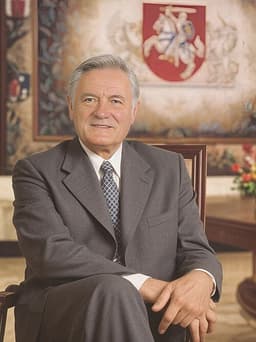
Valdas Adamkus
Politician · Modern
50.7Total
Basic Information
Born
1960
1926
Died
—
—
Era
Modern
Modern
Nationality
Philippines
Lithuania
Occupation
Politician
Politician
Civilization
Eastern
Western
Score Comparison
Military (10%)
13.9
49.1
Political (20%)
68.0
45.0
Influence (20%)
51.8
54.1
Legacy (20%)
43.3
45.0
Leadership (15%)
53.2
66.0
Strategy (15%)
36.5
43.4
TOTAL
47.0
50.7
Benigno Aquino III — Complete Timeline
2010 AD
Elected President of the PhilippinesPolitical Action◆ Major
Benigno Aquino III won the Philippine presidential election with 42% of the vote, succeeding Gloria Macapagal Arroyo. His campaign focused on anti-corruption and good governance, continuing the legacy of his parents.
ElectionPresidencyAnti-Corruption
Impact: nationalconstructive
2011 AD
Launched the Disbursement Acceleration ProgramReform◆ Major
Aquino implemented the Disbursement Acceleration Program to speed up government spending on infrastructure and social services. The program was later criticized by the Supreme Court as unconstitutional for certain fund transfers.
Economic PolicyInfrastructureSupreme Court
Impact: national
2012 AD
Impeachment of Chief Justice Renato CoronaPolitical Action◆ Major
Aquino's administration pursued the impeachment of Supreme Court Chief Justice Renato Corona for alleged corruption and failure to disclose assets. Corona was convicted by the Senate, marking the first impeachment of a Philippine chief justice.
ImpeachmentJudiciaryAnti-Corruption
Impact: national
2013 AD
Typhoon Haiyan responseOther◆ Major
Super Typhoon Haiyan (Yolanda) struck the Philippines, killing over 6,000 people and causing widespread destruction. Aquino's administration faced criticism for slow response and inadequate preparation, though international aid was mobilized.
Natural DisasterHumanitarian CrisisCriticism
Impact: nationaltragic
2014 AD
Signed the Enhanced Defense Cooperation AgreementPolitical Action◆ Major
Aquino signed the Enhanced Defense Cooperation Agreement with the United States, allowing increased US military presence in Philippine bases. The agreement aimed to strengthen defense ties amid territorial disputes in the South China Sea.
Foreign PolicyUS-PhilippinesSouth China Sea
Impact: regional
Valdas Adamkus — Complete Timeline
1998 AD
Election as President of LithuaniaPolitical Action
Valdas Adamkus was elected President of Lithuania in January 1998, winning the runoff election with 50.4% of the vote. He was a former US Environmental Protection Agency official and ran as an independent, focusing on European integration and economic reform.
Lithuanian PoliticsElectionEuropean Integration
Impact: nationalprogressive
2004 AD
Re-election as President of LithuaniaPolitical Action◆ Major
Adamkus was re-elected for a second term in June 2004, winning 52.6% of the vote in the runoff. His second term oversaw Lithuania's accession to the European Union and NATO, and he continued to push for economic and judicial reforms.
Lithuanian PoliticsRe-electionEU AccessionNATO
Impact: nationalconstructive
Lithuania's accession to the European UnionPolitical Action
Under Adamkus's presidency, Lithuania joined the European Union on May 1, 2004, along with nine other countries. This was a major milestone in Lithuania's post-Soviet integration into Western institutions, and Adamkus played a key role in the negotiations.
Lithuanian PoliticsEU AccessionEuropean Integration
Impact: nationalconstructive
Expert Analysis
Origins
Benigno Aquino III was born on February 8, 1960, in Manila, Philippines, into a political dynasty. His father, Benigno Aquino Jr., was a senator and opposition leader assassinated in 1983, and his mother, Corazon Aquino, became president after the People Power Revolution. He studied economics at Ateneo de Manila University but did not graduate. His formative years were shaped by his parents' struggle against the Marcos dictatorship.
Valdas Adamkus was born on November 3, 1926, in Kaunas, Lithuania. His father was a civil servant. During World War II, his family fled to Germany, and later he emigrated to the United States, where he studied civil engineering at the Illinois Institute of Technology. He worked for the U.S. Environmental Protection Agency (EPA) from 1971 to 1997, rising to become a regional administrator. His Lithuanian heritage and exile shaped his deep commitment to Lithuanian independence.
Rise to Power
Aquino entered politics after his mother's presidency, serving as a congressman (1998-2007) and senator (2007-2010). He ran for president in 2010 on an anti-corruption platform, winning with 42% of the vote. His campaign slogan "Daang Matuwid" (Straight Path) resonated with voters tired of corruption under Gloria Macapagal Arroyo.
Adamkus returned to Lithuania after it regained independence in 1991. He was elected president in 1998, winning 50.4% in the runoff. His background as a U.S. civil servant and his reputation for integrity appealed to voters seeking Western-oriented leadership. He was re-elected in 2004 with 52.6%.
Leadership & Governance
Aquino's leadership focused on transparency and anti-corruption. He pursued the impeachment of Chief Justice Renato Corona in 2012 for corruption, a high-profile case. His Disbursement Acceleration Program (DAP) aimed to speed up government spending but was later declared partly unconstitutional. He signed the Enhanced Defense Cooperation Agreement (EDCA) with the U.S. in 2014, strengthening military ties. His governance style was cautious and technocratic, but critics noted slow response to Typhoon Haiyan in 2013.
Adamkus led Lithuania toward Euro-Atlantic integration. He prioritized EU and NATO membership, which were achieved in 2004. His leadership style was consensus-building and diplomatic. He maintained high approval ratings and was seen as a stabilizing figure during a period of transition. He also focused on environmental issues, reflecting his EPA background.
Triumph & Tragedy
Aquino's greatest triumph was the successful impeachment of Chief Justice Corona, a symbolic victory against corruption. The economy grew at an average of 6.3% during his term. His tragedy was the poor response to Typhoon Haiyan, which killed over 6,000 people. The DAP scandal also tarnished his legacy.
Adamkus's greatest success was Lithuania's EU and NATO accession, securing the country's Western orientation. His tragedy was the failure to address social inequality and emigration, as many Lithuanians left for Western Europe after EU accession. His political score of 45.0 reflects moderate influence.
Character & Destiny
Aquino was reserved and intellectual, often criticized as aloof. His indecisiveness hindered crisis management. His character, shaped by his parents' martyrdom, made him resolute against corruption but also rigid. He scored 53.2 in leadership and 36.5 in strategy.
Adamkus was pragmatic and diplomatic, with high leadership (66.0). His exile background gave him a unique perspective, but he was sometimes seen as detached from local issues. His strategy score of 43.4 shows measured decision-making.
Legacy
Aquino's anti-corruption efforts set a precedent, but his legacy is mixed due to the Haiyan response and DAP controversy. His influence score of 51.8 reflects moderate global impact.
Adamkus's legacy is tied to Lithuania's EU integration. He is remembered as a founding father of modern Lithuania. His legacy score of 45.0 is slightly higher than Aquino's 43.3.
Conclusion
Valdas Adamkus had greater impact due to his role in Lithuania's EU accession, a transformative achievement for a small nation. His leadership score (66.0 vs 53.2) and overall score (50.7 vs 47.0) reflect his effectiveness. Aquino's anti-corruption efforts were important but overshadowed by governance failures. Adamkus's strategic integration of Lithuania into Western institutions provides a lasting legacy.
Rankings
🥇
Valdas AdamkusLeader
Mil: 49.1Pol: 45.0Inf: 54.1
50.7
🥈
Benigno Aquino III
Mil: 13.9Pol: 68.0Inf: 51.8
47.0
+3.7 behind
How This Comparison Works
Algorithm
Each figure is scored on 6 dimensions (0—100 scale) based on structured historical data: Military (10%), Political (20%), Influence (20%), Legacy (20%), Leadership (15%), Strategy (15%). The weighted total produces the final ranking.
Data Sources
Scores are computed from structured sub-indicators in the database. Scale factors adjust for era (Ancient ×0.85, Modern ×1.0) and civilization size (Eastern ×1.05, Other ×0.80) to account for differences in population and military scale.
Maximum 3 Figures
Comparisons are limited to 2—3 figures to ensure readability and statistical meaningfulness.
Error Margins
±5 points per dimension — Sub-scores are derived from historical records with inherent uncertainty. Two figures within 5 points on a dimension should be considered roughly equivalent in that area.
Total Score Accuracy
±3 points overall — The weighted combination of 6 dimensions produces a total score with approximately ±3 points of uncertainty. Differences of less than 3 points are not statistically significant— the figures are effectively tied.
Known Limitations
- Historical records are incomplete and uneven across civilizations
- Figures from oral-tradition societies may be underrepresented
- Occupation labels can misclassify multi-role figures
- Scores measure capability and impact, not moral character
- Quantitative scoring is a comparison tool, not absolute truth
Capability Radar
Military (10%) — Battles & Warfare
Battles
15
31
Win Rate
17
32
Expansion
19
35
Political (20%) — Governance & Reform
Reform
40
60
Diplomacy
45
65
Economy
35
55
Influence (20%) — Cultural & Global Reach
Cultural
30
30
Global
20
35
Legacy (20%) — Historical Impact
Historical
35
40
Longevity
25
30
Leadership (15%) — Power & Stability
Tenure
50
55
Stability
30
60
Strategy (15%) — Tactics & Innovation
Strategy
22
38
Tactics
25
42
Reform
29
45
Similar Comparisons
Comments & Discussion
No comments yet. Be the first to share your thoughts!